
The Tongue-Eating Parasite
Clip | 2m 34sVideo has Closed Captions
Gross science: This parasite crawls into a fish’s mouth and replaces its tongue.
Produced, edited, and animated by Anna Rothschild Production Assistant Allison Eck Special Thanks Stefanie Kaiser Original Footage © WGBH Educational Foundation 2013 ADDITIONAL MEDIA CREDITS (Ceratothoa sp in Blacktail) Host: Diplodus sargus sargus (common names: blacktail or white seabream) Locality: Tsitsikamma National Park, Eastern Cape, South Africa © Nico Smit
Problems playing video? | Closed Captioning Feedback
Problems playing video? | Closed Captioning Feedback
National Corporate funding for NOVA is provided by Carlisle Companies. Major funding for NOVA is provided by the NOVA Science Trust and PBS viewers.
Support provided by:


The Tongue-Eating Parasite
Clip | 2m 34sVideo has Closed Captions
Produced, edited, and animated by Anna Rothschild Production Assistant Allison Eck Special Thanks Stefanie Kaiser Original Footage © WGBH Educational Foundation 2013 ADDITIONAL MEDIA CREDITS (Ceratothoa sp in Blacktail) Host: Diplodus sargus sargus (common names: blacktail or white seabream) Locality: Tsitsikamma National Park, Eastern Cape, South Africa © Nico Smit
Problems playing video? | Closed Captioning Feedback
Where to Watch NOVA
NOVA is available to stream on pbs.org and the PBS app.
Buy Now
NOVA Labs
NOVA Labs is a free digital platform that engages teens and lifelong learners in games and interactives that foster authentic scientific exploration. Participants take part in real-world investigations by visualizing, analyzing, and playing with the same data that scientists use.Providing Support for PBS.org
Learn Moreabout PBS online sponsorship
Video has Closed Captions
Preview | 38s | A filmmaker with a rare type of multiple sclerosis explores the mysterious causes of MS. (38s)
Video has Audio Description
Clip | 30m 37s | A filmmaker with a rare type of multiple sclerosis explores the mysterious causes of MS. (30m 37s)
Introducing NOVA's Financial Lab
Video has Closed Captions
Clip | 1m 22s | Practice making financial decisions – and overcoming common biases – in this fun game. (1m 22s)

Video has Closed Captions
Clip | 20m 37s | Two leading researchers investigate racial bias built into widely used search engines. (20m 37s)
Video has Closed Captions
Clip | 5m 2s | Could parallel universes exist? If so, what would they look like and how would they form? (5m 2s)
Video has Closed Captions
Clip | 6m 50s | You're being chased by zombies, and understanding tangent vectors may save your life. (6m 50s)

Video has Closed Captions
Clip | 3m 23s | Urban archaeologists dig for stories beneath city streets. (3m 23s)

Video has Closed Captions
Clip | 5m 40s | Three physicists untie a 150-year-old tangle of a puzzle. (5m 40s)
2.5 Ways to Die in a Black Hole
Video has Closed Captions
Clip | 7m 12s | The answer to how you would die in a black hole could revolutionize the laws of nature. (7m 12s)
Carnivorous Plants and Killer Ants
Video has Closed Captions
Clip | 3m 3s | Ant eats plant's parasites. Plant eats ant's poop. It's the circle of life. (3m 3s)
Video has Closed Captions
Clip | 2m 19s | Thinking about getting a nose job? Thank goodness it's not the 16th century. (2m 19s)
Video has Closed Captions
Clip | 2m 33s | Modern wind turbines capture energy from the wind and convert it into electricity. (2m 33s)
Video has Closed Captions
Clip | 2m 56s | What can be done to make the power grid more reliable and efficient? (2m 56s)
Video has Closed Captions
Clip | 3m | How can we convert the Sun’s light and heat into energy we can use? (3m)
Video has Closed Captions
Clip | 2m 44s | What makes an energy source renewable and how can we use them to power our societies? (2m 44s)
Growing Appetites, Limited Resources
Video has Closed Captions
Clip | 2m 21s | The need for alternative energy sources is more pressing than ever. (2m 21s)
Video has Closed Captions
Clip | 2m 41s | What is energy and why are we on a never ending search for new energy sources? (2m 41s)
 Now Playing
Video has Closed Captions
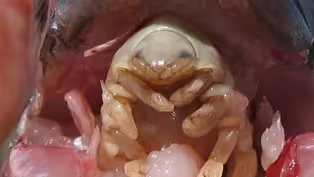
Clip | 2m 34s | Gross science: This parasite crawls into a fish’s mouth and replaces its tongue. (2m 34s)
Video has Closed Captions
Clip | 4m 33s | Explore an interactive periodic table, play an elemental game, and watch the NOVA program. (4m 33s)
Video has Closed Captions
Clip | 4m 46s | Learn how Peter Higgs' ideas about matter transformed our understanding of space. (4m 46s)
Video has Closed Captions
Clip | 4m 6s | Learn how to find signs of extraterrestrial life in our galaxy without leaving home. (4m 6s)
Video has Closed Captions
Clip | 3m 20s | See why an explosion three miles above Earth would act like a hot tornado on the surface. (3m 20s)
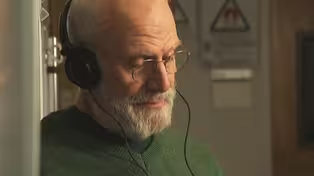
Video has Closed Captions
Clip | 4m 5s | See neuroscientist Oliver Sacks's brain respond differently to music by Bach & Beethoven. (4m 5s)
How Algorithms Decide Who Gets a Kidney
Video has Closed Captions
Clip: Special | 1m 7s | Clinical algorithms are meant to guide doctors toward better care – but do they? (1m 7s)
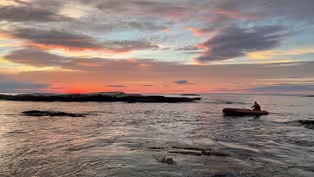
Sea Change: Survival in the Gulf of Maine Preview
Video has Closed Captions
Preview: Special | 30s | Meet the people leading new efforts to shape the future of the Gulf of Maine and our oceans. (30s)
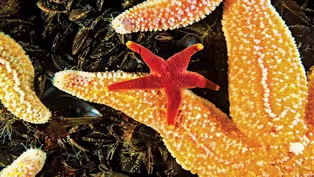
Sea Change: Peril in the Gulf of Maine Preview
Video has Closed Captions
Preview: Special | 30s | Explore Cashes Ledge - part of the Gulf of Maine that helps power the Gulf’s more than 3,000 species (30s)
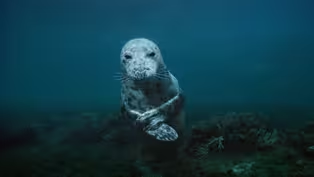
Sea Change: Bounty in the Gulf of Maine Preview
Video has Closed Captions
Preview: Special | 30s | Discover the lasting impact of how international trade forever changed the Gulf of Maine’s bounty. (30s)
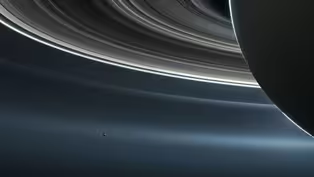
Clip: Special | 2m 39s | Out near Saturn, the spacecraft Cassini has just entered its final and riskiest chapter. (2m 39s)
Providing Support for PBS.org
Learn Moreabout PBS online sponsorship












Support for PBS provided by:
National Corporate funding for NOVA is provided by Carlisle Companies. Major funding for NOVA is provided by the NOVA Science Trust and PBS viewers.