
Warren King: King of Cardboard
Special | 15m 40sVideo has Closed Captions
Follow Warren King as he transforms cardboard into intricate sculptures.
Follow Warren King as he transforms cardboard into intricate sculptural reflections of his Chinese-American family’s immigration and his path from engineer to artist. Preparing for a Wisconsin homecoming show, King explores belonging through art.
Problems playing video? | Closed Captioning Feedback
Problems playing video? | Closed Captioning Feedback
Support for American Masters is provided by AARP, The Rosalind P. Walter Foundation, Thea Petschek Iervolino Foundation, Burton P. and Judith B. Resnick Foundation, The Philip and Janice Levin Foundation,...
Support provided by:

Warren King: King of Cardboard
Special | 15m 40sVideo has Closed Captions
Follow Warren King as he transforms cardboard into intricate sculptural reflections of his Chinese-American family’s immigration and his path from engineer to artist. Preparing for a Wisconsin homecoming show, King explores belonging through art.
Problems playing video? | Closed Captioning Feedback
Where to Watch American Masters
American Masters is available to stream on pbs.org and the PBS app.
Buy Now
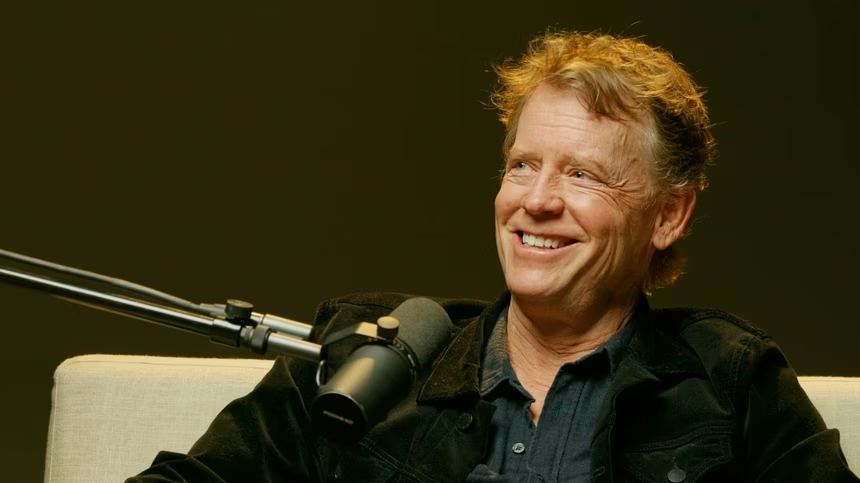
A front row seat to the creative process
How do today’s masters create their art? Each episode an artist reveals how they brought their creative work to life. Hear from artists across disciplines, like comedian Chris Fleming, actor Greg Kinnear, sports journalist Taylor Rooks, and more on our video podcast "American Masters: Creative Spark."Providing Support for PBS.org
Learn Moreabout PBS online sponsorshipMore from This Collection
This documentary shorts series from American Masters and Firelight Media follows emerging cultural icons – creators who bring insight and originality to their craft – on their journeys to becoming masters of their artistic disciplines.
Stankface Standing Soldier: The Rise of Mato Wayuhi
Video has Closed Captions
Watch as Oglala Lakota musician Mato Wayuhi draws on ancestral knowledge to inform his process. (16m 11s)
Aliah Irvine & Kehau Kapua’a: Kukulu
Video has Closed Captions
Follow Aliah and Kehau as they take on the male-dominated practice of building Hawaiian hale. (17m 19s)
Video has Closed Captions
Poet Cindy Tran found her voice on Yelp and writes about family, identity and belonging. (16m 11s)
Video has Closed Captions
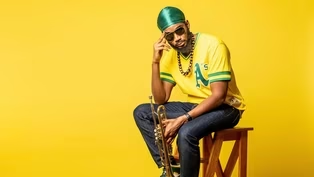
Trumpeter Lani B. Supreme carries forward a musical legacy that transcends generations. (12m 38s)
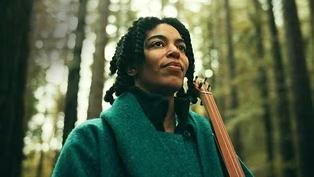
Hannah Mayree: Songs of Reclamation
Video has Closed Captions
Musician Hannah Mayree organizes workshops and performances celebrating the banjo's Black history. (16m 20s)

Video has Closed Captions
Follow Sudanese musician and ethnomusicologist Alsarah as she leads Alsarah and the Nubatones. (17m 36s)
Video has Closed Captions
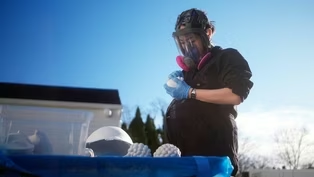
Artist Ani Liu creates provocative artifacts at the intersection of art, science and technology. (16m 15s)
Providing Support for PBS.org
Learn Moreabout PBS online sponsorship(pensive music) - I'm a Chinese American artist.
I work in cardboard, figurative sculpture.
I started art late.
I went into engineering because it was expected of me.
Once I started making art, it opened up a whole new world that I had never been a part of or understood.
The most important thing about my whole art practice is just the opportunity it gives me to connect with the community around me, the stories of my family, my culture, my experiences, my own identity.
Along with that comes a sense of just like belonging.
(lively music) (scissors cutting) I started working with cardboard really because it was just around.
The first stuff that I ever made was for my two boys.
The way I use it is pretty unique because I don't handle the cardboard in an unnatural way.
If you look at cardboard and you look at the material, it has a certain character.
It's two pieces of paper with corrugations in between.
There's a front side and a backside, and there's differences between the two.
Even when I color it and paint it, I only wanna use certain types of treatments because I don't wanna lose that texture of the paper.
And I approach working with cardboard very similar to woodworking.
The best woodworkers, they know the character of the wood.
They're very attentive to the grain and the shape and the natural properties of the wood.
(cardboard whooshing) I never bend the cardboard against .. so the shapes that I have are very limited.
But when you look at a face or a person's body, there's all manners of shapes, right?
Look at the cheekbone.
If I'm gonna stick to my rules that I put on myself for cardboard, then that shape is impossible to render with cardboard.
So what I have to do then is simulate that shape.
Since I have this set of rules that I won't break, that's what gives my pieces their distinctive planar, geometric look.
I love precision.
I love a clean cut or a seamless joint with no gaps in there.
That's part of why my pieces take so long to make.
I'll work on a piece 12, 13 hours a day.
There is a lot of engineering that goes into my work, but it's all behind the scenes.
So all the strength is from this middle section.
Everything kind of hangs off these middle pieces here.
Every piece that I put on, I'm thinking, "Okay, it's adding a weight here.
Is there another weight that needs to be put on the back?"
And making sure that it's a realistic person, but also at the end, it'll stand up.
And that's the part that I've always gravitated towards.
And I think I leverage my background in engineering with my art.
The parts of art making that is different from engineering is tapping into your intuitions and your emotions, and that's something that I've had to learn.
(objects clattering) I've been starting to develop ideas for another series of works that speak specifically to the Asian American immigrant experience in the Midwest.
I always was very conscious of how I didn't fit in.
All through the years of growing up, living with my grandparents, I never had a single discussion about, "Oh, what was it like in China?"
Or, you know, "What did you go through?"
I wanted to close my eyes to that.
My relationship with my dad was not like a really familiar casual one.
His plan before the time I was born was to have me follow in his footsteps and take over the family business and go into engineering.
If he saw you not being productive, then he always had ways of filling that time.
So at some point, I was actually hiding in closets to read my books.
And then I eventually worked for my dad as well.
I was just hating going to work.
It was just miserable.
After I quit the family firm, I didn't think that I would ever go back.
I hoped I would never go back.
For me to actually discuss it with him meant that I had hit rock bottom.
It was the dream that he had for us, and he had done all this work to set that up to make sure that we were gonna be okay.
And now here I was saying, "No, I don't want it."
That caused a lot of stress for many years.
At one point, again, to my older son, he said, "Dad, why don't you try making something for yourself?"
I identified these themes that I wanted to pursue with my artwork, exploring my roots, telling the family stories, and learning about this kind of stuff.
Then I had a different reason to start calling my dad and talking to him because I had actual questions I wanted to have answered.
And at first, he didn't really understand why.
When we started to have these discussions and saw that I wanted to know about his past, I wanted to stay in his life, that was way more meaningful than anything else.
(tranquil music) (objects clattering) (pensive music) When I eventually started to do these things, it struck such a strong chord because I was already feeling a lack of connection with my family, and suddenly I was making figures out of them and studying them, and that filled that gap in a certain way.
You're thinking about their gestures, you're thinking about their movement, their subtle expressions.
What makes that person them?
At the end of it, I feel like I know them.
I'm very aware that it's not the same as actually knowing these people or spending time with these people, but I don't have access to that anymore.
Being hard on myself is just part of my DNA.
I've always been self-critical, the last to appreciate my own stuff.
Why that is, you probably have to get a psychiatrist or something to really figure that out.
(pensive music) I have a show coming up at the Watrous Gallery, which is in Madison, Wisconsin, and I'm gonna have a collection of figurative pieces, as well as relief wall-hanging ones.
But they're all oriented around this idea of how my family made it from China to the suburbs of Wisconsin.
This is one of the key stories in my family's history.
In this piece, I'm portraying my grandmother at the moment that she's making the decision, and starting on that journey to leave her hometown, and I'm trying to capture her internal emotion at the time, knowing that this could be the last time that she sees her family, having the resolve to take that first step, not knowing where that journey's gonna end up.
(pensive music) (cutlery clattering) (legs cracking) (plate dinging) What about Nai Nai?
Like how do you think she's gonna react to this one?
- Does she get like the other ones, like-- - Yeah, that are based on family?
- [Warren] Yeah, probably not.
- Does she take that as like, "Oh, this is my son telling our family story," or is this like, "Oh, it's good arts and crafts.
- Yeah.
- Do you know what I mean?
- It's probably the second one.
- Yeah.
- Yeah.
There's no question.
It's like, "Oh, why are you doing .. Or "What does it mean?"
That's not a discussion that she w.. - [Genta] This is kind of blunt to say, but like, would you ever expect Nai Nai to like express her feelings?
- I don't know.
I've learned to not expect certain things.. and that sounds bad, but it's not.
That's not what I mean.
- [Genta] Yeah.
It doesn't need to be a bad thing.
It's just like some people are... That's just not where their head's at.
- Right, right.
- Because they grew up hardened in the US in a foreign country.
- [Warren] Yeah.
- Like, showing that kind of emotion isn't gonna no win them any points.
- [Warren] No, she doesn't even really understand why anyone would be interested in it.
You know what I mean?
- [Genta] Yeah.
- I don't have any expectations about like her going, "Yay."
(Warren clapping) - [Genta] Yeah but you have hopes.
You have hopes though.
- I don't know if I do.
I would be shocked if that ever happened.
I'd probably never checked out if that ever happened.
(pensive music) What does it mean to be a child of immigrants?
How does that reflect on you?
What parts of the old culture are carried through and why?
I'm still on the path to figuring that out.
This show, it is sort of a homecoming for me, right?
I was not an artist when I was leaving Wisconsin, and so coming back with this new thing is an opportunity to revisit my relationships that I had in Wisconsin with friends and family in a whole nother way.
(pensive music) The one I'm looking for is the one with a sword.
- Okay.
- it's over here.
- Why don't you tilt it and I'll pull it out?
- [Dan] Okay.
Yeah, it's probably better.
(boxes whooshing) - So this is also based on the same grandmother, right?
Based on that story where she's like this tiny woman who wants to go fight the Japanese.
So I was thinking this would be a good companion piece to that latest one.
- Yeah.
- I don't wanna just leave people with the impression it's like this Chinese peasant woman with like a little baby too.
There's like the warrior spirit.
- There's a fierce warrior.
- A fierceness to her, yeah.
- Yeah, yeah.
Right?
So I think this would be a good companion thing.
Plus I like this piece.
(insects chirping) (Warren and Gloria speaking in Chinese) (Gloria speaking in Chinese) (Warren speaking in Chinese) - Yeah.
Yeah.
Yeah.
- [Warren] Yeah.
- Oh, sure, sure.
- Yep.
- [Speaker] I've already seen it, man.
(Warren chuckling) - [Warren] Again?
- [Rochelle] So what?
- Okay, look.
- Okay, yes.
- My mom says it looks like Poi.
- Yeah.
(Gloria speaking in Chinese) - Phew.
- That's awesome.
(all laughing) (Warren sighing) - What do you think?
Eh.
- Pretty good.
(all laughing) (pensive music) - Yeah.
It is hard to tell when a piece is actually done.
In my background with engineering, the things that you analyze are very tangible.
They're very measurable.
With art, it's something completely different.
There's no set answer to it.
With art, the goal is not clear.
Sometimes you don't really know what you're going after when you set out doing it, and you only discover it along the way.
Embracing that, accepting the unknowns has been a new world for me.
(tranquil music) Even if my work, once I finish it, it just goes into my living room and no one ever sees it, I would still do it.
It's the time that I spent with those people that is the most important to me.
So for whatever time I have left, that's what I wanna pursue.
(tranquil music continues) (tranquil music continues)












Support for PBS provided by:
Support for American Masters is provided by AARP, The Rosalind P. Walter Foundation, Thea Petschek Iervolino Foundation, Burton P. and Judith B. Resnick Foundation, The Philip and Janice Levin Foundation,...