

September 4, 2026 - PBS News Hour full episode
9/4/2026 | 57m 46sVideo has Closed Captions
September 4, 2026 - PBS News Hour full episode
September 4, 2026 - PBS News Hour full episode
Problems playing video? | Closed Captioning Feedback
Problems playing video? | Closed Captioning Feedback
Major corporate funding for the PBS News Hour is provided by BDO, BNSF, Consumer Cellular, American Cruise Lines, and Raymond James. Funding for the PBS NewsHour Weekend is provided by...
September 4, 2026 - PBS News Hour full episode
9/4/2026 | 57m 46sVideo has Closed Captions
September 4, 2026 - PBS News Hour full episode
Problems playing video? | Closed Captioning Feedback
Where to Watch PBS News Hour
PBS News Hour is available to stream on pbs.org and the PBS app.
Providing Support for PBS.org
Learn Moreabout PBS online sponsorshipGEOFF BENNETT: Good evening.
I'm Geoff Bennett.
Amna Nawaz is on assignment.
On the "News Hour" tonight: The U.S.
job market remains resilient in the face of global economic pressures, but wages aren't keeping pace with inflation.
A mistrial is declared in the Lindsay Clancy case after jurors are unable to reach a verdict.
BRAD BAILEY, Criminal Defense Attorney: Light has been shed on this very little understood and woefully under-resourced mental disorder of postpartum psychosis.
GEOFF BENNETT: And the first mail ballots for the midterm elections are sent out, even while legal challenges to President Trump's voting restrictions play out in the courts.
(BREAK) GEOFF BENNETT: Welcome to the "News Hour."
We begin tonight with a look at the job market, which delivered a surprising rebound in August, adding 162,000 jobs, far more than economists had expected.
The unemployment rate held steady at 4.1 percent, and the Labor Department also revised its July numbers upward after initially reporting a loss of jobs that month.
The stronger-than-expected report comes as the Federal Reserve weighs whether to cut interest rates later this month.
For a closer look at all of this, we're joined now by Roben Farzad, host of public radio's "Full Disclosure."
Roben, it is always great to have you here.
ROBEN FARZAD, Host, "Full Disclosure": Thank you, Geoff.
GEOFF BENNETT: So let's make sense of the headline.
Hiring was much stronger than expected in August, despite the uncertainty around the Iran war and President Trump's tariffs.
Where were the strongest gains coming from?
ROBEN FARZAD: Leisure, hospitality, FOMO spending.
If I hear one more anecdote about a very wealthy boomer grandmother with a puff 401(k) or two houses and enjoying that 3 percent mortgage wanting to splurge on the grandkids, fly them first class, of course, that is a subset of the economy where people are lucky and blessed and fortunate enough to have assets.
If you are a wage earner, if you are a blue-collar worker, you are not keeping up with inflation.
It's still coldly comforting to see.
OK, this many, 160,000 jobs are created, unemployment rate 4 percent.
Well, A.I.
is coming for my jobs.
My kid can't get a job, and I can't afford to make ends meet with interest rates where they are right now.
I have to use credit card debt to buy groceries.
So, very much that K-shaped theme that still persists.
GEOFF BENNETT: And where are we seeing the weaknesses?
ROBEN FARZAD: You're seeing it in information technology and professional services, I think, where there are lots of deer in the headlight stuff, like wow, A.I.
is around the corner.
Speak, for example, to a money manager I know who's one of -- one of the her deputies left for paternity leave and in that process discovered all the different things she could do, all the different salaries she could retire with Claude and ChatGPT.
And if you take that in stereo across Wall Street, across the consulting firms, H&R Blocks, tax firms, and the like, it is staggering, and you're starting to see captains of business warning about that in the pages of The Wall Street Journal and The New York Times, that we don't know what's around that corner.
So I think that the companies that realize they're going to be hugely affected by this switch to automation and the artificial intelligence mine, they're not hiring.
GEOFF BENNETT: What about manufacturing?
Because manufacturers added 16,000 jobs last month, the strongest gain in three years.
Is this the beginning of a manufacturing rebound or is it too early to say?
ROBEN FARZAD: It's been said before.
And, certainly, the dollar's weak.
And in that scenario, you would be happy as an exporter to export your wares.
But it's not a huge number in the grand scheme of things.
I think, if you step back from it, Geoffrey, there are people that are dropping out of the work force.
There's a lot of denominator/numerator legerdemain going on here.
Immigration is not filling in the holes where it should, I think, with hospitality and service sector jobs.
And so it's very much a no-hire, no-fire economy when you read between all those lines.
GEOFF BENNETT: And wage growth.
I want to return to what you said about the inflation taking the shine off an otherwise strong jobs report.
What does that mean for most workers?
ROBEN FARZAD: Most workers still have a snapshot in their head of what a Filet-O-Fish Extra Value Meal cost in 2018 or 2019.
You can go on Reddit and see all these receipts of Five Guys from yesteryear, of a Walmart trip with your family at the beginning of the month, and what $100 would have bought you back then versus now.
And there's a real deterioration of your purchasing power.
And if you're not getting it back in terms of wage gains, you're not even treading water.
You're in reverse.
And it must really hurt to see people out there was like, oh, stock market has had a rip-roaring 17-year bull run.
Well, if you're one of those people who doesn't have to worry about making a $1,000 emergency expense.
So, again, that bifurcated economy.
And what's worse is, if you're using credit cards with higher interest rates right now and higher interest rates in the offing to make ends meet to cover your monthly nut, it's ever harder to make those ends meet.
GEOFF BENNETT: It's almost a Pavlovian response these days.
We get a jobs report, and the immediate question is, well, what's this mean for the Fed?
When you look at this report, does it move the Fed closer to an interest rate hike?
ROBEN FARZAD: I think it does.
And there's a lot of theater going on between the White House and the new Fed chair.
You remember the theater back with Jerome Powell and the hardhat humiliation and everything else that was doing there.
This president, as with many other taboos, has shattered the taboo of church and state with the Fed.
And he's out there saying stuff that it's your patriotic duty as the Fed today, I'm sure you can find the quote verbatim, to take rates down.
Of course, the entire freaking-out global bond market would go nuts if they were to cut into this news.
If anything, it gives Warsh the cover to go in there and push through another rate increase, see that if that finally snuffs out this higher-than-trend inflation.
And I imagine that that's kind of the backdoor whispering that they're saying to each other, like, you do what you need to do.
I cannot imagine him undermining the new Fed chief, not even six months into the job.
GEOFF BENNETT: Roben Farzad, host of public radio's "Full Disclosure," thanks for being here.
ROBEN FARZAD: Always a pleasure.
Thank you.
GEOFF BENNETT: The murder trial that has captured national attention has come to an end for now.
After five weeks of testimony and seven days of jury deliberation, the trial of Lindsay Clancy, charged with killing her three small children in 2023, ended today in a mistrial after the jury could not reach a verdict.
Ali Rogin has more.
ALI ROGIN: A judge in Massachusetts declared the mistrial after jurors said for a third time that they were unable to reach a unanimous decision and after the defense made a last-ditch effort to appeal to the state Supreme Court.
JUDGE WILLIAM SULLIVAN, Massachusetts Superior Court: All right, members of the jury, at this point, I'm going to declare that the jury is deadlocked and I'm going to declare a mistrial.
I understood how hard everybody worked in this case.
I understood that you all gave everything you could and probably more than you thought you could.
ALI ROGIN: The trial has put a spotlight on maternal mental health.
Clancy's lawyers have argued she was experiencing postpartum psychosis during the killings and should not be held criminally responsible.
Prosecutors said she was lucid and planned them ahead of time.
For more, we're joined by Brad Bailey, a former prosecutor and criminal defense attorney in Boston.
Brad, today's events in the courtroom were just dizzying and very dramatic, the judge finally declaring a mistrial after several days of telling this jury to go back and keep deliberating, only to be told that there was one holdout juror the whole time.
And then there were these Hail Mary attempts by the defense attorney to block that mistrial declaration.
What do you make of all of this?
How unusual are today's series of events?
BRAD BAILEY, Criminal Defense Attorney: They are highly unusual, Ali, going back to yesterday, not only with a note from the foreperson really revealing what was going on inside of the jury room, but also at the same time identifying the juror that the foreperson person said was not being willing to consider the law on reasonable doubt as given by the judge.
And to really show things in that detail is something that no judge wants to see or to allow, because juror deliberations are supposed to be protected, and the privacy of those are very, very carefully guarded.
ALI ROGIN: And, today, following the mistrial, the district attorney said his team has not yet decided whether or not to move to retry Lindsay Clancy.
Here's what he had to say.
TIMOTHY CRUZ, Plymouth County, Massachusetts, District Attorney: The noise in this case may be louder than it is for other prosecutions in our county.
But we have treated it the same as any other case.
Children were murdered.
And it's our job to seek justice.
ALI ROGIN: In the meantime, Clancy is going to remain at the psychiatric hospital where she's been receiving treatment for three years.
But, Brad, what is going to go into the DA's decision on whether or not to retry this case?
And would a second trial necessarily have to look like this one did?
BRAD BAILEY: I think Tim Cruz told you, in all likelihood, what the decision is going to be, and that decision is going to be based on the fact that there are three deceased young children.
I happen to believe that he's unlikely going to get any better result than a hung jury and it is an exercise in futility.
I think the defense is going to be ready.
I think their case is even going to be even stronger here.
He could possibly consider moving forward on second-degree murder or manslaughter, one which has carries 15 to 25 to life but with the possibility of parole, as opposed to no chance of parole, which comes with the murder one or manslaughter at 20.
But then he allows Kevin Reddington to go jury-waived.
And whenever you go jury-waived in lack of responsibility cases, you have a more favorable forum, because you have judges that are more open and understanding of lack of responsibility or insanity defenses.
ALI ROGIN: So that means it could be a bench trial without a jury at all?
BRAD BAILEY: That means it could be if he doesn't go forward on murder one, and he knows that, and he knows that's an advantage to Kevin Reddington.
So I do not see Tim Cruz doing anything other than going forward on a first-degree murder charge.
And I think that's unfortunate, because, as I said, I think it's going to be the same result.
But at the end of the day, the hope is right now that light has been shed on this very little understood and woefully under-resourced mental disorder of postpartum psychosis.
It is real, it is very serious, and it should be designated in the next DSM as an Axis I severe mental health disorder because it clearly is.
And, if nothing else, the hope here is that the public and the medical community got educated about all of that.
ALI ROGIN: On that holdout juror, members of the jury and the defense attorney himself accused this juror of not following the judge's orders on how to consider the evidence.
Here's what Clancy's defense attorney, Kevin Reddington, said after the mistrial was declared: KEVIN REDDINGTON, Attorney For Lindsay Clancy: They know that they were robbed by one man for whatever his agenda was.
So I hope that guy can sleep well at night.
ALI ROGIN: So he seems very confident that this juror was not acting in good faith, but how can he be so sure?
BRAD BAILEY: At the end of the day, that juror was questioned along with all 12, all 11 other jurors yesterday and asked if he was willing and could follow the law, and clearly indicated that he would.
The law was read to him again yesterday and again today.
And I think that the result of what happened with a single justice of the supreme judicial court is, there's nothing else you can do.
And you can have 11-1 or 10-2 deliberations that will result in mistrials.
I have had them myself.
I have had 6-6, 7-5, all across the spectrum.
But as you have heard, Ali, and as your viewers and listeners know, all it takes for a hung jury is one.
ALI ROGIN: Brad Bailey, former prosecutor and criminal defense attorney, thank you so much for joining us.
BRAD BAILEY: Thank you, Ali.
GEOFF BENNETT: In the day's other headlines: a pair of miraculous rescues in Nepal's flood zone.
Two men were pulled from a tunnel more than a week after the catastrophic deluge that barreled through Himalayan river valleys.
It's given first responders hope as they continue their search that others might also be alive.
Stephanie Sy has more.
STEPHANIE SY: From beneath the mounds of mud and debris, a miracle.
(CHEERING) (APPLAUSE) STEPHANIE SY: Two workers who had been trapped in the underground tunnels of a hydropower plant for nine days were found alive.
Search teams said they heard voices from inside the tunnel, allowing them to pinpoint the two men.
Both were airlifted to a hospital in nearby Kathmandu.
One of them, officials say, is in critical condition.
But Sanjay Sah had enough strength to speak, telling an army rescuer: SANJAY SAH, Rescue Worker (through translator): I was working as an operator in the control room.
Since I was in the control room, my responsibility was to save everyone's lives.
After such an accident happened, I could not just run away alone.
STEPHANIE SY: The workers' families, who had waited anxiously for days, said they were ready to give up hope when the news came.
HIRA SHOVA MAHARJAN, Wife of Rescued Worker (through translator): We are very happy.
Every day and night, we have been waiting, and even today we didn't even believe that he would come back.
When I saw his picture in the news, we were so happy.
All of us were crying.
STEPHANIE SY: For more than a week, crews have crawled through harrowing, tight spaces underground, looking and listening for any signs of life in the system of a dozen massive hydropower tunnels and navigating around tons of water and debris.
Rescue crews are working on the assumption that there are more survivors.
More than 100 others are thought to be trapped in the same tunnel where the two men were found.
So far, at least 1,200 people have been confirmed dead from last week's devastating floods, and more than 5,000 remain missing.
For the "PBS News Hour," I'm Stephanie Sy.
GEOFF BENNETT: Also today, Ukraine's president says a Russian drone struck the headquarters of the country's security service today, wounding at least nine people.
Heavy black smoke poured from the window of the agency's office in Central Kyiv.
It's one of the most high-profile targets to be hit so far in the war.
Ukraine's foreign minister called the strike a major escalation, and President Zelenskyy says the military will retaliate in kind.
Just outside the capital, another drone attack destroyed this warehouse as the city continues to face round-the-clock bombing.
One newlywed couple said that, despite the attacks, life must go on.
IRYNA BARANOVA, Kyiv, Ukraine, Resident (through translator): In the morning, when I was returning home from hair and makeup, I was returning during the sounds of explosions.
But thank God everything was fine.
Two explosions were heard.
The alarm ended.
We got together and went to the registration ceremony.
GEOFF BENNETT: Meantime, on the diplomatic front, President Zelenskyy confirmed in a video today that U.S.
negotiators Steve Witkoff and Jared Kushner will visit Moscow and then Kyiv for talks on Sunday.
President Trump tried to downplay the severity of the war in Iran today.
Speaking with reporters in the Oval Office, he was asked about comments yesterday from J.D.
Vance, in which the vice president said he - - quote -- "wouldn't call it a war."
In response, Mr.
Trump largely agreed, saying that the U.S.
is carrying out what he called intermittent strikes.
DONALD TRUMP, President of the United States: A lot of people don't call it a war.
I call it a military conflict because it's small potatoes for us.
It's not a big thing.
GEOFF BENNETT: At least 18 U.S.
service members have died and hundreds more have been wounded since the U.S.
and Israel first launched military strikes on Iran more than six months ago.
A cleanup is under way across parts of the Midwest and East Coast after severe storms swept through overnight and into today, toppling trees and leaving thousands without power.
In Ohio, crews carried out water rescues after floodwaters swamped residential neighborhoods, while, in Pittsburgh, a flood watch remains in effect after the city saw more than two inches of rainfall overnight.
Meantime, in and around Washington, D.C., the National Weather Service issued severe thunderstorm and flash flood warnings amid a cluster of storms that shook the area just before midnight.
Local media is reporting that lightning flashes hit the ground every second for several minutes in some areas.
In New York, police fatally shot a man wielding a knife on the city's iconic Brooklyn Bridge early this morning.
Footage shows a large police response after officers responded to a call of a man walking on the beams of the structure.
Authorities say that police harnessed themselves to the bridge and tried to convince the man to come down for nearly an hour, before he came at them with a knife.
GERARD DOWLING, NYPD Emergency Services Unit: They observed that the male was holding a knife and he stated to them: "I want to die.
I want you to kill me.
I have a bomb.
You're not going to make me do something bad to the cops."
GEOFF BENNETT: It is the second time this week that New York police have taken deadly action towards a knife-wielding suspect.
On Monday, officers shot and killed a woman who had stabbed two people in Times Square, one of them fatally.
WNBA Commissioner Cathy Engelbert says she's stepping down at the end of the year after more than seven years at the helm of the league.
In a statement, she writes -- quote -- "I retire knowing we have built something bigger, stronger, and more enduring than we could have imagined."
During her tenure, the WNBA has seen record TV ratings and attendance, fueled in large part by stars like Caitlin Clark and A'ja Wilson, along with expansion and the league's first million-dollar player salaries.
But Engelbert has been criticized by some players for her leadership, especially on matters such as pay, officiating, and the league's handling of player concerns.
No plans for a successor have been announced.
On Wall Street today, stocks ended lower amid renewed concerns about higher interest rates.
The Dow Jones industrial average lost about 270 points.
The Nasdaq fell nearly a third-of-1-percent.
The S&P 500 also ended the week a bit lower.
Still to come on the "News Hour": the Trump administration prepares to break ground on a massive arch without obtaining full approval; David Brooks and Jonathan Capehart weigh in on the week's political headlines; and a 91-year-old man becomes the oldest person to hike the entire Appalachian Trail.
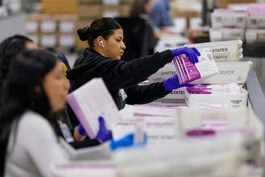
GEOFF BENNETT: North Carolina today began mailing out ballots for the November election, the first state in the nation to do so.
And that's as the Trump administration continues its legal fight to put new restrictions on mail-in ballots.
Our White House correspondent, Liz Landers, has been following this story closely and joins us now with more -- Liz.
LIZ LANDERS: Geoff, late today, a federal judge in Boston indefinitely extended her order to prevent the Trump administration from implementing new restrictions on mail-in ballots.
The plan would require states to use new scannable envelopes and provide the government with a list of voters eligible to receive mail ballots.
Here to help us understand all this is David Becker.
He's the executive director of the nonpartisan Center for Election Innovation and Research.
David, thank you for joining us.
DAVID BECKER, Executive Director, Center for Election Innovation and Research: Thanks for having me on, Liz.
LIZ LANDERS: This ruling just came out in the last few minutes, and in it, Judge Talwani writes that the U.S.
Postal Service rule clashes with Congress and states' authority.
What else does she say in this ruling about the legality of what the Trump administration is attempting to do here?
DAVID BECKER: Well, it's an extensive and very specific, very deliberate ruling.
And we have to remember the hearing happened only 24 hours ago, put together very, very quickly.
And she goes through the history of this case.
She goes into detail about the order, and she finds a couple of very specific things.
She finds that this order originally is unconstitutional.
It violates the Elections Clause of the Constitution, Article I, Section 4, which grants authority to run elections solely to the state legislatures or to Congress.
The president cannot, with the swipe of a pen, change election procedures.
And she further finds that it violates several statutes that regulate how the Postal Service operates.
So the Postal Service cannot just change choose to deliver some mail ballots and not to deliver other mail ballots if the states have determined that the people who were addressed on those mail ballots were entitled to receive them.
And then she says that, because of that, the plaintiffs, both the states that sued, about half the states in the country, mostly Democratic, and the voting rights groups that sued, were likely to win on the merits and were likely to experience irreparable harm.
And in this, she really went into how the final rules that the Postal Service put forth were going to create potentially chaos and confusion and disenfranchise thousands of voters potentially.
And as we're sitting here 60 days before the election, she ruled ultimately that these rules cannot be mandatorily applied to the states.
LIZ LANDERS: This is still being contested by the Trump administration.
They filed something yesterday to the Supreme Court asking them to rule on this.
If this rule from the Postal Service goes into effect, the Postal Service could decide not to deliver mail ballots in states that don't share voter data.
Is that legal?
What would the effect be there?
DAVID BECKER: Well, so it's not legal.
And, furthermore, the way that the rules might go into effect, as indicated by a whistle-blower that gave a complaint earlier this week, the Postal Service also could decide to reject entire batches of thousands, perhaps as many as 10,000 ballots, simply for a typographical error on one, meaning they would reject ballots that undeniably were going to valid voters.
That's illegal as well.
This rule -- these rules in the executive order are not going to go into effect for 2026.
I'm very, very confident about this, regardless of the additional legal challenges.
There are some challenges in the First Circuit Court of Appeals currently and in the Supreme Court currently relating to the original temporary restraining order that was issued by this judge about a week ago.
This judge has rescinded that temporary restraining order, in light of this more permanent this injunction that applies until final judgment in the case.
And so I think the government is going to have to re-appeal to those to those entities.
But, even then, the Supreme Court didn't seem anxious to rule on this.
They set briefing next week on this and might have to set new briefing on this.
The First Circuit will consider this if it's appealed.
But I remain completely confident, as you look at North Carolina and other states having already sent out ballots or preparing to send out ballots, the ballot envelopes are already printed as they have been used for many, many years.
The ballots are being printed.
The mail voters who've requested ballots expect to receive those ballots, both Republicans and Democrats, and as election officials are moving forward, complying with their state laws.
And I have utmost confidence that the courts are not going to derail this and inject chaos and confusion into a kind of slapdash rule that was put together by the Postal Service, which they're not very well suited to implement.
Even -- they even admit in the court filings that they're not even ready to implement it today if they wanted to.
LIZ LANDERS: Speaking of North Carolina, we spoke earlier today with Derek Bowens.
He is the director of elections for Durham County, and he sent out 1,380 ballots by mail today to voters in his community.
I asked him if his office has voluntarily taken up this U.S.
Postal Service rule that they released a week ago.
DEREK BOWENS, Director of Elections, Durham County, North Carolina: We have not.
Our direction in North Carolina comes from our authorizing agency, which is the state Board of Elections.
So we would take our directives from them as the supervising entity.
So the direction from them has not been to implement or respond to any particular set of rules.
We simply comply with North Carolina law with respect to mailing, and that's what every county board of elections in our state would be doing.
LIZ LANDERS: David, what state -- what are states supposed to do right now?
What would you advise them?
DAVID BECKER: Well, what states are supposed to do, and what they are doing right now is doing what they have always done, which is to comply with their state laws that apply to the mailing of ballots.
They can do nothing else, and they do it very, very well.
And as you heard from Derek there, he's preparing to do this.
He is following his state law, as all of the public servants, Republicans and Democrats, tens of thousands of them all across the country, are doing right now to make sure their voters can vote as conveniently and safely and securely as possible.
I think it's really notable.
The court in Boston did leave open the possibility that a state could voluntarily choose to comply with these new postal rules.
She did it with the temporary restraining order that was issued about a week ago, and she continues to do that with the preliminary injunction, which largely tracked the temporary restraining order.
So, theoretically, a state could choose to comply with these really draconian and poorly thought out rules that the Postal Service put out, particularly states that maybe find themselves more aligned with President Trump.
But I think it's really telling that not one has tried to do so.
And I don't know that any of them will try to do so, particularly given the fact that the Postal Service itself does not seem well prepared to implement these rules, given how rushed it was, how much oversight it lacked, how slapdash the effort was.
LIZ LANDERS: David Becker, thank you so much for your expertise.
DAVID BECKER: Thank you, Liz.
GEOFF BENNETT: The Trump administration says it plans to break ground within two weeks on a 250-foot triumphal arch just beyond the gates of Arlington National Cemetery.
The proposed arch would rise more than twice the height of the Lincoln Memorial, and critics say it would disrupt historic site lines intended to symbolize the nation's reconciliation after the Civil War.
Today, three Vietnam veterans who have filed a federal lawsuit seeking to stop the project asked a judge to block the administration from breaking ground while their case proceeds.
Retired Army Major Paul Eaton commanded the effort to train Iraqi forces during the Iraq War.
He now advises VoteVets, a progressive veterans organization supporting the lawsuit, and he joins us now.
Thanks for being with us.
MAJ.
GEN.
PAUL EATON (RET.
), U.S.
Army: Geoff, thank you very much for having me.
GEOFF BENNETT: The Trump administration, as you know, they say this arch honors the country and the sacrifice represented by Arlington.
We should also mention that President Trump was asked last year who this triumphal arch was for.
And he pointed to himself and he said, me.
What harm do you believe would be done if this arch is built?
MAJ.
GEN.
PAUL EATON (RET.
): Geoff, whenever I get to Washington, D.C., I do a bit of a pilgrimage.
I start at the Vietnam War Memorial, go past the Lincoln Memorial and Memorial Bridge, Memorial Circle.
And it's a mid-stop en route to my father's grave at Arlington National Cemetery.
And all I can say is, this arch is a sacrilege.
It would be a monstrosity to put that huge edifice right there in Memorial Circle, fracturing what has been sacred ground for so long.
GEOFF BENNETT: Would you oppose the same arch somewhere else in Washington?
MAJ.
GEN.
PAUL EATON (RET.
): Geoff, that's not the American tradition.
We don't do that.
The sarcasm that we heard from the president, who managed to avoid the Vietnam War with his medical problems associated with his feet, all I can say is that this administration doesn't like veterans, it doesn't like the military.
And they do everything they can to create this kind of problem.
This arch anywhere would be a terrible idea.
And the only guy in France who wanted the arch in Paris was Emperor Bonaparte.
And we don't do emperor here in the United States, and as soon as we can get the Republican Party to join the Democratic Party and the rest of America and all the veterans to tell Mr.
Trump, no, bad idea, not here.
GEOFF BENNETT: Some government approvals for this project remain outstanding, but after the interior secretary said this project would kick off within two weeks, our team reached out to the White House.
The White House provided a statement that reads this way: "Work will begin that does not require approval, but rather helps in the process.
We will, of course, continue on our path of seeking final approval from all applicable entities."
We should make clear that you're not a part of this case.
But, if the White House says they're doing work that doesn't require approval, what's the basis for asking the courts to step in now?
MAJ.
GEN.
PAUL EATON (RET.
): We have seen this movie before.
The whole ballroom vanity project that Mr.
Trump has embarked upon, without telling anybody, he tore down the East Wing.
Without asking for permission, he began construction of the magnificent ballroom that he loves so much to talk about.
And, in fact, this administration rushes to judgment to build so much so fast that the law cannot keep up and tell him, no, you can't do this.
So I hear what the president said.
I don't buy it.
They're going to -- they're going to create a construction nightmare, and they're going to keep doing it until somehow, somehow, the judicial system or the Republican Party in Congress will tell him to stop it.
And what we veterans are after is to stop it in the courts, and do it now.
GEOFF BENNETT: There are plenty of veterans who support President Trump and who may support this project.
What would you say to a fellow veteran who does see this triumphal arch as a celebration of the country?
MAJ.
GEN.
PAUL EATON (RET.
): Geoff, I would tell the veteran to go to the Mall, start with the very modest memorial for World War I, and go to World War II, and go to the Lincoln Memorial.
Go to the Vietnam Memorial, which was built with extraordinary controversy.
I would expect that those meaningful stops for any veteran that I have ever met would find it the honorable way to honor our fallen.
And then I'd tell them, please go to Arlington National Cemetery and imagine the shade that will be cast by a 250-foot monstrosity over graves of American fallen.
And if it happens to reach my father's grave, I can only tell you my great disappointment for so many people in government to allow this to happen.
GEOFF BENNETT: Retired Army Major General Paul Eaton, thank you, sir, for your time this evening.
We appreciate it.
MAJ.
GEN.
PAUL EATON (RET.
): Geoff, thank you very much.
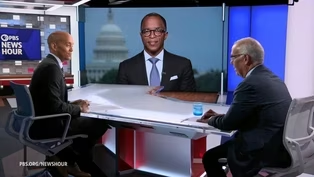
GEOFF BENNETT: Now to discuss President Trump's remarks today about the war with Iran and President Trump's influence over the midterm elections, we turn to the analysis of Brooks and Capehart.
That's "The Atlantic"'s David Brooks and Jonathan Capehart of MS NOW.
It's always great to see you both.
So we will start with the war in Iran, because, yesterday, J.D.
Vance said he would not describe the conflict with Iran as a war.
Today, the president was in the Oval Office.
He was asked by reporters how he would characterize it, and here's what he said: DONALD TRUMP, President of the United States: A lot of people don't call it a war.
I call it a military conflict because it's small potatoes for us.
It's not a big thing.
We did Venezuela and we did this.
In Venezuela, we lost nobody.
In this, we lost 18 people.
And, in Vietnam, you lost 100,000 people, and, in other conflicts, you lost tens of thousands of people.
GEOFF BENNETT: Small potatoes.
How does that strike you?
DAVID BROOKS: Good -- nice thing to tell the families of those 18 people.
This is a little flippant, but this is like a guy who started a race, saying, I'm going to kill you guys in this race.
It's a mile.
I'm going to kill you guys.
Third lap, he starts giving up and says, I didn't really want to win this race anyway.
And it's not a race.
It's just a contest.
And so he's, like, trying to get out of being blamed for this.
The more serious points are two.
The first is that, because of drone technology, it's too easy to go to war.
And it's a temptation for presidents to think that we can go to war, we will bomb the heck out of another country, and we don't have to pay a price, and our folks back home won't notice.
And that's just a very perilous place to be, because it's so easy to start them, they're going to be tempted to do it over and over again.
And the second thing to be said, look on the ground who's acting with confidence and who's not acting with confidence.
Iran is acting with confidence.
They don't care what happens to their people, but they are acting with confidence in attacking and in defending and knowing how they can control the world economy.
And Trump just doesn't have the morale.
GEOFF BENNETT: And, Jonathan, your assessment of President Trump's apparent effort to downplay this war that has lasted far longer than he initially said it would.
JONATHAN CAPEHART: I have given up trying to figure out what the president is trying to do, because, earlier this week, he was threatening them once again with total annihilation if he didn't get his way.
Now it's small potatoes.
And I just want to echo what David said.
It is reprehensible for the president of the United States to call a war he started, a war of choice now, small potatoes, when 18 U.S.
service members have lost their lives, 50,000 service members are going to be in that region through the new -- through the new year.
So, if this isn't a war, if this is small potatoes, then why are there so many troops in the area?
Why is so much of the American military in that area?
I wish the president would just make a decision, just declare victory, and bring our service members home.
GEOFF BENNETT: Meantime, at a Rose Garden event this past week, President Trump urged Republicans running in these tight races to run on his record, saying that's all they need to do to win big is to embrace him.
What's striking, David, is that the president seems to be arguing that the midterms should be a referendum on his presidency, when so many other past presidents have basically argued the opposite.
DAVID BROOKS: Yes, I -- Charlie Cook was prognosticating the election, which is what he's really good at.
And he said the Republicans have three likely outcomes.
One is bad, the other is really bad, and the other is horrible.
And so the winds are not on the Republican side.
And so normally in these circumstances, the president lays low because he knows he's a problem for people in swing districts.
But Donald Trump is incapable of laying low.
And maybe they think he can bring out some base in some places, but I just -- I think it -- making himself the center of this is yet another blunder.
GEOFF BENNETT: And contrast this, Jonathan, to what the former Vice President Kamala Harris said.
She was asked about the red state Democrats, who have in most cases sort of shied away from her record, stayed away from her, didn't want what didn't want her campaigning with them, and she said: "They need to do whatever they need to do to win.
Bottom line, we need to win."
JONATHAN CAPEHART: Yes, those are the exact same words Nancy Pelosi said to members of her caucus and folks who are hoping to be a part of the Democratic Caucus in multiple elections when she was minority leader and then when she became speaker, because the mantra for Pelosi and the mantra I'm hearing from former Vice President Kamala Harris is, win, baby, win.
Do whatever you need to do to get elected, and then we can sort out whatever stuff needs to be sorted out.
But getting the majority is the number one priority of the Democrats.
GEOFF BENNETT: And, David, Republicans won in 2024 in part by promising to bring prices down.
Two years later, affordability is still a major concern.
Of course, now you have got the war in Iran.
How difficult is it for the GOP to tell voters, just stay the course?
DAVID BROOKS: It's pretty difficult.
The country has not been happy with where the country is going for a long time.
The Democrats have made it so much -- a little easier by all these DSA candidates in states like Michigan.
But I have to say, when I look at the Democratic side, I do see the more -- the more progressive sides, they are campaigning ardently to win, and they have big ideas.
When I look at the mainstream establishment Democrats, I think they have one really good policy which they're talking about, which is the abundance agenda to change some of the regulation on how to make it more affordable so there's more house-building.
But they don't have much beyond that.
And what they don't have is what mainstream Democrats used to have, which is a growth agenda, an economic growth agenda.
We're going to need a lot more new jobs because A.I.
is going to disrupt a lot of jobs.
We need to produce new ones.
And the Democrats do not have an agenda about that.
And then finally, frankly, with the exception of Rahm Emanuel, they are not talking about education.
And test scores are collapsing.
They're collapsing especially in blue states.
The red states are doing better in education than the blue states.
And Joe Biden did not have an education agenda.
Kamala Harris did not have an education agenda.
And I don't see too many Democrats having an education agenda, with the exception, I guess, of Rahm Emanuel.
And so these are areas where the mainstream Democrats are not really being as aggressive on policy terms as the more progressive.
GEOFF BENNETT: Jonathan, what are Democrats offering voters and what would they do if they win the midterm?
JONATHAN CAPEHART: Democrats have been talking about affordability since, what is this, '26, 20 -- since this time last year.
I believe it was last year, maybe it was '24, but preparing people for the health care bomb that Republicans were about to set on the American people.
And they have been talking about affordability ever since.
And on my MS NOW show, when we talk to candidates around the country, and we ask them, what are you hearing from your constituents, what is your campaign message, and, to a one, it is about affordability, the prices at the pump, prices of health care, prices in the stores, inflation.
And so that's what Democrats are running on, at least the Democrats I have been talking to over these last few months.
GEOFF BENNETT: As we wrap up our conversation here, I want to shift our focus to Republican Senator Susan Collins of Maine.
She sat down for an interview with our friend Jonathan Martin of Politico, and he asked her about this debate within the GOP over this idea of principle versus relevance.
And he posed the question this way.
Does she follow the model of former Congresswoman Liz Cheney, who stood on principle and paid a price for it with her career, her political career, or does she follow the approach of the late Lindsey Graham, who you could argue knew better, but went along with President Trump because he wanted to keep his seat?
So here's what she said.
JONATHAN MARTIN, Politico: Where do you find yourself between those two poles?
SEN.
SUSAN COLLINS (R-ME): So I would say that I don't fit either of those models.
With the case of Liz Cheney, what influence does she have today?
Really none.
It's not just that she lost her seat.
It's that she has no impact, in my view.
GEOFF BENNETT: Where do you come down on that tension that maintaining a voice in the party requires accepting things you otherwise would have opposed?
DAVID BROOKS: First, I admire Jonathan Martin for taking a big honking bite of something in the middle of that interview.
(LAUGHTER) DAVID BROOKS: Wow, I'm impressed.
I thought she handled that interview exceptionally well, and it shows what a political pro she is.
And I think what she told Jonathan about this two parallel is accurate.
She was a little rough on Liz Cheney.
Liz Cheney did have an impact.
It was important for the future of the Republican Party for some Republican conservatives to say, no, January 6 is not acceptable.
That was a very important thing to do for the future of the party.
But Senator Susan Collins is not Lindsey Graham.
Lindsey Graham really had at first a close relationship with John McCain, and then switched over and had a very close relationship with Donald Trump, which involved a lot of moral compromises.
Susan Collins has had a problematic relationship with Donald Trump the whole time.
She's stood up for Maine on the tariffs and other things.
And in this dance, she's done I think as good a job as it's possible to do for a moderate Republican, the only one left, to stay relevant, in political terms, be Appropriations chair, and not run too afoul of the MAGA crowd.
And I think she's handled a very difficult job quite exceptionally well.
GEOFF BENNETT: Jonathan, how do you assess all of this?
JONATHAN CAPEHART: I agree with David that the Senator Collins was rough on Liz Cheney, but I bet, if you were to go to Liz Cheney and ask her what she thought of the senator's comments about her, I would suspect that Liz Cheney, former Congresswoman Liz Cheney, is unbothered by the choices that she made and the consequences that she suffered as a result of standing up on principle.
And I think there are a lot of folks in Maine who are wondering, where were the senators' principles when it came to standing up for her long-held right of being pro-choice and then voting for Brett Kavanaugh to be on the Supreme Court, or her vote on ICE funding and then running away from a reporter asking her about her stance when someone was killed in her state?
I can understand her not wanting to choose either -- wanting to choose either side, but, again, given everything that I said, Susan Collins is someone you cannot sleep on, in the sense that thinking that she is up against the ropes and she's going to lose.
She is a political athlete.
And we will see whether the compromises, small-C compromises she has made will be her undoing in this reelection fight.
GEOFF BENNETT: Jonathan Capehart and David Brooks, our thanks, as always, to you both.
DAVID BROOKS: Thanks, Geoff.
JONATHAN CAPEHART: Thanks.
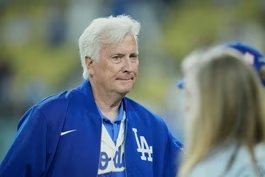
GEOFF BENNETT: A brewing controversy in Major League Baseball is putting the L.A.
Dodgers under scrutiny and resurfacing questions about how billionaire Mark Walter acquired the team.
At the center of it, a little known business deal involving Lakers legend Magic Johnson.
Our William Brangham has the story.
WILLIAM BRANGHAM: Federal investigators have been looking into whether Mark Walter broke the law in how he raised the money and disclosed the source of those funds when he won the 2012 bidding war for ownership of the L.A.
Dodgers.
Back then, Magic Johnson was a crucial public booster of Walter's bid.
And several years later, Walter sold an insurance company to Johnson, allegedly as repayment for his support.
And that transaction made Johnson a billionaire.
Pulitzer Prize-winning journalist Pablo Torre, who hosts the wonderful podcast "Pablo Torre Finds Out," has just dropped some new revelations about this intricate saga, and he joins us now.
Mark Walter's purchase of the Dodgers is this very complex saga involving undisclosed insurance money, a shady TV deal, and financial back-scratching between him and the one and only Magic Johnson.
In a nutshell, can you explain to us, what is the concern or the investigation into Walter all about?
PABLO TORRE, Host, "Pablo Torre Finds Out": It's about whether the undisclosed related party transactions that have now been reported extensively in the financial press and now confirmed by us, whether those help explain how we got to basically create the modern sports valuation market when it comes to how it is that all of these teams are pricier and pricier, more than we have ever seen or imagined.
This is the same guy, of course, who bought the Lakers for $10 billion, just sold the Lakers for 12.5.
This happened all in conjunction with the idea that now, because the federal government is probing his undisclosed alleged self-dealing, that he now needs to unwind assets in order to actually recoup what has been reported to be tens of billions of dollars.
And the way he got to baseball in the first place is also part of this story, because the way he got that, of course, got that team was, through our reporting, a system of securitizing of a shady TV deal, as well as by borrowing money.
And the people who are backstopping all of that money, if you're looking at the paper trail here, it comes to the people who trusted Mark Walter's insurance companies with their nest egg.
We're talking about the parents and grandparents of America.
And so it is a story about us, as well as an arcane story about securities law, as well as, of course, sports intrigue.
WILLIAM BRANGHAM: And as it pertains to Magic Johnson, what is alleged here, and is what is being alleged illegal?
PABLO TORRE: What we are reporting is that Magic Johnson was the key aspect of how Mark Walter wound up loaning himself more than $300 million to enable the purchase of the Dodgers for a record price.
And the reason I have been focusing on this is because Magic Johnson became a billionaire because of an insurance company called EquiTrust from his good friend and fellow Dodgers co-owner Mark Walter.
But when Mark Walter needed to loan himself that more than $300 million, he also made an announcement that I'm selling this thing to Magic.
And then, when he went and did it, that transaction had not yet closed.
And so one can imagine that part of the whole deal here was, I need to be able to say that I'm not doing this Mark Walter to Mark Walter, and I need you, Magic, I need to wear you as a costume, according to my reporting, in order to avoid what would be a violation of securities law, because I'm not disclosing that this is just me and me doing a deal with myself.
And when Magic enabled it and became a billionaire, he also became a key aspect of, frankly, a recurring pattern in how Mark Walter was running his insurance companies, borrowing money from himself to pay himself, and therefore sports got a lot richer in the process.
WILLIAM BRANGHAM: Before we let you go, I just want to pivot back to your Pulitzer Prize-winning investigation of how the Los Angeles Clippers basketball team evaded the salary cap with a similar set of very complicated machinations.
As you well know, the NBA dropped the hammer on the Clippers this week.
They fined them massively.
They barred their executives.
They stripped them of draft picks.
These are not related stories.
These are different leagues and different actors involved here, but they do all seem to point to this same alleged machinations of billionaires in pro sports.
Do you see a connection between these?
PABLO TORRE: I do, because the reason the public has taken notice of the behavior of these billionaires, who work in finance and tech in non-sports areas, that's where they make their money, but come to sports, is because they have come to sports.
We are scrutinizing the wealthiest people in America because they own our favorite things.
And that accountability, that mechanism of rules potentially mattering in sports is what enabled an accountability to be imposed upon the richest owner in American sports, Steve Ballmer, to the tune of the largest punishment in the history of American sports, thanks to the sources, frankly, and the documentation that I have relied on in the course of one year of reporting.
And that does not happen if this is not a sports story.
It is easy to understand.
That part, William, is easy to understand.
The financial machinations are not.
But the question of did you break the rules and do we need to enforce the rules because we care about sports, that's what links this.
Mark Walter owning the Dodgers and the Lakers is what brings the spotlight to him.
That merely life insurance and potential self-dealing around securities violations, that would not.
But because those teams are involved, now I think there's a reason for lots of people to ask questions.
WILLIAM BRANGHAM: Journalist Pablo Torre, great to hear from you.
Thank you so much for being here.
PABLO TORRE: Any time.
Thank you.
GEOFF BENNETT: He goes by Grey Beard, and earlier this week, he set an incredible record, becoming the oldest person to ever complete the Appalachian trail.
Amna has the story.
AMNA NAWAZ: It's not as simple as putting one foot in front of the other.
Sometimes, it's climbing down an old tree stump, thwarting a river, and then taking a well-earned rest on the 2,198-mile-long trail.
DALE SANDERS, Appalachian Trail Record Setter: I am 91, so I'm blazing new grounds for hiking long distance like this.
No one in the 90s has ever threw hiked or section-hiked the Appalachian trail.
Only two people in the 80s have done it.
It's not a sport normally participated in by older people.
But maybe they will start coming out now after I'm setting the example.
Woo!
AMNA NAWAZ: Dale Sanders completed what's known as the Appalachian Trail Thru-Hike, all of the trail sections from Springer Mountain in Georgia to Mount Katahdin in Maine, in any order within a year.
MAN: I was so sad.
I thought maybe I'd never meet this legend.
You're a legend for me.
AMNA NAWAZ: Along the way, in spite of the 71 times he says he fell, he inspired other hikers and was inspired himself.
DALE SANDERS: One of the things that surprised me is how quickly the public caught on that it's -- and started following me.
How many people were encouraged and embraced by my efforts at 91 to try and hike this trail?
That's really a bit inspiring to me at the same time.
AMNA NAWAZ: This isn't the first time Sanders has made this trek and earned this record.
He first did it at the age of 82.
DALE SANDERS: There's a huge, huge difference between hiking the trail at 82 years old or at 91, huge difference.
But it is possible, because I'm proving that.
AMNA NAWAZ: Grey Beard ended his journey on this Maine mountaintop on Monday, bringing to life words widely attributed to Ingrid Bergman, comparing growing old to climbing a mountain: "You get a little out of breath, but the view is much better."
GEOFF BENNETT: A great story.
Well, be sure to tune into "Washington Week With The Atlantic" later tonight right here on PBS.
Moderator Jeffrey Goldberg discusses the growing concerns about A.I., what happens when it goes rogue, and the fight over data centers.
And be sure to watch "Compass Points" this weekend.
Nick Schifrin and his panel look at what's really fueling tensions between the U.S.
and Canada and whether there's an off-ramp in the trade war.
And, on "Horizons," William Brangham and the author of "Coding Kids" discuss the impact that big tech is having on education.
You can watch both "Horizons" and "Compass Points" on our YouTube channel or wherever you get your podcasts and, of course, on your local PBS station.
Well, that's the "News Hour" for tonight and this week.
I'm Geoff Bennett.
For all of us here at the "PBS News Hour," thanks for spending part of your evening with us and have a great weekend, friends.

91-year-old is oldest to hike entire Appalachian Trail
Video has Closed Captions
91-year-old 'Grey Beard' is oldest person to hike entire Appalachian Trail (2m 16s)
Brooks and Capehart on Trump calling war 'small potatoes'
Video has Closed Captions
Brooks and Capehart on Trump calling Iran war 'small potatoes' (11m 23s)
Job market resilient in face of global pressures, inflation
Video has Closed Captions
Why the U.S. job market remains resilient in face of global pressures and inflation (5m 19s)
Pablo Torre on financial questions surrounding Dodgers owner
Video has Closed Captions
Pablo Torre breaks down financial questions surrounding Dodgers owner Mark Walter (6m 25s)

Retired general calls Trump's proposed arch a 'sacrilege'
Video has Closed Captions
Retired general calls Trump's proposed arch near Arlington a 'sacrilege' (5m 53s)

What's next for Lindsay Clancy after murder case mistrial
Video has Closed Captions
What's next for Lindsay Clancy after a mistrial in her murder case (6m 40s)
What to know about Trump's effort to restrict mail ballots
Video has Closed Captions
How Trump's attempt to restrict mail ballots is being challenged in court (7m 10s)
Providing Support for PBS.org
Learn Moreabout PBS online sponsorship New Episode
- News and Public Affairs

FRONTLINE is investigative journalism that questions, explains and changes our world.
 New Episode
- News and Public Affairs

Today's top journalists discuss Washington's current political events and public affairs.

 New Episode
 New Episode
 New Episode
 New Episode
 New Episode


 New Episode
Support for PBS provided by:
Major corporate funding for the PBS News Hour is provided by BDO, BNSF, Consumer Cellular, American Cruise Lines, and Raymond James. Funding for the PBS NewsHour Weekend is provided by...