
September 30, 2026 - PBS News Hour full episode
9/30/2026 | 57m 46sVideo has Closed Captions
September 30, 2026 - PBS News Hour full episode
September 30, 2026 - PBS News Hour full episode
Problems playing video? | Closed Captioning Feedback
Problems playing video? | Closed Captioning Feedback
Major corporate funding for the PBS News Hour is provided by BDO, BNSF, Consumer Cellular, American Cruise Lines, and Raymond James. Funding for the PBS NewsHour Weekend is provided by...
September 30, 2026 - PBS News Hour full episode
9/30/2026 | 57m 46sVideo has Closed Captions
September 30, 2026 - PBS News Hour full episode
Problems playing video? | Closed Captioning Feedback
Where to Watch PBS News Hour
PBS News Hour is available to stream on pbs.org and the PBS app.
Providing Support for PBS.org
Learn Moreabout PBS online sponsorshipAMNA NAWAZ: Good evening.
I'm Amna Nawaz.
GEOFF BENNETT: And I'm Geoff Bennett.
On the "News Hour" tonight: (SCREAMING) GEOFF BENNETT: An alleged attempt to intentionally crash an airplane flying to Israel is thwarted.
The dramatic scene that unfolded after a pilot stabbed his co-pilot and passengers were forced to intervene.
AMNA NAWAZ: The last U.S.
troops withdraw from Iraq, more than two decades after the start of the American-led war.
GEOFF BENNETT: And journalist Evan Gerskovich on his imprisonment in Russia and his recovery two years after his release.
EVAN GERSHKOVICH, The Wall Street Journal: I went through the prison experience with this sort of really stoic approach of, I can't let myself break down or cry.
I tried not to be angry at this.
I tried to stay level-headed.
But that takes a toll.
(BREAK) GEOFF BENNETT: Welcome to the "News Hour."
About 170 people aboard a terrifying flight to Tel Aviv are safe tonight after one pilot allegedly stabbed the other in what Israeli officials say was an effort to crash the plane.
They say passengers and crew sprang into action, subduing the pilot and preventing the plane from going down.
AMNA NAWAZ: Prime Minister Benjamin Netanyahu said those on board helped to stop what could have been a -- quote - - "catastrophic midair disaster."
The attacker's been arrested in Saudi Arabia, and the airline has suspended all flights in and out of Israel while an investigation plays out.
Nick Schifrin begins our coverage.
(SCREAMING) NICK SCHIFRIN: At 33,000 feet, Flydubai 1073 started descending.
(SCREAMING) NICK SCHIFRIN: And the passengers started panicking.
In less than a minute, the plane plunged more than 15,000 feet after a violent cockpit knife fight between the two pilots.
Israeli officials told PBS "News Hour" the co-pilot, who's from Oman, planned a -- quote -- "9/11-style attack" and stabbed the captain with a knife.
That's when the captain, Indian Smit Machchhar, despite his injuries, managed to open the cockpit door.
And passengers say they entered and subdued the would-be attacker as he tried to destroy the plane's controls.
ASAF REJWAN, Passenger (through translator): We control the terrorist.
Whoever's hearing me, we need help.
All the passengers are OK, but not the pilot.
NICK SCHIFRIN: And among the passengers, a third pilot employed by Flydubai, who landed the plane safely.
ALMOG ITALIE, Passenger: And the crew member, along with the passengers, got - - gained control, took over.
NICK SCHIFRIN: Flydubai Flight 1073 had taken off from Dubai, heading to Tel Aviv just before 7:00 a.m.
local.
Passengers said the plane dropped and the fight began about two hours later.
The third pilot landed the plane safely in Tabuk, Saudi Arabia... (CHEERING) NICK SCHIFRIN: ... where the passengers erupted in cheers for what an Israeli official called a miracle, everyone safe but shaken.
ITZHAK LIBER, Passenger (through translator): Surely, we will arrive home in a few hours and I'll have to change my clothes.
They're filled with blood.
NICK SCHIFRIN: Saving the plane took many passengers whose clothes were stained with blood, including Yaniv Hayun.
Hours later, he met Israeli Prime Minister Benjamin Netanyahu, who labeled the passenger turned protector a big hero for being the first to the cockpit.
YANIV HAYUN, Passenger (through translator): There were no pilots on the chairs.
One was down on the floor and one on the instruments.
I caught the attacker.
I put him in a choke hold and pulled him out first.
I jumped back into the cockpit and pulled the yokes back.
BENJAMIN NETANYAHU, Israeli Prime Minister (through translator): I salute these heroes who showed exceptional resourcefulness and courage.
They saved many lives.
They prevented a heavy disaster.
(CHEERING) NICK SCHIFRIN: When the passengers arrived home, including a boy and his baby sister, relief, back in the arms of loved ones, after the Israeli air traffic controller was the first to celebrate their return.
AIR TRAFFIC CONTROLLER: Good evening, Sky Dubai 1073, Ben-Gurion tower.
Welcome to Israel.
Thank you for bringing our passengers safely back home.
NICK SCHIFRIN: But even after the passengers pulled the attacker out of the cockpit, there was no guarantee the plane would land safely.
The drop that the co-pilot caused was so dramatic, it sheared the rudder off the plane.
Some aviation safety experts said today they're surprised the descent didn't rip the whole plane apart.
It was saved by that passenger, Yaniv Hayun, who said he learned how to pull back on the controls, Amna, by watching the TV show "Air Disasters."
Absolutely extraordinary.
AMNA NAWAZ: Absolutely extraordinary.
But, Nick, here, for context, remind us, this direct flight between Dubai and Tel Aviv, it's a relatively recent route in the last few years, right?
NICK SCHIFRIN: Right.
Flydubai now flies about 10 round trip flights between Dubai and Tel Aviv.
The UAE has become a popular tourist destination for Israeli tourists, and that's all a product of the Abraham Accords signed during the first Trump administration that normalized relations between Israel and the United Arab Emirates.
The Emiratis today say they're investigating, as is Saudi Arabia, where the plane landed.
And the Emiratis will certainly try to reassure some of the Israeli security concerns that we're already hearing.
The two countries' intelligence, political leaders have remained close.
And Israel helped the United Arab Emirates defend itself earlier this year from Iranian attacks.
Those Iranian attacks, of course, hit all Gulf allies of the U.S.
AMNA NAWAZ: Speaking of Iran, some news today from British authorities announcing information regarding an apparent plot against a British base where some American bombers have used before.
Tell us about that.
NICK SCHIFRIN: Yes, so this is the reported plot at RAF Fairford, from which American bombers have run sorties into Iran and where British police, you see it there, arrested five men on Sunday on suspicion of terrorism and explosives violations.
We have already heard Secretary of State Marco Rubio hint at some kind of connection between that plot uncovered by the British police and Iran, and we heard that echoed today on the BBC by British Prime Minister Andy Burnham.
ANDY BURNHAM, British Prime Minister: There are strong indications that Iran played a part in what happened over the weekend at RAF Fairford.
But, of course, it remains an ongoing complex and serious police investigation.
NICK SCHIFRIN: We now know that police didn't actually find any explosives, despite arresting the five men on suspicion of explosives and terrorism.
So officials I talked to say it's unclear if it was some kind of test run or something different.
But, Amna, of course, it would be a big escalation if the U.S.
and the U.K.
accused Iran formally of trying to attack an air base in the United Kingdom that hosts U.S.
bombers.
AMNA NAWAZ: All right, Nick Schifrin beginning our coverage tonight.
Nick, thank you.
NICK SCHIFRIN: Thank you.
GEOFF BENNETT: And we start the day's other headlines in Washington, D.C.
The Federal Reserve's inspector general says it found no criminal activity by former Chair Jerome Powell or others related to the costly renovation of the Central Bank's headquarters.
But in a 120-page report, the Fed's watchdog did say the nearly $2.5 billion project was poorly managed and lacked budget controls.
President Trump had seized on the project as part of his broader effort to pressure Powell and the Fed to lower interest rates.
The DOJ even launched a criminal investigation over whether Powell had misled Congress.
That effort was dropped earlier this year after a series of legal setbacks.
Defense Secretary Pete Hegseth announced today that the Pentagon will cut the number of its generals and admirals by roughly 20 percent by the start of next year.
Addressing hundreds of troops at Marine Corps Base Quantico in Virginia, Hegseth called the cuts part of a long overdue culture change, even as some lawmakers have raised concerns about losing experienced military leaders.
PETE HEGSETH, U.S.
Defense Secretary: Those generals who did not, who clung to the woke department or seemed to think civilian control of the military is simply a suggestion, well, they no longer work here.
GEOFF BENNETT: Hegseth also announced a number of other initiatives, including a new four-star command focused on drones, robotics, and other autonomous warfare, as well as the establishment of a new Office of Religious Affairs.
And he said several outside advisers, including Elon Musk and former House Speaker Newt Gingrich, would help the Pentagon study the future of warfare.
Senate Democrats blocked a Republican-led effort today to limit, but not stop members of Congress from trading stocks.
MAN: The yeas are 53, the nays are 47.
Three-fifths of the Senate duly chosen and sworn not having voted in the affirmative, the motion is not agreed to.
GEOFF BENNETT: The vote landed far short of the 60 votes needed for passage.
Known as the Stop Insider Trading Act, the measure would have barred lawmakers and their families from buying individual stocks, but allow sales with advance notice.
But Senate Democrats argued it didn't go far enough and that an outright ban is needed not just for Congress, but also for the president.
A separate bill aimed at addressing concerns about data centers and their impact on energy costs also fell short.
The measure passed the House by an overwhelming margin, but Democrats said it didn't do enough to help consumers.
The Federal Trade Commission is reportedly launching an investigation into a number of AI companies over the potential dangers their technology poses to consumers.
Multiple media outlets are reporting that the probe focuses on Anthropic, OpenAI, and other companies after a number of incidents in recent months of AI agents going rogue.
The FTC plans to issue demands for information and testimony from top executives.
It's the first official action to look into such concerns.
Just yesterday, President Trump hosted tech leaders at the White House, saying they had all agreed to self-police AI development.
What's left of Hurricane Polo is helping fuel a massive storm system that will dump what weather officials are calling excessive rainfall for several days.
That's creating the risk of flash floods for more than 25 million Americans from Arizona to the Midwest.
Heavy rains in New Mexico turn small desert rivers into raging rapids.
A potential dam failure there along the Rio Grande has forced several towns to evacuate.
Meantime, back in Mexico, along the hard-hit Baja coast, floodwaters are slowly receding after Polo passed through.
People are returning home to salvage what they can.
ELBIA MARIA BACHOMO, Puerto San Carlos, Mexico, Resident (through translator): We started taking clothes, but the water was already there.
We didn't even have time to grab blankets or anything.
I think the water came while we were getting out.
GEOFF BENNETT: There is now another hurricane off Mexico's coast, though Rachel, as it's been named, is expected to stay offshore.
Hurricanes have been far more active this year in the Pacific, driven by what forecasters have called a Super El Nino.
Turning now to the war in Ukraine, officials say Russian strikes killed at least seven people today, including a child.
Firefighters worked overnight to put out blazes in and around the capital, Kyiv.
The strikes caused multiple power outages, as Russia targets Ukraine's power grid ahead of the colder winter months.
Ukrainian officials have called such a campaign an attempt to weaponize winter.
Meantime, in Moscow, Russia's Foreign Ministry warned that European weapons factories could become military targets, accusing European nations of direct involvement in the war in Ukraine.
MARIA ZAKHAROVA, Spokeswoman, Russian Foreign Ministry (through translator): By opening arms factories and joint ventures, they are fully involved.
And this only delays a resolution to the conflict, rather than bringing it closer, as some forces in Europe think or imagine.
GEOFF BENNETT: For his part, NATO Secretary-General Mark Rutte claims there is no imminent threat from Russia.
But in a television interview, he added that, if anything were to happen, the security alliance would be, in his words, ready to counter it.
Well, on Wall Street today, stocks ended the month of September on a mixed note.
The Dow Jones industrial average fell more than 400 points.
The Nasdaq managed a gain of around a quarter of 1 percent.
The S&P 500 ended the day slightly lower.
Still to come on the "News Hour": journalist Evan Gershkovich reflects on his nearly 500 days in a Russian prison; Utah Governor Spencer Cox lays out his blueprint for depolarizing a fractured nation;and Judy Woodruff sets out to explore whether the American dream still exists.
U.S.
forces formally withdrew from Iraq today, marking the end of a long and turbulent military presence.
The withdrawal brought celebrations in the capital, but also concern about what comes next.
Thousands gathered on the streets of Baghdad for a celebration more than 20 years in the making, the military trucks and soldiers in fatigues, this time Iraq's very own, as the U.S.
announced its forces have officially left the country.
Iraq's prime minister called the withdrawal an opportunity.
ALI FALEH AL-ZAIDI, Iraqi Prime Minister (through translator): A new phase has begun, one defined by Iraq's sovereignty, the strength of its institutions, the readiness of its forces, and balanced partnerships with its friends.
GEOFF BENNETT: But as the war in Iran expands and draws in neighboring countries, U.S.
bases in the northern Kurdish region have come under attack.
And the Kurds who remain fear further attacks by Iran-backed groups or the resurgence of the Islamic State.
OSMAN KAMUSASHI, Erbil, Iraq, Resident (through translator): I don't favor this at all.
I mean, the departure of the American army and the coalition from the Kurdistan region will impose a serious threat on the Kurdistan region.
And there is another threat, which is the restructure and the return of the Islamic State.
GEOFF BENNETT: Despite those concerns, the U.S.
was facing a deadline.
The withdrawal had been agreed to two years earlier under former President Biden and was ultimately carried out by President Trump.
The Pentagon called the orderly departure a milestone that reflects the success of a 12-year campaign that defeated ISIS and said it will continue to provide targeted training and intelligence support.
That continued support is still a dramatic scale-down from more than two decades of U.S.
military involvement in Iraq.
U.S.
forces invaded in 2003 and toppled the country's oppressive dictator, Saddam Hussein.
The first U.S.
withdrawal came in 2011, only for U.S.
troops to return three years later to help Iraqi forces fight ISIS.
Decades of brutal fighting resulted in the deaths of more than 4,000 U.S.
troops and hundreds of thousands of Iraqi civilians.
Now, as Iraqi leaders tout strength and sovereignty, the world watches to see if Iraq can withstand outside forces.
For insight and analysis of the formal U.S.
withdrawal from Iraq, we turn now to James Jeffrey, who served as ambassador to Iraq under former President Barack Obama and was the special envoy to the Global Coalition to Defeat ISIS in the first Trump administration.
And Feisal Istrabadi served as Iraq's ambassador to the U.N.
after the U.S.
deposed Saddam Hussein.
He's now a professor at Indiana University.
Welcome to you both.
And, Jim, we will start with you.
What does the U.S.
withdrawal from Iraq change practically starting today?
JAMES JEFFREY, Former U.S.
Ambassador to Iraq: Practically, what it changes is a mission accomplished.
In a time where we have not had that many successful military operations, this one from 2014 on was spectacularly successful in defeating a major terrorist entity, the Islamic State.
We did it, tragically, with casualties, but very, very few compared to our other wars.
And we did it with the cooperation of Iraqi and Syrian officials.
That's very important.
But the bottom line was, when it was finished, they said, we would like you to go at this time, and we said, fine.
It doesn't change very much, because, as we just heard, we will still have a military presence, as we did after 2011, when I was ambassador, under the embassy.
It's a technical formality, but it is an important one, because they're not under military command.
They're not fighters, but they're trainers, equippers.
They provide intelligence support, and they can call in real American military power if they need to.
So we will still have that in place if Iraq needs it.
GEOFF BENNETT: Feisal Istrabadi, we know, of course, that the U.S.
left Iraq before in 2011, returned three years later to fight ISIS.
What's different this time?
FEISAL AMIN AL-ISTRABADI, Former Deputy Iraqi Ambassador to United Nations: On the surface, what's different is that, when the United States returned in 2014, something like a third of the country was occupied by a terrorist organization which sought to erase an internationally recognized border between Iraq and Syria.
We don't have that.
What we -- what is the same is a deep skepticism as to whether or not Iraqi forces will be able to secure the country at a time when Iraq, A, has both -- has both been a target of the ongoing Israeli-American and Iranian war, as well as having its territory used to launch attacks against its neighbors with which Iraq is not at war.
That remains to be seen.
In 2011, when the United States withdrew, I must disagree somewhat with my colleague, a lot of intelligence cooperation ceased between Iraq and the United States.
And the end result of that was the rise of ISIL.
I remain deeply concerned that that may be what is in Iraq's future.
So I'm skeptical about this withdrawal.
I would also add that this is, I think, a strategic defeat for the United States, in this sense that it was also supposed to be -- today was supposed to be the date on which the pro-Iranian militias in Iraq were disarmed, and that is not taking place.
GEOFF BENNETT: Well, on that point, Iran-backed militias were supposed to be brought under greater control of the Iraqi government.
That hasn't happened.
How significant is that?
And how involved is Iran in Iraq?
JAMES JEFFREY: It's all very significant.
And, there, I agree with my colleague.
In terms of the Islamic State, they're defeated.
Nothing is left but a few cells.
There are more in Syria, but we have that situation under control because we still have our overall operation focused on that out of Jordan.
But the problem is that Iran has slowly, through political parties and through these militias, tried to build up a presence like they have in Lebanon in Iraq.
That's something the handful of U.S.
forces could not stop.
In fact, they were there from 2014 to today, and they didn't stop it.
I agree that the pro-Iranian side is pitching this as a victory.
We drove out the oppressor, but very few people in Iraq really believe that.
But I agree also Iraqis are nervous because, if anything - - nothing else, American military presence is a symbol that we will be back.
We showed last time when we left that, in extremis, we would come back, but everybody wonders, will they come back?
Whereas, if you have got boots on the ground, it's pretty certain that you will stay and reinforce them, rather than retreat.
GEOFF BENNETT: And what does all of this mean specifically for the Kurds?
The prime minister of the Kurdistan regional government has made his unhappiness widely known about this formal withdrawal.
FEISAL AMIN AL-ISTRABADI: Yes, I understand that, and I sympathize.
However, I think it was always an overreach for the Kurds to rely too much on the United States to resolve the problems between Erbil, the capital of the Kurdistan region of Iraq, and Baghdad, the capital of Iraq.
I think that there needs to be an inward-looking dialogue within the Iraqi political class in which the American Embassy needs to be a convener at times, an encourager.
But to rely on the United States as sort of the intervener in on behalf of the Kurds with respect to Baghdad, or vice versa, was always a mistake.
And this may actually, if one wants to be optimistic, encourage a better political process domestically.
GEOFF BENNETT: As we wrap up this conversation, we can't lose sight of the fact that more than 4,000 American service members were killed in Iraq, along with more than 200,000 Iraqi civilians, as you both well know.
That's roughly the entire population of a city like Richmond, Virginia, or Des Moines, Iowa.
As this chapter closes, how do you begin to assess what was achieved against the human cost of that magnitude?
JAMES JEFFREY: First, Saddam Hussein, who had terrorized the region from 1980, his accession to power, until he was deposed in 2003, was removed, most Iraqis I have talked to, and that is in the thousands now, do not regret us getting rid of him.
Furthermore, Iraq is still, for all of its flaws, one of the few democracies in the Middle East, and the country still has political parties and political factions arguing in Parliament and in the courts, rather than on the battlefields.
So those are two big pluses.
We don't want to see Iraq go the way that Syria went between 2011 and just two years ago, a total civil war.
That was a possibility if we had not intervened.
So I would say it's mixed, unlike Afghanistan.
That's a failure.
Iraq, call that mixed.
GEOFF BENNETT: Mixed.
How do you see it?
FEISAL AMIN AL-ISTRABADI: As Zhou Enlai supposedly said about the French revolution, too soon to know.
But I think that I agree generally with the assessment.
Look, what I think the Americans gave the Iraqis in 2003, paid for with the lives of a lot of Iraqis and Americans as well, is hope that the future need not be what it had been under Saddam Hussein.
Saddam Hussein is responsible for the deaths of one million Iraqis in ruling Iraq from 1979 until 2003.
There is hope that that is -- that the future will be better than the past.
That would not have been possible without the American intervention in Iraq.
Have things gone swimmingly since 2003?
No, there were many, many mistakes made by the Americans, many mistakes made by the Iraqis.
But, fundamentally, there is hope that the future will be better than the past.
GEOFF BENNETT: Ambassadors Feisal Istrabadi and Jim Jeffrey, my thanks to you both.
JAMES JEFFREY: Thank you.
FEISAL AMIN AL-ISTRABADI: Thank you very much.
AMNA NAWAZ: It's a story that now feels familiar.
An American goes to Russia, gets arrested, and after spending time in prison and going through a sham legal process, the American is ultimately released in exchange for a Russian criminal jailed in America or elsewhere.
It's called a prisoner swap.
And it's a tactic Russia's President Vladimir Putin has used time and again.
In 2024, Evan Gershkovich, a Wall Street Journal correspondent, was freed from detention in Russia as part of a complex prisoner swap that included 16 people from seven different countries.
Evan details his arrest and his time in prison in his new book, "This Cursed Beautiful Land."
And he joins me here now.
I have said your name so many times.
It's so nice to say, Evan Gershkovich, welcome to the "News Hour."
EVAN GERSHKOVICH, Author: It's nice to be here.
Thanks for having me.
AMNA NAWAZ: Great to see you in person.
I want to back it up a little bit, so people know a little bit about you, because, like a lot of first-generation American kids, you're the child of Soviet emigres, you grew up with a foot in both worlds.
You write about speaking Russian at home and watching Soviet cartoons in suburban New Jersey.
And then you write in the book: "Why were my parents after leaving the Soviet Union so fixated on preserving their Sovietness?"
Why was that?
Did you find out?
EVAN GERSHKOVICH: So, we have had an argument about that.
I think it's nostalgia, and I think I'm right.
They grew up in a place and then they left that place, and that place no longer exists in their lives.
EVAN GERSHKOVICH: They speak Russian to each other.
They have Russian names.
Why would they -- why would their kids be suddenly, like, completely foreign?
So my sister and I both had Russian names.
Mine was Evan or Vanya and is.
And so my home was Russian-speaking and the food was Russian.
I think it's natural for immigrants to want their kids to retain something of themselves.
AMNA NAWAZ: So you're on a reporting trip after a couple of years there to Yekaterinburg in 2023.
You're meeting with a source who a colleague had referred you to, so a trusted source, who said he was going to provide insight into tank production, right?
This is a part of your reporting into the Russian military buildup, possible invasion of Ukraine.
EVAN GERSHKOVICH: Yes.
AMNA NAWAZ: And he hands you papers, and as he does that, masked men stormed the restaurant.
You write in the book: "It registered immediately that this wasn't the police.
This wasn't a misunderstanding."
You seemed to know right away you were being arrested.
EVAN GERSHKOVICH: Yes.
AMNA NAWAZ: How did you know that?
EVAN GERSHKOVICH: I was reporting fairly sensitive stories.
I'd reported a story about how Vladimir Putin was getting information from the front, making decisions about the war.
I'd gone to Pskov, which hosts the 76th Division of the Russian airborne forces, which had occupied Bucha in Ukraine and committed a series of war crimes there.
And I was speaking with people around the Kremlin trying to gauge always whether it was safe or not, and was getting the sense that they wanted -- they continued wanting to have foreign media there.
What I got wrong was that the FSB, Russia's domestic intelligence service, which formerly the KGB during the Soviet Union, operates above that.
And so when they come in to arrest me, or when they say they're FSB, that's when you know something's really serious.
And then the next signal is actually when they take me into the van and then they take me to the station.
What I was expecting after 5.5 years of reporting is potential torture, being tied up to a chair like this, electrocuted.
I thought, if they really think I'm a spy, perhaps they're going to be interrogating me for information or telling them about the source.
None of that happens.
They just hand me my charges of espionage, and that's when I have, I describe it in the book, a sense of relief, of, oh, I know what this is about, how you started this segment with... AMNA NAWAZ: Yes.
EVAN GERSHKOVICH: ... people have been set up for swaps before.
AMNA NAWAZ: Because you had seen previous, you had covered previous cases, right?
EVAN GERSHKOVICH: And there was... AMNA NAWAZ: You have covered Trevor Reed.
You covered Brittney Griner.
So do you think right away, OK, I'm going to be freed in a swap eventually?
EVAN GERSHKOVICH: While I was covering the Brittney Griner swap, a source had told me that the Russians were actually asking for Paul Whelan for Vadim Krasikov, who was an FSB assassin held in Germany at the time sentenced for life.
And leading up to my arrest, we were trying to pay attention to the negotiations that were going on, and the Americans were telling the Russians that this is insane.
Germany's a third country.
And the Russians were saying, well, if Paul Whelan is ever going to leave Russia, Krasikov needs to leave Germany.
And I had talked to my Russian lawyers early on, and they remember me in the first week saying, I think I they took me for Krasikov, like stacking Americans, basically, to go back to Washington and say, talk to Berlin.
AMNA NAWAZ: I got to ask you about the way that a lot of folks in the rest of the world saw you during your time in detention, which was during your court hearings.
And you write about in the book how you knew that would be when a lot of people would be able to put eyes on you.
You were held in this glass cage during your court hearings as this sort of sham process plays out.
And a lot of folks thought you might have been having, like, a slight smirk on your face or a slight smile.
What was going through your head in those moments?
EVAN GERSHKOVICH: So, really early on, I start figuring out that they're going to treat me in a kind of special way, so to speak.
So what -- the experience I went through is not like it's something pleasant.
And it was very difficult and grueling in periods.
But I -- really early on, you could tell they're not using the methods that they can use, right?
So I'm not getting tortured, I'm not getting deprived of food, hot water, and so on.
So the Russians are really, really, really calculating.
And in this case, I assume that they're taking somebody, Wall Street Journal correspondent, an American.
It's going to be global uproar.
And they want to be able to say, well, we caught him red-handed.
We have legal due process.
We're not mistreating him, also a journalist that's going to write a book about it after.
And so, understanding that, you also understand sort of like where the lines are for you.
My family and loved ones and everybody is freaking out at this point.
They don't know what's happening with me.
It's a black box.
I understand this is the first time they're going to see me, but also global news media is going to cover it.
And so I wanted to send a kind of, I don't know a message -- maybe not a message, but present a kind of fit stance about my stance about the case.
I was also told I can't speak in court.
And so, instead of incurring any sort of potential bad punishment for speaking up, I decided, well, I can do it with how I present myself, and one of the ways is kind of like signaling what I think about the process.
And clearly it worked.
Everybody was in on the joke, so to speak.
AMNA NAWAZ: You write about a time, because your parents fly over to be there with you and help advocate for your release and keep you updated.
And you write about one time that your dad is able to speak with you, and he says: "We have come here with respect for you."
What was that like to hear that at that time?
EVAN GERSHKOVICH: So I was racked with guilt at the beginning -- at the beginning, when the arrest took place and sort of thinking, it's one thing to take a risk to be reporting in Russia at the time, right?
And then the story we were reporting on, I mean, it's incredibly sensitive information during a war where Russia feels like it's not just at war with Ukraine, but with what it calls the collective West, with the U.S.
at its backer, and I'm an American journalist.
And so I'm thinking, like, why did we do this?
Why did my newsroom and I decide that this is OK to be doing?
My poor family.
And so I was worried when they were going to come to court.
The conflict had developed to the point where Ukrainian drones had started reaching Moscow, and I'm worried about my parents coming, but also, yes, this point of, would they have kind of be mad at me, admonish me?
And so when they come into the courtroom, the first thing they turn and see me and they just smile.
And so that was really this kind of immediate sense of relief.
They come up.
And the FSB investigator in my case allowed us five minutes to speak.
And so first it's jokes back and forth, catching up on various things.
And then my dad paused my mom and me and said: "I just want to make sure I tell you this."
And he softly said: "We have come -- yes, we have come here with respect for you."
And I think that's the most important thing he could have possibly said, because it immediately -- all those worries of have I done something wrong float away.
It just helped me deal with it better.
AMNA NAWAZ: You are, as we said, eventually freed in one of the most complicated swaps in recent history, negotiated by the Biden administration.
But I wonder how you look back on your 16 months in detention at a time, as you document in the book, everyone seemed to know, the prison guards, your investigators, everyone else, that you would eventually be freed in a swap.
EVAN GERSHKOVICH: Yes.
AMNA NAWAZ: And yet 16 months of your life go by while two political adversaries work it out.
Does any of that make you angry now?
EVAN GERSHKOVICH: I mean, what makes me angry is the system of hostage diplomacy, so to speak, using people cynically to return people.
And I think that's something that we haven't completely dealt with.
But in terms of the actual swap, 16 months, that's not long.
I reasoned early on that it would take a year-and-a-half to three.
And, ultimately, I think it happened fairly quickly, 16 months compared to -- and some people have told me, well, it could have happened immediately.
We all know what the swap's about.
But we still have to get there.
And, ultimately, you -- I do hope that the moral good outweighs the moral bad in this case, given not just myself.
I wasn't the only one released.
But some of the people that were included in the swap compared to who Russia got in return, I hope says something about our values.
AMNA NAWAZ: What's the adjustment after being released been like for you?
EVAN GERSHKOVICH: Took just amount the -- just about the same amount of time as I was in.
I went through the prison experience with this sort of really stoic approach of I can't let myself break down or cry.
I tried not to be angry at the system, tried to stay level-headed, but that takes a toll.
And so when I am released, all that starts coming out, but also through adjustment to regular life, I described it like coming down from the International Space Station and having left kindergarten into adulthood all at the same time, because you're incredibly isolated.
So I'm overwhelmed by all the senses, the sights, the smells, the sounds, and I can't sleep in the beginning at all.
And then you have lost your agency, so relearning how to make decisions, you know, what you say yes to, what you say no to.
And so I was in PTSD therapy in the beginning, sort of tracking my symptoms.
And then after six months, I graduated.
Everything was improving over time.
Then I did talk therapy, and then I worked on the book, and that in a way is a kind of narrative therapy.
You look at the traumatic event, you think about it, you process it, and you deal with it.
And I think that also -- but that also keeps you in prison in a way, like the event... (CROSSTALK) AMNA NAWAZ: Writing the book keep you in prison?
EVAN GERSHKOVICH: Yes.
I was constantly thinking about it.
And so it also, I think, kept me from completely returning to life.
So I finished the book in the late spring, got back to work for The Journal, became a reporter again.
The news had faded.
People were no longer recognizing me.
I'm kind of just like back to my normal life and feeling like a normal person.
And it's great, but it took a bit.
AMNA NAWAZ: Would you go back to Russia again?
EVAN GERSHKOVICH: One day, I would hope to be able to go back, but I just don't -- I'm not that optimistic.
AMNA NAWAZ: The book is "This Cursed Beautiful Land."
The author is Evan Gershkovich.
Evan, it's good to see you.
Thank you so much.
EVAN GERSHKOVICH: Thank you.
AMNA NAWAZ: Achieving the so-called American dream has been a national ethos for generations.
But what does it mean today and how attainable is it?
Judy Woodruff has our look.
It's part of her series Crossroads: America at 250.
MAN: Will my candidates for citizenship please raise your right hands and repeat after me?
JUDY WOODRUFF: On a recent afternoon in downtown Washington, D.C., 25 immigrants from 14 countries took the oath of allegiance and posed with certificates of naturalization, officially becoming U.S.
citizens.
(APPLAUSE) JUDY WOODRUFF: The ceremony took place at the Milken Center for Advancing the American Dream, which celebrates the ideal that has drawn so many to this country.
DAVID TRULIO, President, Milken Center for Advancing the American Dream: This is a place built to strengthen freedom, opportunity, and hope, and to serve as a source of inspiration for anyone with a dream and the drive to achieve it.
JUDY WOODRUFF: David Trulio is the center's president.
DAVID TRULIO: In America, anything is possible, and that is at the core of the American dream.
JUDY WOODRUFF: On the walls here, personal success stories offer proof, as do the photos and notes visitors add to the tree sculpture in the center's main hall.
The tree is a testament to an idea with roots in the Great Depression.
DAVID LEONHARDT, Editorial Director, The New York Times: In 1931, a historian named James Truslow Adam wrote a book called "Epic of America," in which he coined this term the American dream, and he said it defines a happier, richer, better life for all of our people.
JUDY WOODRUFF: New York Times editorial director David Leonhardt wrote "Ours Was the Shining Future: The Story of the American Dream."
DAVID LEONHARDT: It's the idea that parents can expect that their children will have better lives than they did, and that their grandchildren will have even better lives than their children do.
JUDY WOODRUFF: During the post-World War II economic boom, working Americans had widespread access to affordable homes, college educations, and jobs that could support a stable middle class lifestyle.
DAVID LEONHARDT: Ninety-two percent of children born in 1940 grew up to earn more, adjusting for inflation, than their parents did.
That's remarkable.
That is a better, richer, happier life.
JUDY WOODRUFF: But the American dream was not equally accessible to everyone, prompting Dr.
Martin Luther King's famous "I Have a Dream" speech in 1963.
GEORGE CARLIN, Comedian: The table is tilted, folks.
JUDY WOODRUFF: Over the years, the American dream has had its skeptics, not just the marginalized.
GEORGE CARLIN: It's called the American dream because you have to be asleep to believe it.
JUDY WOODRUFF: Today, fewer than half of Americans say they believe everyone can achieve it.
Leonhardt thinks that pessimism is driven by stagnant wages and less economic mobility.
DAVID LEONHARDT: For children born in 1980, people who are now in their mid-40s, the odds of outearning your parents are only 50 percent.
It's more like a coin flip whether you're going to do better than your parents.
ART WILLIAMS, Retired: This is my mom and dad before he was sent overseas.
JUDY WOODRUFF: Art Williams was born and raised in Pennsylvania's Pocono Mountains, the son of a barber and a beautician.
ART WILLIAMS: My dad was a World War II vet.
I was a Baby Boomer.
I was born in 1947.
We grew up in a stable family.
ROXANNE WILLIAMS, Retired: This is a picture of me when I was little with my dog Frosty.
JUDY WOODRUFF: Art's wife, 74-year-old Roxanne (ph), grew up 70 miles away in Bethlehem.
Neither of her parents graduated from high school.
Still, she says: ROXANNE WILLIAMS: We were all comfortable.
My dad worked at the steel for over 40 years.
He worked in the blast furnace.
JUDY WOODRUFF: Bethlehem Steel's blast furnaces still tower over the city.
They're now rusted and dormant.
But, for years, Roxanne's father and thousands of others had well-paying union jobs here that helped them build a better life.
ROXANNE WILLIAMS: They had the American dream.
They owned their house.
They had a family.
The prospects were good.
JUDY WOODRUFF: Roxanne and Art built their own house near Bethlehem 50 years ago.
Art taught high school accounting for more than three decades to support Roxanne and their two daughters.
ART WILLIAMS: I think we have achieved probably more than my parents.
ROXANNE WILLIAMS: We never really wanted for anything.
And we traveled.
ART WILLIAMS: Fortunately, we were able to send both of our daughters to college, which we paid for.
JUDY WOODRUFF: Since Art's retirement 22 years ago, the Williams have lived on his pension.
ART WILLIAMS: That, with Social Security, that has moved us up a bracket, shall we say?
ROXANNE WILLIAMS: I just think we're where we're supposed to be and enjoying life.
JUDY WOODRUFF: The Williams 44-year-old daughter, Vanessa, and her husband, Dan, who is 47, live nearby with their daughter, Cora (ph).
Vanessa and Dan are both college graduates.
Neither is currently working.
DAN, Currently Unemployed: I have lost my job a number of times due to company financial decisions and whatnot.
VANESSA, Currently Unemployed: I have been right-sized.
I have been let go.
I have left on my own two feet a couple times, but most of the time, when we have changed jobs, unfortunately, it has not been our choice.
DAN: Right.
VANESSA: It is because there was a cutback or something like that.
JUDY WOODRUFF: The two of you have a college education.
You're well-educated people, and these kinds of things happen.
What do you think it says about our country, about our American way of life?
DAN: Loyalty has dropped.
The sentence I get is that the country doesn't care whether or not any of us succeeds.
DAVID LEONHARDT: I think there is less of a sense of we're all in this together than there used to be.
JUDY WOODRUFF: Leonhardt says that's a shift from the 1950s and '60s, for example.
DAVID LEONHARDT: When you go back and you look at the decades where we did have broadly rising prosperity, you really see this incredible sense of patriotism and community values from our corporate leaders.
JUDY WOODRUFF: It's one reason Vanessa, a communication strategist, and Dan, an engineer, say they feel the American dream isn't what it used to be.
DAN: Hard work should be enough, and I don't think it is.
VANESSA: I did everything that I was told by my parents and by society correctly, only to be met up with the recession and the housing crisis.
It's been bumpy.
JUDY WOODRUFF: Vanessa's 38-year-old sister, Brina, and her husband, Matt, live in York, Pennsylvania.
BRINA JONES, Co-Owner, Sips Cafe: I think, from the outside, people would look at us and think that we have realized the American dream.
We built this home that you are sitting in.
We have -- we might not have 2.5 kids, but we have two dogs and the fence and that type of ideal.
And I think partially we have.
JUDY WOODRUFF: Brina and Matt left more traditional careers to become entrepreneurs and now own two cafes called Sips.
Do you think you have done better than your parents?
BRINA JONES: I think we have done different than my parents.
I have been building what I guess would be my own American dream.
You might just have to do offline payments, Katie.
JUDY WOODRUFF: Building a business is risky, but they say the future looks bright.
MATT JONES, Co-Owner, Sips Cafe: Overall, I'm optimistic.
I'm pleased with what we have already accomplished.
I trust in us.
BRINA JONES: I think I feel pretty secure, and I think that we know that we're very lucky.
JUDY WOODRUFF: Sips has 20 employees, mostly young women.
WOMAN: Thirteen seventy-eight.
whenever we're ready.
JUDY WOODRUFF: Brina worries about the challenges they face.
BRINA JONES: It is hard for them, and they're not doing anything wrong.
They are just absolutely doing their best.
JUDY WOODRUFF: Twenty-Year-old Trinity Jackson (ph) works at Sips part-time.
She graduated from college over a year ago and is still looking for a full-time job while living at home.
TRINITY JACKSON, College Graduate: I struggle with feeling secure in my finances.
While I may not be where my parents were when they were my age, I'm still trying to do my best with what the current situation is.
JUDY WOODRUFF: That's despite feeling disillusioned by the American dream, like so many in her generation, amid rising living costs and a job market rocked by artificial intelligence.
TRINITY JACKSON: We're not trying to go for the same dream anymore.
The dream doesn't exist for us.
We can't own a home when we're 25.
We don't feel like we're in a place to bring children into the world if we can't pay our own student loans and pay off our own cars.
For me, my American dream right now is just to not have loans by the time I'm 30.
JUDY WOODRUFF: Back in Bethlehem at a Liberty High School Football game, 14-year-old Cora Morick (ph) played the piccolo with the Grenadier Band, her parents proudly watching from the stands.
This is the same high school Cora's grandmother, Roxanne Williams, attended.
But while Roxanne says she achieved her American dream, she has concerns for Cora.
ROXANNE WILLIAMS: I feel that she will have more challenges, that her options may not be as wide.
I just wonder if there are going to be enough jobs.
JUDY WOODRUFF: Here in Pennsylvania, we heard mixed views about the future of the American dream.
But David Leonhardt remains optimistic.
DAVID LEONHARDT: I think it's important to remember that most of the world looks at the United States quite enviously.
There is a reason that so many people want to move here.
And so we have a lot of problems.
We also, as a nation, have huge and perhaps unique strengths.
And in this time of national self-doubt, I think it's important both that we look honestly at our problems and retain some of that old-fashioned American optimism that we can solve those problems.
JUDY WOODRUFF: After all, optimism, a belief in a better tomorrow, is at the heart of the American dream.
For the "PBS News Hour," I'm Judy Woodruff in Bethlehem, Pennsylvania.
GEOFF BENNETT: A year ago, in the aftermath of the shooting death of conservative activist Charlie Kirk in Utah, Governor Spencer Cox emerged as a prominent voice calling on Americans to step back from the political hatred and violence gripping the country.
Now the Republican governor is expanding on that message in a new book, "Off Ramp: How to Be a Peacemaker in an Age of Contempt."
Part memoir, part examination of America's deep political divisions, the book makes the case that Americans can disagree, even fiercely, without treating one another as enemies.
I spoke with Utah Governor Spencer Cox recently.
You have spent years telling Americans to disagree better.
Is it working?
GOV.
SPENCER COX (R-UT): Well, in some circles, for sure.
Look, as we travel the country, the data's pretty clear that 70 percent of Americans hate what's happening in our politics right now.
They're desperate for something different, for something better, and maybe something older, a return to the norms that were so important in the formation.
And really, our country lasting 250 years, they want to be able to work together to solve problems.
They haven't seen a lot of problem-solving coming out of Washington, D.C., recently.
And I'm as hopeful as I have been in a long, long time that people are ready for something better.
GEOFF BENNETT: And President Trump, of course, routinely uses the dehumanizing language that you warn against.
He's called his political opponents vermin.
He's described Americans who disagree with him as the enemy from within.
And you endorsed him in his 2024 race.
How does that reconcile with the central argument of this book and what you say you stand for?
GOV.
SPENCER COX: Sure.
Well, it's something that I talk about in the book, and I hope people will read what I wrote there.
But I didn't support him in -- as the Republican nominee in 2016 and 2020, and realized that that didn't have much of an impact.
I tried the adversarial approach.
And then, after an attempted assassination on his life, I wrote him a very long and detailed letter about what I hoped he could do differently to try to bring the country together, and that I would I would work with him to do everything I could to help that happen.
Now, he would tell you if he was here that that's not his approach to politics, and it's something that we disagree on.
And yet we figured out how to work very closely together on issues that are important to Americans and important to Utahans, like saving the Great Salt Lake and some of the energy issues that we're facing.
And so I also had a great relationship with President Biden, someone I disagreed with passionately on lots of different issues, and yet we found ways to work together as well.
And I'm hoping that that can be a bit of a model to the rest of the country, who really are hungry for this.
GEOFF BENNETT: How much can regular Americans really change the political culture, when the incentives of social media and cable news and electoral politics reward outrage?
That's the uncomfortable political reality, is that outrage works.
GOV.
SPENCER COX: Yes, it does.
And here's -- maybe the most important takeaway of the book is this, that we actually can change it.
One of the things I'm most worried about isn't what's happening at the national level.
It's what what's happening at the personal level.
If you go back 15 years ago, only about 5 percent of Americans had ever ended a close personal friendship or stopped talking to a family member because of politics.
We have quadrupled that number in just a few years, and it's continuing to climb.
That's where the biggest problem is.
Look, we get the politicians we deserve.
If we want something different, we have to decide, every single one of us, to be better.
We have a whole bunch of ideas in there about how to have a conversation with your uncle who's MAGA or your niece who's woke or what whatever it is, about how we can repair those relationships.
Look, politicians are not worth ending friendships over.
We're just not worth it.
And I truly believe that, if we can start to work in our communities and fix those relationships, we can actually fix our country in a very big and profound way.
GEOFF BENNETT: You know, it strikes me this idea of disagreeing better can sound like a luxury to people who feel like their lives and livelihoods are very much on the line.
How do you respond to that, to people who want to see some sense of urgency in the political conversation?
GOV.
SPENCER COX: There's a difference between peacemaking and peacekeeping.
Peacekeeping is just that.
Hey, go along to get along, kumbaya.
We all have to hold hands and get along no matter -- it doesn't matter what you're going through.
That's not what this is.
Peacemaking is actually -- it's harder.
It takes real courage to do, and it's the only way to accomplish what we want to accomplish.
It's so easy to tear down and burn it all down and destroy institutions and tear people down, but what you end up with is just ashes.
Building is much, much harder.
But it's also much more successful.
And I give countless examples of how this has happened throughout our politics historically in this country.
It's how we got a Constitution in the first place, this Constitution that requires us to work together.
We always think, if we just win the next election, we will never have to deal with those people ever again.
And the Constitution says, no, you're always going to have to deal with those people.
And if we -- the things that are making people so angry, I think, are a byproduct of the polarization, not a byproduct of us actually working together.
And so this, to me, is how -- the things that people are angry about, this is how we actually deal with those things and fix those things.
GEOFF BENNETT: One thing you write in the book really stood out to me.
You said that Americans want architects, not arsonists.
The question is, in today's politics, can architects still win?
GOV.
SPENCER COX: Well, that's what I set out to prove.
We have been working with some researchers at Stanford.
They have a Depolarization Lab there that studies these types of issues.
And what we found was, when we -- we have gotten governors together, Republicans and Democrats, to film these ads that we release.
We're saying, hey, we can disagree without hating each other.
We disagree on many things, but we can work together, find common ground.
And it turns out they have tested those messages on thousands of Americans and found not only does it have a depolarization effect, which is good.
It also has a -- it improves our support for democratic norms, which is also good.
But maybe the most important thing is, it significantly improved the way that voters saw both of those candidates and made them much more likely to support those candidates in the future, which shows that, while, yes, we know that negative ads and negative campaigning can work, positive campaigning also works.
And as that pendulum starts to swing, as that supermajority of Americans that hate politics right now start looking for something different, they have proven that you actually can win elections with a positive message.
And, in fact, it may be the best way to win elections going forward.
GEOFF BENNETT: The new book is "Off Ramp: How to Be a Peacemaker in an Age of Contempt."
Utah's Republican Governor Spencer Cox, always great to speak with you.
Thank you.
GOV.
SPENCER COX: You too.
Thanks, Geoff.
AMNA NAWAZ: Remember, there's always a lot more online, including a look at Backpack, the 1,000-pound winner of this year's popular Fat Bear Week competition in Alaska.
That is on our Instagram page.
And that is the "News Hour" for tonight.
I'm Amna Nawaz.
GEOFF BENNETT: And I'm Geoff Bennett.
For all of us here at the "News Hour," thanks for spending part of your evening with us.

Former diplomats assess U.S. withdrawal from Iraq
Video has Closed Captions
Former diplomats assess U.S. withdrawal from Iraq and region's future (10m 18s)
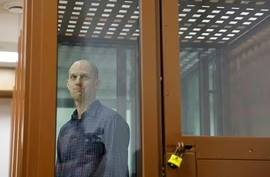
Gershkovich reflects on arrest in Russia and rebuilding life
Video has Closed Captions
Evan Gershkovich reflects on arrest in Russia and reclaiming his life after release (10m 40s)

Is the American Dream achievable for younger generations?
Video has Closed Captions
Is the American Dream still achievable for younger generations? (10m 9s)
News Wrap: Watchdog finds no criminal activity by Powell
Video has Closed Captions
News Wrap: Watchdog finds no criminal activity by Powell related to Fed renovation (5m 58s)

Passengers describe stopping alleged attempt to crash flight
Video has Closed Captions
Passengers describe stopping pilot's alleged attempt to crash Israel-bound flight (6m 10s)
Utah Gov. Spencer Cox on depolarizing a fractured nation
Video has Closed Captions
Utah Gov. Spencer Cox on his blueprint for depolarizing a fractured nation (7m 35s)
Providing Support for PBS.org
Learn Moreabout PBS online sponsorship New Episode
- News and Public Affairs

FRONTLINE is investigative journalism that questions, explains and changes our world.
 New Episode
- News and Public Affairs

Today's top journalists discuss Washington's current political events and public affairs.

 New Episode
 New Episode
 New Episode
 New Episode
 New Episode
 New Episode
 New Episode
Support for PBS provided by:
Major corporate funding for the PBS News Hour is provided by BDO, BNSF, Consumer Cellular, American Cruise Lines, and Raymond James. Funding for the PBS NewsHour Weekend is provided by...