
October 28, 2026 - PBS News Hour full episode
10/28/2026 | 57m 46sVideo has Closed Captions
October 28, 2026 - PBS News Hour full episode
October 28, 2026 - PBS News Hour full episode
Problems playing video? | Closed Captioning Feedback
Problems playing video? | Closed Captioning Feedback
Major corporate funding for the PBS News Hour is provided by BDO, BNSF, Consumer Cellular, American Cruise Lines, and Raymond James. Funding for the PBS NewsHour Weekend is provided by...
October 28, 2026 - PBS News Hour full episode
10/28/2026 | 57m 46sVideo has Closed Captions
October 28, 2026 - PBS News Hour full episode
Problems playing video? | Closed Captioning Feedback
Where to Watch PBS News Hour
PBS News Hour is available to stream on pbs.org and the PBS app.
Providing Support for PBS.org
Learn Moreabout PBS online sponsorshipGEOFF BENNETT: Good evening.
I'm Geoff Bennett.
AMNA NAWAZ: And I'm Amna Nawaz.
On the "NewsHour" tonight: President Trump heads to Ohio to rally voters in a race that could determine control of the Senate.
GEOFF BENNETT: Benjamin Netanyahu's party gains in Israel's late election results, but still cannot form a parliamentary majority.
How that country is bracing for political gridlock.
AMNA NAWAZ: Brazil's defeated presidential candidate Flavio Bolsonaro arrives in the U.S., fleeing criminal investigations in his home country.
GEOFF BENNETT: And Judy Woodruff examines the long history of partisan gerrymandering and its role in this year's midterms.
NICK SEABROOK, University Of North Florida: I don't believe that you can call yourself a healthy democracy when gerrymandering is as rampant as it is in the United States today.
(BREAK) AMNA NAWAZ: Welcome to the "News Hour."
President Donald Trump heads to Ohio tonight to rally voters in a race that could determine control of the Senate.
GEOFF BENNETT: And that stop follows dueling rallies in another key battleground state, Texas, that highlighted sharp divisions driving this year's midterms.
Our Liz Landers reports.
LIZ LANDERS: Last night, a political showdown in a usually deep red state, Trump and Democratic Senate candidate James Talarico holding rallies just miles apart in Lubbock.
DONALD TRUMP, President of the United States: And the other guy does not deserve it.
He doesn't represent your values.
STATE REP.
JAMES TALARICO (D-TX), Senatorial Candidate: On November 3, we are going to do something extraordinary.
We are going to do something historic.
LIZ LANDERS: The president mocking the Democrat with insults and a nickname.
DONALD TRUMP: Seven days from now, the people of Texas are going to defeat Democrat communist James Talafreako.
LIZ LANDERS: Talarico using the timing of the dueling rallies and that nickname to fire up the crowd.
STATE REP.
JAMES TALARICO: I know that we're not the only show in town tonight, and I appreciate all 4,000 of you that showed up here this evening.
(CHEERING) STATE REP.
JAMES TALARICO: That's a lot of Talafreakos in one room.
So... (CHEERING) KEN PAXTON (R), Texas Senatorial Candidate: Let's go win Texas.
LIZ LANDERS: Talarico's opponent, State Attorney General Ken Paxton, also taking swings.
KEN PAXTON: So let me tell you about the other guy.
I think you've heard of him, James Talarico, the most radical Democrat to ever run in Texas history.
LIZ LANDERS: All for a key seat in a state that is not elected a Democrat to the U.S.
Senate in more than three decades.
Democrats need a net gain of four seats to retake the majority in the U.S.
Senate.
Another state that captures the fault lines shaping this year's midterms, Pennsylvania.
Just two years ago, the state was central to Trump's return to the White House, but now anxieties over the economy and corruption have crumbled support for Trump and the Republican base.
LINDA MARKLE, Pennsylvania Voter: The Republican Congress does not have a spine.
They've abdicated their powers to one person, one person only.
And that's not democracy.
LIZ LANDERS: But for others, the president and his party still have their support.
JOHN TIM BETTS, Pennsylvania Voter: Probably President Trump.
I mean, I'm sorry people don't like him, but I think he's doing more for us than anybody else has.
LIZ LANDERS: But how big is the battleground for Senate control?
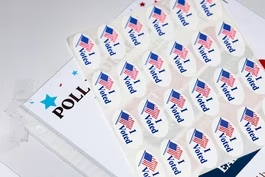
A new New York Times/Siena University poll shows Democrats may be making surprising gains, in reliably red South Carolina, Republican Darline Graham, who was appointed to fill her late brother Lindsey Graham's seat, tied with Democrat Annie Andrews.
Darline Graham in South Carolina today: SEN.
DARLINE GRAHAM (R-SC): Nobody outworks South Carolinians.
That's the formula, and it's working, and we're going to keep it going.
LIZ LANDERS: In North Carolina, where a Democrat hasn't been elected to the Senate in nearly 20 years, former Democratic Governor Roy Cooper leads Republican Michael Whatley by double digits, centering his campaign on affordability.
FMR.
GOV.
ROY COOPER (D-NC), Senatorial Candidate: And these tariffs are chaotic.
They're not -- they're essentially a tax, folks.
We need to overturn them.
I will work to do that when I get to the United States Senate.
LIZ LANDERS: Also in North Carolina today, Vice President J.D.
Vance making the case for Republicans.
J.D.
VANCE, Vice President of the United States: North Carolina, you send a message to Washington that we are sick of being ignored, we are sick of being left behind, and we are going to put America first for a change.
LIZ LANDERS: Both parties have less than one week left to make their closing arguments to voters.
For the "PBS News Hour," I'm Liz Landers.
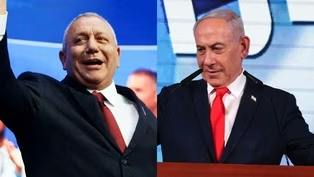
GEOFF BENNETT: In Israel, nearly all the votes have been counted in yesterday's election.
Prime Minister Benjamin Netanyahu and his allies emerged as the largest bloc, but lost seats and fell short of the majority needed to form a new government.
The results leave Israel facing the prospect of political gridlock.
Nick Schifrin joins us now from Tel Aviv.
So, Nick, last night the opposition bloc was leading based on exit polls.
Now that the votes have been counted, where do the party stand?
NICK SCHIFRIN: Well, you're right, Geoff.
The polls essentially inverted the final results.
As you said, Netanyahu's Likud Party won the most seats of any party, and his coalition also won the most seats, even if, as you pointed out, they did lose their majority.
Now, as of now, with the vast majority of votes counted, they -- Netanyahu's bloc has 53 seats, well short of the 61 it needs for a majority in the Parliament or Knesset, but more than the 48 seats that the opposition Change bloc won.
One of the most significant outcomes of this election is the 19 seats that as of now the Arab parties won.
They are also anti-Netanyahu.
So you could conclude that the majority of the country rejected the current government, but that is not how Israeli politics work.
It is Netanyahu's coalition that has the most votes, which means, as of now, there's not only weeks ahead of us of negotiations, but there's no clear direction that the country has chosen to go, even though, Geoff, voters on all sides told us that the country is at a crossroads.
GEOFF BENNETT: And what are the scenarios, Nick, for what could happen next?
NICK SCHIFRIN: So, next week, Israel's president will invite one of the blocs to try and form a majority government.
When it comes to Netanyahu, he would have to persuade one of Eisenkot's coalition partners to defect.
But a Netanyahu official told me today they consider that impossible.
Or he could form what's known as a unity government with Eisenkot.
This has been done before, especially in times of war.
But Eisenkot and all of his allies have ruled it out.
They are vociferously anti-Netanyahu.
Now, Eisenkot does have his own path.
Note again, the Change bloc in blue and the Arab parties in green combined have more than 61 and could create a government together.
But Israelis have been resistant to Jewish parties needing Arab parties to be part of the ruling coalition, especially after October the 7th, and Eisenkot calls his coalition -- quote -- "Zionist."
But we will see what happens because there is a technical way for those Arab parties to support Eisenkot from the outside.
As for Netanyahu today, his campaign accused Arab voters of -- quote -- "stealing the election," an allegation police responded to by saying there is no investigative substantiation to the claims.
And last night, Netanyahu called for the Arab parties to be excluded.
BENJAMIN NETANYAHU, Israeli Prime Minister (through translator): We must form a right-wing national strong government.
That is what must be done.
We must not, must not endanger Israel and establish a government that is backed by anti-Zionist Arab parties.
NICK SCHIFRIN: Finally, Geoff, the fourth and perhaps most likely scenario at this point, one that many Israelis do not want, neither side gets to form a government or neither side succeeds in forming a government, and Israel heads to more elections.
GEOFF BENNETT: And what might all of this mean for Netanyahu and his political future, Nick?
NICK SCHIFRIN: Well, Netanyahu stays prime minister, even if he's supposed to act with restraint.
But analysts here say that he could choose to take the country to war.
A U.S.
official confirms to me that Netanyahu pushed for attacks on Iran before the Israeli election.
Israeli defense officials have also said that, and that led to this extraordinary warning last night from Gadi Eisenkot.
GADI EISENKOT, Israeli Prime Minister Candidate (through translator): I call on the heads of the security establishment and the civil service, remember that you serve only the state and the interests of the Israeli citizens.
Stand firm against any attempt to challenge you.
Netanyahu, do not dare use Israel's security for your own political needs.
NICK SCHIFRIN: Now, U.S.
officials have also said, including President Trump in public, that the U.S.
could go back to war with Iran after the U.S.
midterm elections.
And that would presumably give Netanyahu more leverage as these coalition talks play out, and which shows, really no matter what happens, Geoff, whether Netanyahu is able to form the coalition or not, we are still in a country dominated by Netanyahu and the opposition's inability to sell a majority of the country on the idea of a post-Netanyahu Israel.
GEOFF BENNETT: Nick Schifrin reporting again for us from Tel Aviv.
Nick, our thanks to you.
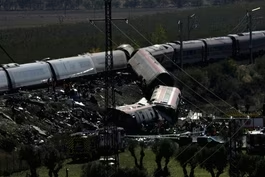
AMNA NAWAZ: In the day's other headlines: There is shock, anger and mourning in Spain after the second fatal train crash this year in what's now the deadliest collision there in more than a decade.
At least 68 people have died.
William Brangham has our report.
WILLIAM BRANGHAM: A normal morning train journey in Central Spain today ended in a field of twisted steel.
Near the town of Urda, about 90 miles south of Madrid, a high-speed train bound for Seville slammed into another train that was stopped, knocking them both off the tracks and shearing at least one apart; 147 people were aboard the stopped train.
From inside, survivors could see out the windows at the destruction they'd narrowly missed.
On the other train, nearly 400 passengers were thrown into chaos.
RAFAEL BARCELO, Train Passenger (through translator): We were having breakfast, having a coffee, and we felt a huge impact.
We were all thrown into the air.
I am reasonably OK.
My friend is quite worse.
WILLIAM BRANGHAM: Many are now looking for their loved ones.
WOMAN (through translator): My husband was in the train that left Madrid, and we just rushed here as soon as we heard about the accident.
We came here and no one tells us anything.
I don't know anything.
WILLIAM BRANGHAM: Firefighters and a military unit climbed through the wreckage, digging by hand through shattered seats and crushed steel.
Authorities said this is Spain's deadliest rail accident in more than a decade, but it's not the first one this year.
In January, on the same high-speed line, a train operated by the same carrier derailed and struck another, killing 46, and ignited a debate over whether Spain is doing enough to keep its railways safe.
Prime Minister Pedro Sanchez, who faces national elections next month, went to the scene and promised action.
PEDRO SANCHEZ, Spanish Prime Minister (through translator): We are going to get to the bottom of this.
If there were failures in the safety system, we will address them decisively.
WILLIAM BRANGHAM: All high-speed service between Madrid and the southern province of Andalusia has been suspended.
But in a country that built one of the world's larger high-speed networks, with the promise that its cities could be linked quickly and safely, today, that promise lies in pieces for the second time in a year.
For the "PBS News Hour," I'm William Brangham.
AMNA NAWAZ: Also today, the Federal Reserve held interest rates unchanged, even as officials acknowledged that inflation remains elevated.
In its statement, the Central Bank said today's decision gives officials time to gather more information on how to address rising prices.
Last month, the Fed raised rates for the first time in three years.
And, today, two Fed officials called for an additional hike.
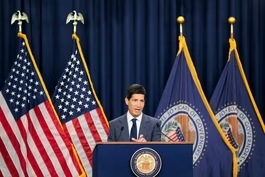
Speaking to reporters, Fed Chair Kevin Warsh addressed those dissenting views and brushed off any notion that politics played a role with the midterm elections just days away.
KEVIN WARSH, Federal Reserve Chairman: We just came out of a heck of a family fight, a serious, sober discussion.
I think we came to the right policy decision for this moment.
I just spent two days with my colleagues upstairs.
I didn't hear an utterance about politics.
AMNA NAWAZ: Warsh also said that he plans to reduce the number of meetings devoted to setting interest rates starting next year.
Alvin Hellerstein, the federal judge overseeing the prosecution of former Venezuelan President Nicolas Maduro, died today at the age of 92.
He appeared at a hearing in that case just this month.
It will now be randomly handed off to another judge, as will his other cases.
The New York native spent nearly three decades on the bench, where he oversaw cases involving nine 11 victims and Donald Trump's hush money lawsuit, among many others.
Colleagues described him as personable to the people in his court and careful with procedure.
A court official says Alvin Hellerstein died of natural causes.
In California, a federal judge says the top U.S.
prosecutor in Los Angeles is serving in the role unlawfully.
Bill Essayli was also barred from overseeing certain cases.
He's technically the first assistant U.S.
attorney, but the judge said that, in reality, he's the -- quote -- "de facto United States attorney."
And such a role can only be filled on an acting basis for 120 days without Senate confirmation.
In a statement, Essayli said he disagreed with the ruling and that the case will ultimately be decided by the Supreme Court.
Hundreds of passengers aboard a U.S.
cruise ship found themselves stranded in Cambodia after their trip was cut short due to high fuel prices.
The MV Odyssey was about two years into a three-year global voyage when its owners pulled the plug, citing rising energy costs due to the Iran war.
Its Florida-based operator says it's working on temporary living arrangements for passengers.
Some paid hundreds of thousands of dollars for a suite on the ship, and there was widespread disappointment at the trip's early termination.
STEVE SKULNICH, MV Odyssey Passenger: We got thrown off the ship yesterday.
They ran out of money.
They don't have any money for fuel, so they told us we all have to get off.
RUSS BORMAN, MV Odyssey Passenger: A lot of people now have no place to go.
This was their home.
They put all of their money -- sold their home back in the U.S.
or Australia or wherever they're from, but now they have nowhere to go.
AMNA NAWAZ: According to Cambodian officials, the ship had been carrying more than 200 passengers, most of them Americans, and 156 crew members.
The vessel itself is docked at a Cambodian port with no planned departure date.
Well, "LIFE" magazine is making a comeback, returning to print next month as a quarterly publication.
Launched in 1936, "LIFE" became a fixture on the nation's collective coffee table with its trademark red box logo and commitment to visual storytelling.
But media habits changed over the years, and the magazine ceased publication nearly two decades ago.
Model and entrepreneur Karlie Kloss is backing "LIFE'"s reboot, which will also include a Web site, social media presence and videos.
But it faces an increasingly challenging media landscape that is vastly different from its mid-century peak.
A group of investors led by billionaire Nelson Peltz is offering to buy Wendy's for around $1.4 billion.
That amounts to a nearly 20 percent premium over the stock's closing prices yesterday before the offer.
The burger chain has struggled in recent years amid competition from the likes of In-N-Out Burger and Five Guys, as well as a recent spike in beef prices.
Shares of Wendy's ended 15 percent higher today after the news.
Elsewhere on Wall Street, stocks posted modest gains after the Fed held steady on interest rates.
The Dow Jones industrial average added nearly 100 points.
The Nasdaq rose about a quarter-of-1-percent.
The S&P 500 also ended in positive territory.
Still to come on the "News Hour": where the most competitive Senate races stand less than a week before Election Day; we speak with the Associated Press about how they count the vote; and we take a look at the life and legacy of the late labor activist Dolores Huerta.
GEOFF BENNETT: Another member of Brazil's Bolsonaro family has found safe haven from possible prosecution in Brazil by fleeing to the U.S., where they have an ally in President Trump.
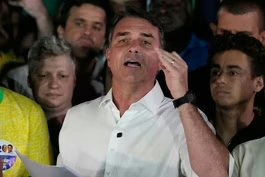
Just three days after losing Brazil's presidential election, Flavio Bolsonaro, who faces multiple criminal investigations, defied a Brazilian court and left the country.
And, today, he issued a statement saying that he is the rightful leader of Brazil.
Our Stephanie Sy is here with more.
STEPHANIE SY: Geoff, it's been a dramatic few days in Brazil's politics, starting with president Luiz Inacio Lula da Silva's surprise comeback in Sunday's presidential election.
Even though he won by more than four million votes, Bolsonaro refused to concede.
On Monday, a judge ordered Bolsonaro to surrender his passports and banned him from leaving the country.
But, on Tuesday, he and his family crossed by land into neighboring Argentina, then flew to Ecuador.
And, today, he was granted entry into the United States, landing at an airport near Miami.
For more on all this, I'm joined by Brian Winter, editor in chief of "Americas Quarterly."
Brian, thanks for joining the "News Hour."
So Bolsonaro issued a statement this afternoon saying he is facing a politically motivated witch-hunt and that he is the true elected president of Brazil.
How do you think this is going to motivate his base?
And how do you think this may play out?
BRIAN WINTER, Editor in Chief, "Americas Quarterly": It's an open question, Stephanie.
We will have to see.
But the early indications from Brazilians, including some on the right, are that this is not a strategy that is likely to work.
It's hard to set up a parallel government or a government in exile.
Flavio Bolsonaro compared himself in this statement to Juan Guaido, who was the Venezuelan president-elect who assumed that role at least in exile for several years and was unable to dislodge Nicolas Maduro from power.
It's important to note that Flavio Bolsonaro's own party, the Liberal Party in Brazil, recognized the results of Sunday's election as legitimate.
Other allied countries with the Trump administration in South America have also done so in the last couple of days.
So I'm not sure that Flavio Bolsonaro is going to find the audience to be quite as receptive as he's hoping, either in Brazil or in the rest of South America.
STEPHANIE SY: And yet some are arguing that asking Bolsonaro to surrender his passports just a day after the election does look like political retribution and is the result of bias within the judicial system in Brazil.
Is that a legitimate concern?
BRIAN WINTER: You know, it's hard to tell simple stories about Brazil, in part because it's a country where some institutions work exceptionally well.
Others have shadows.
One of them is the Brazilian Supreme Court, which has been embroiled in corruption and fallen into some of the political polarization that we have seen in Brazil over the last 10 years or so.
And so, yes, there are questions about whether there are political elements in this case against Flavio Bolsonaro, although most legal observers think that the cases themselves are legitimate.
STEPHANIE SY: The Bolsonaros have been cultivating relationships within the Trump administration really for years, and that certainly came into play today.
Let's listen to what President Trump said earlier this morning.
He was asked about whether he approved of Flavio coming to the U.S.
election.
DONALD TRUMP, President of the United States: The election was very strange and I thought it was terrible.
It's gotten bad reviews.
You look at what happened to their market.
Would I approve of it?
Yes, I would approve of it.
STEPHANIE SY: Brian, is this appropriate?
Should the U.S.
be providing political refuge for politicians and influencers who may be trying to evade legal processes in their home countries?
BRIAN WINTER: Well, look, the Bolsonaro family has been among President Trump's closest allies in South America over the last 10 years.
The only other sort of competition in that space is Javier Milei, the president of Argentina.
The connections between the families are real.
There are figures like Steve Bannon and Jason Miller in President Trump's orbit who have made themselves specialists, let's say, on Brazilian politics over the last couple of years.
So I see President Trump trying to accomplish two different objectives with these statements that he's made over the last couple of days.
One of them is trying to at least give some support to the Bolsonaro family, who he considers ideological fellow travelers.
But I also interpret President Trump's statements as a clear effort to keep a bit of distance with the Bolsonaro family for two reasons, one, because the Bolsonaro family has now lost two consecutive elections in Brazil and may no longer be the future of conservative politics in Brazil.
And, two, because there's a big commercial and investment relationship between Brazil and the United States, the two biggest economies in the Western Hemisphere.
President Trump has carefully noted that he has a good relationship with Lula and has said several times in recent days, he said, "I didn't take sides in this election."
STEPHANIE SY: All right, that is Brian Winter, editor in chief of "Americas Quarterly," joining us.
Thank you.
BRIAN WINTER: Thank you.
GEOFF BENNETT: The fight for control of the U.S.
Senate is coming down to a hard-to-predict finish, where Democrats see a possible path to reclaiming the chamber in a year where that seemed like a long shot.
Our Lisa Desjardins joins us now from the super screen to break down the map, the key contests, and what it will take for either party to win.
All right, Lisa, so where does the race for the U.S.
Senate stand?
LISA DESJARDINS: It is unpredictable and it is also incredibly dramatic.
Let's jump right in with Cook Political Report's view of things to help us out.
First of all, Democrats, right now, they are defending four vulnerable competitive seats.
However, for Cook, three of these, you see them in the dark blue, they don't think are likely to go to Republicans.
There is, however, a toss-up seat for Democrats, Michigan.
That's number one on their watch list.
How about Republicans?
Look at this.
Their job is much harder.
You can see they're defending far more places, and far more of them are that light color.
That means that they are toss-ups or a state that is about to lean potentially for Democrats.
Now, in order to take over the Senate, the magic number, I want everyone to remember this, is four.
Democrats need a net gain of four seats here.
To do that, you can read the map as well as I,they have got to win in some of these deep red states, but they are competing there.
I want to give everyone a sense of how extraordinary this is by looking at the 2024 presidential results of some of these states where Democrats are competing this year.
Ohio, where there's a toss-up race, look at that.
Trump won by 11 points.
Let's go not far away over to Iowa, also a state that is in competition this year.
Trump won that state by 13 points.
And go just down the way to Kansas.
Look at that.
Trump won Kansas by 16 points just two years ago, but, right now, Senate Democrats think they might be able to pick this or other deep red states up to turn over the Senate entirely.
GEOFF BENNETT: So Democrats, as you say, need to pick up four seats.
What's the path to do that or the Republican path to block it?
LISA DESJARDINS: All right.
This is your cheat sheet for election night.
Remember this.
Again, four seats is the magic number.
Let's talk about where each party may have some likely or potential pickups.
First, where can Democrats pick something up?
North Carolina.
Both parties will tell you that they do think this is likely to go from red to blue this year.
Now, how about likely pickups for Republicans, per The Cook Political Report?
There are none right now.
There are some potential hopes that Republicans have, but right now there are none that are forecast to go their way.
So this leaves the ball game right here, everyone, in the toss-ups.
Look at these seats.
These seats are the ones likely to determine the fate of the U.S.
Senate.
Now, how do you figure this out on election night?
Again, it does come back to that magic number.
Democrats need to pick up four.
So it's actually a little bit simple.
Let's imagine North Carolina goes, as it's expected to, for Democrats.
That's one.
Now it comes down to Michigan.
If Democrats keep it, that means they need to pick up three seats among these swing states.
If Democrats lose Michigan, they have got to pick up four.
And that's what it comes down to.
GEOFF BENNETT: And how does that compare to the map two years ago?
LISA DESJARDINS: Right.
This is far more seats.
In fact, we have 14 competitive seats right now versus nine two years ago, so a lot more.
GEOFF BENNETT: Lisa Desjardins, I don't know how you do it, but you always do.
Thanks so much.
LISA DESJARDINS: You're welcome.
AMNA NAWAZ: Well, for more on how the races are shaping up in these final days, we turn now to the insights of Democratic strategist Mo Elleithee and Republican strategist Doug Heye.
Good to see you both.
DOUG HEYE, Republican Strategist: Good to be with you.
MO ELLEITHEE, Democratic Strategist: Hi.
AMNA NAWAZ: Less than a week to go for that final day of voting in these midterm elections.
So far, as you both seen and have said, the indicators are good for Democrats.
It's a matter of how good a night it will be.
So, Doug, what are Republicans bracing for?
Is it a blue wave, a blue tsunami, a blue ripple?
What do you expect?
DOUG HEYE: First, they're prepared to lose the House of Representatives.
Every conversation I have had with Republicans has been that seems to be a done deal.
The question is, is, what is that margin?
And we don't really know at this point.
And it goes to ultimately what is turnout going to be.
And that then goes to the United States Senate.
And I can't talk to a single person who can tell you anything that is solid or predictable about what's going to happen in pick your seven states.
AMNA NAWAZ: Mo, what are you -- how are you looking at it?
MO ELLEITHEE: Yes, I think that's exactly right.
AMNA NAWAZ: Yes.
MO ELLEITHEE: The margin in the House is going to matter for governing, right, for running the House?
If it all goes as expected.
Speaker Jeffries needs a little bit of a cushion, because we have now seen several consecutive speakers who have had incredibly small margins.
But the Senate, I think it's a coin flip at this point.
I think Democrats are in a really good position, much stronger position.
I think they will, at the very least, pick up seats.
The question is how many.
Lisa was talking about the need for four.
I think a lot of people are hoping that it's actually five just in case John Fetterman decides after the new year to have some fun with the math.
AMNA NAWAZ: What do you think are the most likely seats for Democrats to pick up from the Senate?
MO ELLEITHEE: I think North Carolina is done.
AMNA NAWAZ: I think Ohio is looking really good.
I think Kansas is looking better and better.
Texas is a coin flip.
People are feeling really good about Alaska as well.
DOUG HEYE: And everyone I talk to, R or D, when you ask about specific states, they sort of make that face that Mo made.
I don't really know what's going to happen in Iowa.
DOUG HEYE: I don't really know what's going to happen in Michigan.
AMNA NAWAZ: Yes.
DOUG HEYE: There are a lot of states like that.
AMNA NAWAZ: Well, that may be your answer when I ask for this next question as well.
But I want to point to what The New York Times showed in their latest poll about South Carolina this morning, a reliably red state there, but the Senate race between Darline Graham and Annie Andrews is now effectively tied.
Doug, is that an outlier or a warning sign for Republicans?
DOUG HEYE: It's a real warning sign.
It's a warning sign in this race for two reasons.
One, Darline Graham just hasn't been a candidate that's really caught fire, been incredibly weak and weak support from within the party.
But it also tells us where Donald Trump's numbers are in South Carolina, like they are everywhere else.
And when I was at the Republican National Committee in 2010, our magic number for Obama was 46.
If Donald Trump were at 46 percent approval right now, we're not talking about Iowa or Michigan or Maine or a lot of these other states.
It'd be a very good night for Republicans.
His numbers are just so critically low, even in South Carolina.
AMNA NAWAZ: Can a Democrat win in South Carolina, Mo?
MO ELLEITHEE: I think they can.
I mean, look, we all have -- every Democrat has memories of Lindsey Graham's last race against Democrat Jaime Harrison, where the polls showed it was tied headed into Election Day and he ended up winning by double digits.
The big difference is that Lindsey Graham was so popular among South Carolinians.
Darline Graham is not.
By a double-digit margin, the voters are saying they don't think she's qualified to be in the United States Senate.
Candidate quality really, really matters, and that's the underlying factor beyond the national numbers, beyond the president's number.
You see where Republicans are really struggling across the country is because they nominated really bad candidates in those states.
AMNA NAWAZ: Well, you mentioned Alaska, and I want to put to you another big headline today related to that Senate race, more reporting from The New York Times that Democrats actively recruited a spoiler candidate in Dan J. Sullivan to join the Senate race to boost the Democratic candidate, Mary Peltola.
He, of course, has virtually the same name as the Republican incumbent Dan S. Sullivan.
Late today at Joint Base Andrews, President Trump called on Peltola to resign from the race.
He also said this to reporters.
Take a listen.
DONALD TRUMP, President of the United States: It's a fraud, and they said they didn't do it, and they did do it and they got caught.
And, in fact, it was the plot by the Democrat Party.
And, frankly, they should be -- I think they should be prosecuted.
To me, that's voter fraud at the highest level.
AMNA NAWAZ: Mo, how do you look at this?
Is this unethical but legal?
What happened here?
MO ELLEITHEE: It's boneheaded but legal.
It's dumb but legal.
I don't like it when parties do this.
I don't like this in Alaska.
I didn't like it when Republicans were funding the petition drives to get Green Party candidates on the ballot in a number of states.
I hate this.
Now, the reason it's boneheaded is because this is one of those stories where the headlines are going to be worse than the impact.
Dan Sullivan number two isn't going to have that big of an impact on this race.
He didn't in the primary.
Ranked-choice voting... AMNA NAWAZ: Point out to folks, this is what the ballot looks like, yes.
MO ELLEITHEE: Right.
And ranked-choice voting, which they have in Alaska, will actually help mitigate any confusion.
If people -- the Senator Dan Sullivan campaign is a running ads saying rank Dan and Dan first and second.
So this way it works.
If Dan Sullivan, Senator Sullivan loses, it's not going to be because of this.
It's going to be because of the incredibly high cost of gas and cost of living in the state of Alaska.
There's no reason a Peltola campaign needed to create this story.
AMNA NAWAZ: What's your take, Doug?
DOUG HEYE: If you watch the Ramaswamy campaign over the last week, they have not been able to talk about what they want to talk about.
They have been talking about their ad and trying to defend it.
It's the same problem for Peltola.
Her campaign messaging now has been derailed.
She's going to have to talk about this all day, every day.
What did you know and when did you know it?
And I think nationally it's a problem for Democrats as well, because Democrats will tell you they're very nervous about what Donald Trump may do with a loaded gun.
This is a very silver bullet they just gave him.
AMNA NAWAZ: Well, to that point, we know the DOJ was already suing to potentially block the certification of that Alaska vote.
President Trump has been calling fraud already in the Alaska race.
Does this boost their legal case and does it lead to a long, drawn-out fight after the election?
DOUG HEYE: Well, it certainly boosts their political case.
Donald Trump would not have been able to credibly say what he said today had we not had this revelation from The New York Times.
So the politics for Trump work on this, and he doesn't have a whole lot of politics working for him right now.
And it certainly means that there will be a legal fight if Sullivan doesn't prevail.
AMNA NAWAZ: How worried are you, Mo, about other legal fights?
We know the president's DOJ have been laying the ground, seeding doubt in some of the electoral systems.
Is that a concern among Democrats?
MO ELLEITHEE: Sure.
But Democrats have been prepared, and they have been preparing for months, if not years now, building sort of an army of lawyers around the country who are ready to swoop in, in whatever district.
After he lost in 2020, we saw just how much he would lean into the courts.
And he has every right to do that.
Even though the courts threw out most of those cases, that's the process.
So Democrats have been preparing.
They have got some really good lawyers out there.
The messaging you're hearing, though, more than, look how dangerous this is to the system, is, you're going to be fine, just go vote.
Your vote will count.
We will take care of the rest.
AMNA NAWAZ: Just days to go, and it's all in the voters' hands.
Mo Elleithee, Doug Heye, great to see you both.
Thank you.
DOUG HEYE: Thanks.
GEOFF BENNETT: Nearly 40 million votes have already been cast ahead of Election Day.
And that's for races that will determine not only who controls Congress, but also governors, mayors, and city councils.
AMNA NAWAZ: For many years, PBS News has relied on the Associated Press to keep track of results.
And we will do so again next Tuesday.
Deema Zein takes a closer look at how AP counts the vote.
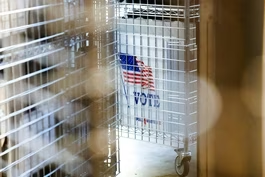
DEEMA ZEIN: Elections are run and ballots are counted by thousands of local jurisdictions across the country.
The Associated Press is tracking results in thousands of races.
Knowing how many voters actually showed up is critical to knowing when a race is over.
To explain what it takes to count the vote, I'm joined by David Scott, vice president of election services at the Associated Press.
David, thank you for joining me.
DAVID SCOTT, Vice President of Election Services, Associated Press: Happy to be here.
DEEMA ZEIN: So I want to jump right in.
Election Day is a big operation.
How many races are you tracking?
DAVID SCOTT: So in this year's general election, we will tabulate close to 7,000 races across national races for Congress, state legislative races, local races for mayor, some city council, some school board.
So it's an enormous effort.
DEEMA ZEIN: And, as we said, elections are locally run.
So how many people does it take for AP to gather results?
And is this done in person, online, both?
DAVID SCOTT: Both, all.
Wherever we can get vote count, we're looking for it.
And that's actually one of the hallmarks of what we do is multiple sources.
So we will employ.
4,000 stringers this year, reporters essentially, who go to local election offices and wait for results to be posted or they talk to election officials as they are releasing ballots.
We also know that those results are posted online in many places.
Some states and some counties have electronic feeds.
So we are looking wherever we can get those and we take all that data and we match it up.
Is what the stringer is hearing from election officials, the same things on the Web site?
It adds a layer of accuracy to our vote count and to what we're reporting on election night.
We like to say that what we do at AP on election night is the single largest act of journalism there is.
Now, there's lots of big stories, but there will be close to 5,000 people working for AP on this election night, all trying to answer that question of who of Americans picked to lead.
DEEMA ZEIN: Wow.
And as you're tracking these results in calling races, you're also estimating the number of votes cast.
So I want to ask, how do you determine the actual size of the electorate?
DAVID SCOTT: It's a big math problem, right, because we don't know in advance, but we get a lot of help from election officials.
So, in many states, they say ahead of time how many advanced ballots have been returned, how many have been cast.
On the day of election, many states, many counties will post details or tell our reporters, this is how many people have voted at the polling place on Election Day.
And so we use that information, that data to make an estimate of how many people have voted and what the turnout will be in every race.
DEEMA ZEIN: How have the elections now changed over the years, in both how people have voted and how you count the vote?
DAVID SCOTT: Well, the biggest change is that people vote before Election Day.
1972, 95 percent of Americans voted at their neighborhood polling place on Election Day.
And that number is now less than 50 percent.
A lot of people, most people are voting before Election Day.
The biggest change has been the rise of mail balloting, early in-person voting, just the different ways that you can cast a ballot.
DEEMA ZEIN: David Scott, vice president of election services at the Associated Press, thank you for joining us.
DAVID SCOTT: Happy to be here.
AMNA NAWAZ: And we will have those live election results next Tuesday, November 3.
Join us and our reporters and our panel of experts for analysis as the votes are counted.
Our coverage begins at 7:00 p.m.
Eastern.
GEOFF BENNETT: Nearly 35 million Americans will vote in congressional districts that were redrawn ahead of this year's midterms following partisan battles over political maps.
As the nation marks its 250th anniversary, our Judy Woodruff explores the origins of gerrymandering and why this centuries-old practice remains one of the most powerful tools in American politics.
It's part of her ongoing series Crossroads: America at 250.
JUDY WOODRUFF: The items on these cards are rare political artifact, protected by Library of Congress curators who carefully brought them out of their Archives.
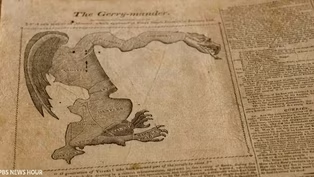
WOMAN: What you're seeing today is a copy of the original Boston Gazette, where you see the actual first appearance of the gerrymander cartoon.
JUDY WOODRUFF: What year was this?
WOMAN: And this was March 26, 1812.
JUDY WOODRUFF: 1812.
At the time, Massachusetts Governor Elbridge Gerry had approved redrawn districts in the state in a bid to keep his party in power.
As the story goes, a newspaper editor saw a salamander in the map's outline, combined it with Gerry's name, and a new word entered the American political vocabulary, gerrymandering, or, as it became, gerrymandering.
NICK SEABROOK, University of North Florida: This is, I would argue, probably the very first example of a viral meme in American politics.
So it spread around The Federalist newspapers in the New England era, and then over the subsequent year it was reprinted in almost 100 newspapers across the country.
WOMAN: It's depicted as this mythical salamander beast.
JUDY WOODRUFF: The library also has the wood blocks used to print this piece of history.
More than two centuries later, gerrymandering is flourishing and playing out in state after state.
The latest round of mid-decade redistricting intensified last year when, at President Trump's request, Texas redrew its congressional maps to try to add five Republican seats.
After that, other states entered the fight.
California Governor Gavin Newsom called a special election to redistrict and pick up more Democratic seats.
GOV.
GAVIN NEWSOM (D-CA): They want to rig these elections and they want the power that gerrymandering provides, because they know what Donald Trump knows.
He's going to lose the midterms.
DONALD TRUMP, President of the United States: The Democrats, or as I call, the Dumocrats, because they are dumb in so many ways, they have redistricted for years, and now we took our shot, and it looks like we're going to pick up a lot of seats.
NICK SEABROOK: The motive for gerrymandering is almost always power.
It's a product of polarization, of Democrats and Republicans not just disagreeing, but actively hating each other.
Negative partisanship is such an incredibly strong force in our politics today.
JUDY WOODRUFF: Nick Seabrook is the author of "One Person, One Vote: A Surprising History of Gerrymandering in America."
He says the practice of manipulating district lines to protect political power is actually older than Gerry.
It began with George Burrington, a colonial governor of North Carolina in the 1730s.
NICK SEABROOK: His attempt to manipulate the districts of the colonial assembly was motivated by a desire to try and prevent the columnists themselves, who elected the lower house of that legislature, from pushing back on the taxes and fees that his administration was charging to try and expand the footprint of the North Carolina colony.
JUDY WOODRUFF: So he had a motive, or motives, for what he was trying to do.
NICK SEABROOK: He did, yes.
JUDY WOODRUFF: Does that qualify as redistricting or gerrymandering as we know it today, manipulating?
NICK SEABROOK: I would say this was certainly gerrymandering because there was no -- there was no legal obligation for him to make any changes to these districts.
He approached it purely as an exercise in maximizing his own political power.
JUDY WOODRUFF: This year, that maximizing of political power has ended up with mid-decade redistricting in nine states, Texas, California, Utah, Ohio, Tennessee, Louisiana, Alabama, Florida, and North Carolina.
From the colonial days of George Burrington to today, North Carolina has been one of the most gerrymandered states in the country.
When congressional maps are redrawn, they sometimes split communities right down the middle.
That's the case in the small town here of Sharpsburg, North Carolina, where three counties come together.
I'm standing at the northernmost edge of the Third Congressional District, but if I take just a few steps across these railroad tracks, you will see I have moved into the First Congressional District.
When Republican state lawmakers redrew these and other lines last year, they said they were trying to pick up one more Republican seat in Congress.
Several counties shifted from one district to another, changing the demographics of both, spreading out eligible Black voters and weakening their electoral power.
The city of Wilson is one of the communities plucked out of the First District and placed in the Third.
For the 50,000 people who live here, the question is, what will the switch mean for their voice in Congress?
Castonoble Hooks has lived in Wilson his entire life.
CASTONOBLE HOOKS, Wilson, North Carolina, Resident: This is a traditional Black area, where most of the original Black residents still live.
JUDY WOODRUFF: He remembers the days of Jim Crow laws, when the town was segregated.
CASTANOBLE HOOKS: What disenfranchisement taught us is that if you're not a part of the political process, you are left behind.
JUDY WOODRUFF: Today, Hooks is a regular fixture at the senior center where he teaches chess and encourages his neighbors to vote.
CASTONOBLE HOOKS: I voted in every election since I have been 18.
Does my vote count?
I hope it did.
But I'm going to keep voting.
JUDY WOODRUFF: Do you think this new district that you're in, this newly drawn district, represents Wilson, the way it's drawn.
CASTONOBLE HOOKS: No, it dilutes our vote.
It dilutes the Black vote.
It puts us with a large number of white people, so much so that our vote is -- if all of us vote one way, it probably won't affect the outcome.
BRITTANY HAMM, Wilson, North Carolina, Resident: And it feels like our votes are kind of being taken away.
It feels like our voice isn't heard, and that's what disconnects and make people not even want to vote.
JUDY WOODRUFF: Thirty-six-year-old Brittany Hamm was born and raised in Wilson.
She's raising three kids here and works to educate people about the political process.
RAYMOND SMITH JR.
(D), North Carolina Congressional Candidate: What we have before us, we have a Congress right now with no backbone.
(APPLAUSE) JUDY WOODRUFF: She's a community organizer and active in local politics.
BRITTANY HAMM: As constituents or voters, we're supposed to choose who represents us.
When they redistrict or they redraw these lines, they're picking the voters, instead of the voters picking them.
And that's not fair to us, because Wilson didn't move, the needs didn't change, but yet you're moving us.
NICK SEABROOK: It's an unfortunate situation where we, as the people, we as citizens can find ourselves cut out of that fundamental democratic role of choosing our representatives in government.
JUDY WOODRUFF: Nick Seabrook says the consequences go beyond any one community.
They go to the heart of democracy itself.
NICK SEABROOK: Because elections are our only voice, there's no way that we can that we can fix that when the election itself has been -- has been rigged against us.
JUDY WOODRUFF: Is it consistent with democracy?
NICK SEABROOK: I don't believe that it is.
I don't believe that you can call yourself a healthy democracy when gerrymandering is as rampant as it is in the United States today.
JUDY WOODRUFF: Given all this, where does it leave the average voter, the ordinary voter?
NICK SEABROOK: It leaves the average voter in a situation where they can never be sure in their individual districts, in their individual state whether the deck has been stacked ahead of time.
I argue that it's not sufficient to place constraints on redistricting to prevent gerrymandering.
The only way to effectively fix this is to just take that power away from the elected branches of government, because you leave the foxes in charge of the henhouse.
It doesn't matter how many sternly worded letters you send them telling them not to eat the chickens.
That's what it's in their nature to do.
JUDY WOODRUFF: For the "PBS News Hour," I'm Judy Woodruff in Wilson, North Carolina.
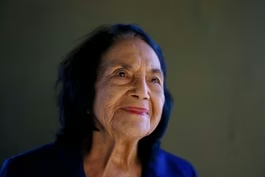
AMNA NAWAZ: Finally tonight, we remember the life and legacy of Dolores Huerta, the pioneering labor leader and civil rights icon.
Huerta died today from cancer at her home in Bakersfield, California.
Leaders from around the country paid tribute, including in California, where flags were lowered to half-mast in her honor.
"Yes, we can," Dolores Huerta's belief and words that helped build a movement.
DOLORES HUERTA, Activist: It means activism.
It means that people can have the power to change things in their lives, change things politically, and it means that every person should feel their own power and know that they can make a difference.
AMNA NAWAZ: Her rallying cry power at the United Farm Workers union and more widely, the labor and civil rights movements.
Dolores Clara Fernandez was born in 1930 in New Mexico.
As a young schoolteacher in the San Joaquin Valley, her students' poverty inspired her to start organizing farmworkers, as she told the "News Hour"s Ray Suarez in 2012.
DOLORES HUERTA: These children that were my classroom were the children of the Dust Bowls, the little Opie and Archie kids, and they were coming in there also and kind of hungry and threadbare.
I thought that was so wrong.
So I thought, well it's better to just get up and start organizing the farmworkers and I decided then to quit.
AMNA NAWAZ: She eventually joined forces with Cesar Chavez in California's Central Valley to found what would become the United Farm Workers Union.
The union joined the Filipino workers' strike against grape growers over low wages and working conditions that lasted five years.
As the union grew, it organized multiple major strikes and boycotts through the '60s and '70s, and it helped negotiate contracts with big growers to win benefits for those in the field, as chronicled in this 2017 documentary "Dolores."
DOLORES HUERTA: We will take economic pressure, strikes, boycotts to force recognition and obtain collective bargaining rights.
The social and the economic revolution of the farm workers is well under way, and it will not be up until we receive equality.
AMNA NAWAZ: Geraldo Cadava, a professor of history and Latino studies at Northwestern University, says Huerta's presence on the ground was key to her emerging voice.
GERALDO CADAVA, Northwestern University: She was a huge kind of influence.
She was on the ground from the beginning.
She was knocking on doors with Cesar Chavez.
She was visiting farm workers in their homes.
She was with them in the fields.
So she was a real fighter and leader and influencer within the movement.
AMNA NAWAZ: She spent almost four decades as the union's vice president and as the second in command to the charismatic Chavez until his death in 1993.
But for decades, Huerta had kept a stunning secret to herself.
Chavez had raped her during those early years.
Huerta only went public earlier this year.
DOLORES HUERTA: I had to protect the movement.
I think that we accomplished a lot with the movement.
So I don't know.
Should I have spoken out sooner?
I don't know.
But at least I'm glad that I'm finally getting this off my chest finally.
AMNA NAWAZ: An investigation from The New York Times found that Chavez had sexually abused multiple women, some of them children.
Huerta told The Times that Cesar Chavez's assaults resulted in two pregnancies that she concealed, two children she gave up for adoption.
She later was in a long-term partnership with his brother, Richard Chavez, and had 14 children overall.
The revelations shocked the world, especially many in the Latino community.
Throughout her life's work, she suffered again and again.
Huerta was jailed 22 times over union demonstrations and was once critically injured after she was beaten by police.
She was active in politics for decades as well, volunteering for Senator Robert F. Kennedy's presidential campaign.
Huerta was on stage with him when he was assassinated in 1968.
Years later, she campaigned for Presidents Clinton, Obama, and Biden.
In 2012, President Obama awarded Huerta the Presidential Medal of Freedom.
BARACK OBAMA, Former President of the United States: On a personal note, Dolores was very gracious when I told her I had stolen her slogan, "Si, se puede," "Yes, we can."
Knowing her, I'm pleased that she let me off easy,because Dolores does not play.
MARIA TERESA KUMAR, Founder and Executive Director, Voto Latino: Dolores Huerta was a giant.
AMNA NAWAZ: Maria Teresa Kumar is the president of the political organization Voto Latino.
Huerta was a mentor of hers.
MARIA TERESA KUMAR: When Voto Latino first started, one of the biggest challenges was how to navigate a space that didn't necessarily welcome women.
This was after the first wave of anti-immigrant sentiment, and Dolores stepped up and she came to us and provided us counsel.
She provided us cheering, she provided us strategy, and she provided us, I think, just generous, generous friendship.
AMNA NAWAZ: Dolores Huerta never slowed down.
The labor leader, civil rights icon, and feminist activist was still rallying well into her late 90s.
DOLORES HUERTA: Every one of our segments of society that are trying to make positive change, that are fighting for social justice, this is what we have to do, come together, organize push back, take that direct action, and then we can make the world a better place.
AMNA NAWAZ: Dolores Huerta was 96 years old.
GEOFF BENNETT: And that's the "News Hour" for tonight.
I'm Geoff Bennett.
AMNA NAWAZ: And I'm Amna Nawaz.
On behalf of the entire "News Hour" team, thank you for joining us.
 New
America's long history of gerrymandering
Video has Closed Captions
America's long history of gerrymandering and its role in this year's midterms (9m 41s)
 New
Brazil's Flávio Bolsonaro flees to U.S. after election loss
Video has Closed Captions
Brazil's Flávio Bolsonaro flees to U.S. after election loss (5m 29s)
 New
Democratic and GOP strategists assess midterm landscape
Video has Closed Captions
Democratic and GOP strategists assess midterm landscape in final week (7m 47s)
 New
How the Associated Press tracks results on Election Night
Video has Closed Captions
How the Associated Press tracks and calls races on Election Night (3m 30s)
 New
News Wrap: Fed holds interest rates unchanged
Video has Closed Captions
News Wrap: Fed holds interest rates unchanged as inflation remains elevated (5m 1s)
 New
Polls suggest surprising Democratic gains in red-state races
Video has Closed Captions
New polls suggest surprising Democratic gains in red-state Senate races (3m 43s)
 New
Remembering pioneering labor leader and civil rights icon Dolores Huerta
Video has Closed Captions
Remembering pioneering labor leader and civil rights icon Dolores Huerta (5m 45s)
 New
Shock, anger and mourning in Spain after train crash
Video has Closed Captions
Shock, anger and mourning in Spain after 2nd major train crash this year (2m 26s)
 New
What's next for Israel after election produces gridlock
Video has Closed Captions
What's next for Israel after election produces political gridlock (4m 35s)
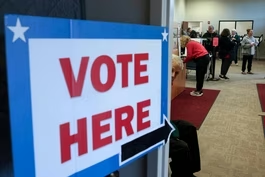 New
Where key Senate races stand in final days of campaigning
Video has Closed Captions
Where key Senate races stand in the final days of campaigning (3m 18s)
Providing Support for PBS.org
Learn Moreabout PBS online sponsorship
- News and Public Affairs

FRONTLINE is investigative journalism that questions, explains and changes our world.
 New Episode
- News and Public Affairs

Today's top journalists discuss Washington's current political events and public affairs.
 New Episode


 New Episode

 New Episode
 New Episode

 New Episode



Support for PBS provided by:
Major corporate funding for the PBS News Hour is provided by BDO, BNSF, Consumer Cellular, American Cruise Lines, and Raymond James. Funding for the PBS NewsHour Weekend is provided by...