
October 16, 2026 - PBS News Hour full episode
10/16/2026 | 57m 46sVideo has Closed Captions
October 16, 2026 - PBS News Hour full episode
October 16, 2026 - PBS News Hour full episode
Problems playing video? | Closed Captioning Feedback
Problems playing video? | Closed Captioning Feedback
Major corporate funding for the PBS News Hour is provided by BDO, BNSF, Consumer Cellular, American Cruise Lines, and Raymond James. Funding for the PBS NewsHour Weekend is provided by...
October 16, 2026 - PBS News Hour full episode
10/16/2026 | 57m 46sVideo has Closed Captions
October 16, 2026 - PBS News Hour full episode
Problems playing video? | Closed Captioning Feedback
Where to Watch PBS News Hour
PBS News Hour is available to stream on pbs.org and the PBS app.
Providing Support for PBS.org
Learn Moreabout PBS online sponsorshipAMNA NAWAZ: Good evening.
I'm Amna Nawaz.
GEOFF BENNETT: And I'm Geoff Bennett.
On the "News Hour" tonight: the latest on the investigation into a deadly elementary school shooting in Bend, Oregon, that killed three young children and a teacher.
AMNA NAWAZ: A tighter-than-expected Senate race sends President Trump to Alaska just weeks before the midterm elections.
GEOFF BENNETT: And Kerry Kennedy reflects on her mother's lifelong devotion to family and human rights and also weighs in on recent political controversies involving the Kennedy name.
KERRY KENNEDY, Author, "Ethel Kennedy: The Extraordinary Life and Bold Legacy": President Trump, do your job.
Do not worry about the Kennedy Center.
Leave it alone, and it will be fine.
(BREAK) GEOFF BENNETT: Welcome to the "News Hour."
Police are still investigating the motive behind the deadly shooting at Silver Rail Elementary School in Bend, Oregon.
Officials say four people were killed, including three young children and a teacher.
Two of those victims were identified, 5-year-old Rhoam Summer and teacher Megan Lambert.
She was 25 years old.
AMNA NAWAZ: Police have identified the alleged shooter as 16-year-old Griffin J. John II.
He previously attended Silver Rail Elementary, where authorities said he was a special needs student.
They said that yesterday he attacked a special needs classroom before being killed at the scene himself.
William Brangham starts our coverage.
WILLIAM BRANGHAM: In Bend, Oregon, families huddle together, mourning those who've been lost, grieving yet another gun-related tragedy in America.
GOV.
TINA KOTEK (D-OR): No parent, no family, no community should have to have this kind of day.
WILLIAM BRANGHAM: Last night, people gathered in a park near the school to sing hymns and offer prayers.
The state's governor, Democrat Tina Kotek, tried to console the city.
GOV.
TINA KOTEK: Let's remember what matters and take care of each other because it's going to be hard.
But you have each other.
And I love you.
WILLIAM BRANGHAM: This all following a terrifying day in the Central Oregon town.
EMERGENCY DISPATCHER: For an active shooter at Silver Rail Elementary.
WILLIAM BRANGHAM: Police rushed to the scene yesterday within minutes after a suspect shot his way into Silver Rail Elementary School, reportedly with a shotgun.
He then shot and killed a teacher and three young students.
A 7-year-old and another teacher were taken to the hospital with critical injuries.
Ten-year-old Aizen recalled the moments he first heard the gunfire.
AIZEN, Student at Silver Rail Elementary School: I locked the door and I went back behind our lockers, as all my classmates did the same.
All of my classmates and my teacher were safe, but we were definitely scared, and most people were crying.
And it was really hard.
Late today, Bend's police chief, Mike Krantz, said at a press conference that the shooter broke through the school's security.
MIKE KRANTZ, Bend, Oregon, Police Chief: He fired multiple rounds into the glass panes in the doors to gain access to the school.
The suspect went directly into the classroom immediately to the left of the entry doors, where he fired as many as 15 rounds.
WILLIAM BRANGHAM: By the time police entered the school, the suspect was already dead.
The 16-year-old shooter's identity was confirmed today, and the shotgun he allegedly used was registered to his mother.
Authorities say he was killed by a bystander who'd seen the suspect enter the school, followed him in and shot him.
Multiple news reports identified that man as Kaylub Giamanco.
According to his mother, he has two daughters who attend Silver Rail.
Many local officials praised Giamanco's intervention.
And President Trump weighed in today, calling Giamanco a hero, adding -- quote -- "Otherwise, it would have been much worse.
It's a terrible thing, but thank goodness for a man that had a gun and knew how to use it."
Chief Krantz also addressed that man's role, describing what happened when he first entered the school.
MIKE KRANTZ: As he made entry through the forced open doors, he heard shooting and saw a teacher involved in a physical altercation with the suspect.
He then went to the classroom where the struggle was under way and fired his weapon, striking the suspect multiple times.
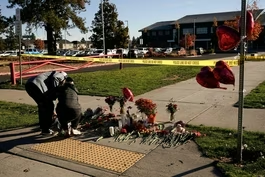
WILLIAM BRANGHAM: Outside Silver Rail earlier today, silence.
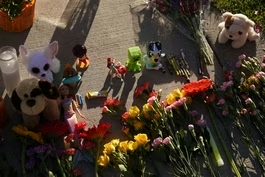
All schools in the district were closed for the day, yellow tape cordoning off the crime scene, flowers and candles and notes signaling the grief of so many.
Among those paying their respects was Brooke Olsen.
Her daughter is a kindergartner at the school.
BROOKE OLSEN, Parent: It didn't feel real.
It didn't feel like it could be happening here at our school.
And it's extremely painful.
And it's hard to understand.
We can't understand it.
And we're trying to grieve and process and recover.
WILLIAM BRANGHAM: The Associated Press marks this shooting as the 28th mass killing in the U.S.
this year.
For the "PBS News Hour," I'm William Brangham.
AMNA NAWAZ: There are many more questions to be answered in the days ahead.
To explore some of them, we're joined now by James Densley.
He's professor and chair of criminology and criminal justice at Metro State University in Minnesota.
He's best known for co-creating The Violence Prevention Project.
That is the largest, most comprehensive database of mass shootings in the United States.
Welcome and thanks for being with us.
So, some limited information about the shooter and the way this attack unfolded so far.
But, from what we do know, what stands out to you about this shooting?
JAMES DENSLEY, Co-Founder and President, The Violence Project: There are several things.
We have 26 years of school homicides in our database, nearly 400 cases.
And this is the first time a civilian shot and stopped the attacker.
Usually, when school shootings are stopped before the police arrive, it's by a teacher, a coach, a custodian, or another student who tackles the shooter before they reload.
So that's a very unique thing.
You know, we have a father here with two daughters at the school.
He ran toward the gunfire.
It's incredible bravery.
And I'm sure it'll be held up as proof of one argument to another, but we must not forget that this also began with a 16-year-old who got hold of a gun that they should not have had.
And that's the best part of prevention that we have here for the next time.
Even with a hero on the scene, in three minutes, four people were already dead.
So, stopping a shooter is not the same as preventing a shooting.
And so the real goal is to never need these heroes at all.
AMNA NAWAZ: We should also point out the teacher who was involved in the altercation with the shooter apparently threw her cell phone at him and was fighting with him when that father entered the building and ultimately shot him.
But I should also point out what officials shared about the fact that the shooter entered the building by forcing his way, shooting his way through locked doors.
The superintendent today mentioned how much they have invested in security.
How should we look at that, the front-end security that many schools have now put in place?
JAMES DENSLEY: Yes, it's a great question.
The doors were locked and he shot through them.
The locks buy time and time saves lives usually.
But a locked door is also the last line of defense.
It's not the first.
In our data, shooters force their way into schools in only a handful of cases.
Most of those, though, do tend to be former students, because they know the building and they're prepared to break in.
And by the time someone is shooting at your front door, prevention's already failed in many ways.
The real work, I think, has to happen weeks and months earlier, when someone notices warning signs and can step in.
AMNA NAWAZ: Officials also said today they don't yet know how the shooter got the weapon or the ammunition.
It's been reported, however, that the shotgun belonged to his mother.
Is that kind of situation consistent with what we have seen in the past where a minor gets access to a weapon from a parent or relative?
JAMES DENSLEY: Yes, sadly, that's part of the story that's painfully familiar.
In school mass shootings in our data, whenever a shooter is a teenager, and we know where the gun comes from, it usually comes from home every single time, actually.
It's typically parents and grandparents.
Children are too young to buy these guns, and so that's why they take them.
But this is also the most preventable part of the problem.
A lock safe at home costs a few hundred dollars.
It's the cheapest school safety measure in America, and it's the one that's right in your house, not even at the school.
So I would say, for every parent watching this tonight, ask yourself this question.
Could my child access my gun today if he or she wanted to?
And if the answer is yes, then you need to do something about this.
Now, we have seen cases in Oxford, Michigan, and also the Apalachee High School in Georgia where parents have actually been charged and found negligent and guilty for these cases.
So the law is starting to treat these unsecured guns as part of the crime.
AMNA NAWAZ: Got a minute or so here left, but I have to ask you about what we heard from the school superintendent when he said how deeply impacted everyone in the community is and how this will stay with them for years to come.
From the shootings you have looked at in the past, how does it stay with a community?
JAMES DENSLEY: I mean, it's just -- it's every parent and every community's worst nightmare.
I mean, the youngest child killed was just 5 years old in this case.
In our data, no younger child has died in an attack on a school.
And the shooter was 16.
This is children killing children.
It's a tragedy on so many levels, and it will have ripple effects throughout that community for generations.
There's going to need to be a lot of care and compassion and aftercare and support for these families and for this community.
And my heart goes out to them, and I'm sure everybody else who's watching this tonight as well.
It's just devastating.
AMNA NAWAZ: That is Professor James Densley from Metro State University joining us tonight.
Thank you so much.
JAMES DENSLEY: Thank you.
GEOFF BENNETT: And we start today's other headlines in Washington, D.C.
The White House confirms that press secretary Katie Zacharia is transitioning out of her role after less than a week on the job.
Speaking to reporters today, President Trump said he gave her the option to leave, saying -- quote -- "Maybe it's not for her."
Zacharia held her first and only briefing on Tuesday.
She took questions from just three outlets.
She's also faced scrutiny over her alleged legal credentials.
Zacharia has defended calling herself a lawyer, even though she's never passed the bar exam.
In Southern California, a number of large brushfires are forcing people to leave their homes, including a blaze in Malibu that's prompted evacuation orders and warnings for residents in the Santa Monica Mountains.
In Orange County, the fires burned multiple homes today.
Power companies have shut off service to tens of thousands of customers.
WOMAN: Airplanes picking up water, trying to put this fire out, but good luck.
GEOFF BENNETT: Strong Santa Ana winds have made firefighting especially difficult with gusts up to 70 miles an hour in some areas.
Weather officials warn that hot, dry conditions will last through Saturday, increasing the fire risk.
Across the West Bank today, dozens of Israeli settlers set cars and trees ablaze and attacked Palestinians as they gathered for their autumn olive harvest.
Masked men, some of them carrying gas canisters, chased and beat people, while others threw rocks and burned trees.
Health officials say more than a dozen people were injured across at least eight villages.
Among those injured was Heidi Levine, an American photojournalist with The Washington Post.
MAN: Run.
Run.
Run.
Run.
MAN: Run!
GEOFF BENNETT: Levine was forced to flee after she says the attackers kicked and beat her, even though she wore a vest clearly marked "Press."
Speaking from a hospital bed, she called the attackers monsters.
HEIDI LEVINE, Photojournalist, The Washington Post: They're not even humans.
And, yes, they are Jewish terrorists, and they are giving everyone in the country a horrible reputation.
GEOFF BENNETT: In a statement, The Washington Post said it is -- quote -- "outraged" by the unwarranted attack, while the office of Israeli Prime Minister Benjamin Netanyahu condemned the violence, but questioned what he called the facts surrounding the assault, saying they remain unclear and are under investigation.
Turning now to the war in Ukraine, President Trump is criticizing Ukraine's renewed strikes on Russian oil refineries as, in his words, a disgrace.
Kyiv had briefly halted such attacks after Mr.
Trump declared an energy cease-fire on Sunday, though Russia then continued its own strikes.
Appearing on Newsmax, Mr.
Trump went on to characterize Ukrainian President Volodymyr Zelenskyy as -- quote -- "not a good guy for us to deal with."
Hours later, Zelenskyy pushed back during an E.U.
summit in Brussels.
VOLODYMYR ZELENSKYY, Ukrainian President: Can you imagine?
Yesterday was 1,000 drones in Ukraine, 1,000.
But -- but the American side said that it is difficult to speak with Zelenskyy.
It's less difficult to manage with Putin.
GEOFF BENNETT: Officials say Russia struck nine Ukrainian regions, including in Odesa, knocking out power to hundreds of thousands of homes.
At least 15 people were injured nationwide.
Meantime, a U.N.
report out today found a sharp increase in Ukrainian civilian casualties in recent weeks.
And President Zelenskyy warned that military communications via the Starlink network from Elon Musk's SpaceX have not been fully restored.
The Vatican says that Pope Leo spoke with Russian President Vladimir Putin today and expressed deep concern for the humanitarian situation in the Russian-occupied town of Oleshky near the front lines.
The Kremlin says that Putin supports Leo's call to allow aid to reach the residents there.
It comes as the Vatican released the first images of the pope since his lung cancer surgery earlier this week.
He's seen celebrating mass at the hospital in Rome where he's being treated.
Church officials say Leo plans to deliver the traditional prayers this Sunday, though it's unclear whether he will do that from the Vatican or from the hospital.
On Wall Street today, stocks ended lower amid a sell-off in tech shares.
The Dow Jones industrial average slipped 175 points.
The Nasdaq dropped more than 2 percent.
The S&P 500 closed out its worst week since June.
Still to come on the "News Hour": the controversial language that President Trump has been using while stumping for Republican candidates; Jonathan Capehart and Matthew Continetti analyze the week's biggest headlines; and a new exhibit explores the connection between Black women and the works of William Shakespeare.
AMNA NAWAZ: Ahead of the midterms, President Trump is on the campaign trail looking to rally his base in battleground races.
His controversial comments at those rallies have drawn attention.
To fact-check some of the president's claims, we're joined now by our White House correspondent, Liz Landers.
Liz, let's just start off with something the president talks about frequently at these rallies, which is immigration.
Here's what he had to say about Somali immigrants during a rally in Ohio earlier this week.
DONALD TRUMP, President of the United States: All they do is kill each other in the streets.
Then they come into the United States of America and they tell us how to run our country.
We're not going to stand for it.
They drive up taxes.
They drive up health care costs, insurance costs, childcare costs, and they cheat on everything.
It's a disaster.
And we're not going to stand for it.
AMNA NAWAZ: Setting aside the comments about violence there, what do we know about what the president had to say about immigration driving up costs?
LIZ LANDERS: Yes, the Congressional Budget Office has analyzed this and looked at the immigration surge here in the United States starting in 2024 and projecting for 10 years and says that the immigration surge will actually add $1.2 trillion to federal revenue.
And, by 2034, the annual increase in revenue will be up to $164 billion.
So this surge is projected to boost economic activity and, in turn, tax revenues.
And when it comes to what he was saying about insurance there, undocumented immigrants are not eligible for Medicaid coverage.
There are certain circumstances where lawfully present immigrants may have some kind of qualified status, but they have to wait five years before they are eligible for it.
And KFF has found that immigrants are not more likely than U.S.-born citizens to report using government assistance for food, housing, and health care, Amna.
AMNA NAWAZ: There's another comment the president made that got a lot of attention at a rally in Arizona.
He called for the death penalty for leakers.
Take a listen.
DONALD TRUMP: In my opinion, leakers should be shot.
DONALD TRUMP: They should be shot.
In the old days, we used to shoot leakers when they leak what time you're going to attack a country?
No, leakers should be dealt with very, very strongly.
They're real -- to me, they're the scum of the earth.
The leakers are the scum of the earth.
AMNA NAWAZ: Liz, do people who leak information ever face capital punishment?
LIZ LANDERS: Well, in this instance, it sounds like the president is talking about recent leaks around the U.S.
attacks on Iran.
So, most government leaks are prosecuted under the Espionage Act of 1917, which penalizes the unauthorized retention or dissemination of national defense information.
Those charges have a standard prison term sentence of either five to 10 years maximum in jail.
Most federal crimes that qualify for the death penalty involve murder or death themselves.
There is one exception with this.
That is treason.
But the last person to be tried with treason in the United States was Adam Gadahn in 2006 for providing aid to al-Qaida.
And the last person to be sentenced to death for treason was in 1948.
It was a Japanese American who'd been convicted of torturing Americans during World War II, but he was deported to Japan before that happened.
AMNA NAWAZ: So, at that same rally, the president also questioned the results of the 2022 Arizona governor's race.
Take a listen.
DONALD TRUMP: The damn machines were broken in Republican areas.
They were broken purposely, and you couldn't vote.
(CHEERING) DONALD TRUMP: What a rigged election that was.
And it's a shame.
It's a shame and that they can allow that happen.
AMNA NAWAZ: Liz, what do we know about that election and where this fits into the president's longstanding claims of election fraud?
LIZ LANDERS: He reiterates this and lies about this almost on a daily basis.
This line that the machines were broken purposefully in Republican areas is false.
I was on the ground in Maricopa County for that election in 2022.
And what happened was, there was an issue with the printer in some, not all, vote centers throughout Maricopa County.
The ballot ink was too light.
It could not be read by tabulators.
And what happened was, it created frustrations with the lines there.
People were having to wait to have their ballots processed, but it did not disenfranchise any voters in Maricopa County or prohibit them from casting a ballot.
There were some subsequent legal challenges that were brought by Kari Lake.
Those were thoroughly reviewed and dismissed across multiple levels of the judiciary there.
AMNA NAWAZ: So, speaking of election administration, we know the Trump administration continues to try to compel states to turn over voter information, try to restrict who can get a mail-in ballot.
The Department of Justice filed a lawsuit just yesterday against California's secretary of state and also Los Angeles' top elections official.
What are they alleging here?
LIZ LANDERS: We have been following how the federal government is trying to impact the midterm elections, even though states in the Constitution are the ones who are designated to set the time, place and manner of how their elections are conducted.
The Department of Justice sent this letter on Wednesday to both the secretary of state there, the top elections official in L.A.
County, and gave them 48 hours to review a list that they had put together of 20,000 people that the Department of Justice says they -- quote -- "believe" are noncitizens on voter rolls in that state.
What happened was, they provided them with a thumb drive that had a sticky note with a password on it.
And I talked to this election official, DEAN LOGAN, in L.A.
County, and he said: "We are not going to put that in our computers.
That is not a safe and secure thing for us to do right now."
The federal government was asking California to set aside those ballots of the 20,000 people that they believe may not be citizens, so, in other words, asking them to change some of their voting practices there.
Problem for the federal government is that they do not have a good track record right now on these lists that they're compiling and giving to states.
Department of Homeland Security sent Nevada a list of 148 people that they thought were noncitizens on voter rolls.
Turns out all of them were citizens.
AMNA NAWAZ: Before I let you go, the newly appointed White House press secretary, Katie Zacharia, officially out today after days on the job.
What do we know about her departure?
LIZ LANDERS: Her departure was a combination of two things.
It sounds like the performance that she had on Tuesday at the podium, she was visibly nervous, did not do well.
I heard from a lot of sources that they did not think that she was up to the job.
Second thing was the questions about her legal background.
She did graduate from law school, but she failed the bar exam.
The president did not seem to know that or understand that.
Today, he said to reporters as he was leaving the White House: "Katie, is this for you?"
He said he this is -- what he said to her, and she said she's a nice person.
But he said: "You don't have to do this if you don't want."
AMNA NAWAZ: That's our White House correspondent, Liz Landers.
Liz, thank you.
LIZ LANDERS: Of course.
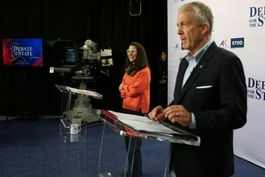
GEOFF BENNETT: Alaska could play a pivotal role in Democrats' efforts to reclaim control of the Senate in November.
In a heated debate last night, Republican incumbent Dan Sullivan faced questions about rising fuel costs driven by the unpopular war with Iran.
That's as his Democratic challenger, former Congresswoman Mary Peltola, pushed back against allegations that she mistreated staff members.
QUESTION: What can Congress do to hasten the war's end?
SEN.
DAN SULLIVAN (R-AK): We need to open the Straits of Hormuz, make sure Iran does not get a nuclear weapon, but it needs to end soon.
The energy costs from this war are too high.
QUESTION: Former staff members have alleged that you have subjected them to angry outbursts and used derogatory language.
How do you respond to these allegations?
REP.
MARY PELTOLA (D-AK), Senatorial Candidate: I do not think that this election is about me on my worst day.
And I found so many of these allegations concerning and outright fabrications.
GEOFF BENNETT: For reporting and insight, we're joined now by Lori Townsend, political director for Alaska Public Media.
Thanks for being with us.
LORI TOWNSEND, Alaska Public Media: So great to be here.
GEOFF BENNETT: And Alaskans, as you well know, are feeling the effects of rising energy prices in ways that much of the rest of the country is not.
In remote communities, you have diesel that fuels generators, it heats homes, it drives up the costs of shipping food.
How are those rising costs shaping this race, the Senate race?
LORI TOWNSEND: People are very, very focused on this issue, Geoff, especially in rural parts of Alaska.
I checked in with our colleagues across the state and our statewide news network today.
Evan Erickson at KYUK in Bethel, the news director there, said gas prices are between $7.29 and $7.66 a gallon.
Downriver from bethel in Napaskiak, gas is $9.40 a gallon.
And that's also, of course, affecting the price of goods in stores.
And east of Bethel in Kwethluk, a small village, a loaf of bread is more than $9 a loaf, and a pound of ground beef is $11.79 a pound.
And in the Arctic, the communities in the northern part of the state, it's even worse.
Gas in the Ambler, the community of Ambler and the Kobuk River, is $26 a gallon.
So it's affecting people greatly.
It will be very difficult for them this winter, and so they're very focused on this issue and wanting answers as to how these prices can be lowered.
GEOFF BENNETT: And Alaska's economy also depends heavily on commercial fishing and trade with Canada.
So you have got diesel prices soaring.
You have got tariff costs adding to the cost of bus doing business there.
So what are you hearing from fishermen and small business owners?
And what are the candidates, what are they saying in response to those concerns?
LORI TOWNSEND: It's sort of a doubling up for a lot of the fishing industry folks that are seeing, because of tariffs on supplies and equipment, that's raising their expenses, and then, again, the price of fuel, fishermen reporting a cost of doubling or tripling the expense of filling up their vessels with fuel.
There's a lot of heat around the issue of bycatch,which is something that is a term used when vessels that are targeting one species of fish like the pollock industry, catch salmon and other species incidentally.
They can't keep those fish, but they do have to take them to shore, have them counted, donate them to food banks.
And fishermen in Alaska, subsistence, sport and smaller commercial fishermen, say that's affecting how much salmon are -- how many salmon are returning to Alaska.
It's a complicated issue.
Climate change is also a factor.
There are many things, but there's a lot of concern around that bycatch issue and calls for regulating the trawl industry more heavily in that regard.
GEOFF BENNETT: President Trump was there in Alaska this past week to rally support for the Republican in this race, Dan Sullivan.
Alaska has long been reliably Republican.
So what does the president's visit say about how competitive this state has become in this cycle?
LORI TOWNSEND: Well, President Trump, of course, has been visiting numerous states to support his Republican colleagues, and he won Alaska in 2024 by 13 points.
So his base here is enthusiastic when he visits, and it remains to be seen how much that will affect turnout in the midterm election.
But it could motivate some of his voters, his supporters who might have otherwise sat out the midterms to come out and vote.
It just remains to be seen.
GEOFF BENNETT: Lori Townsend, political director for Alaska Public Media, thanks again.
LORI TOWNSEND: Thanks so much for your interest.
AMNA NAWAZ: Two years ago this month, Ethel Kennedy passed away.
The matriarch of the prominent political dynasty, she was a steadfast supporter of her husband Robert F. Kennedy's career and a lifelong advocate for human rights.
ETHEL KENNEDY, Human Rights Advocate: Really, everybody can do it.
There's always something just around the corner that, if you see something wrong, if you speak out, you can change it.
AMNA NAWAZ: She's now being remembered in a new book by her daughter Kerry Kennedy called "Ethel Kennedy: The Extraordinary Life and Bold Legacy."
And Kerry Kennedy joins me now.
Welcome to the "News Hour."
Thanks for being here.
KERRY KENNEDY, Author, "Ethel Kennedy: The Extraordinary Life and Bold Legacy": Great to be here.
Thanks.
AMNA NAWAZ: So you described your mother, who you call mom, as fun and funny and fully alive.
How hard was it to try to capture the span of her life in a book?
KERRY KENNEDY: Well, you're right.
There's so many more stories I could have put in this book.
But I really want to capture her, her story, rags to riches.
She started in an Irish slum in Chicago, grew up in this huge mansion in Greenwich, Connecticut, Republican, then married my father, and it changed her life, of course.
And they had this amazing romance.
And then she lost him in such a violent way.
And then she became one of the most empowered women in our country, full of determination, and one of our great leaders on civil rights.
AMNA NAWAZ: I mean, after your father's very violent, very public death, to go on and raise 11 kids ultimately in the national spotlight, how did you do it?
And what new did you -- what new things did you learn about her in writing this book?
KERRY KENNEDY: You know, you have to think about that day, because Mommy was -- she had 10 children.
She was pregnant with my little sister Rory, and she was holding my dad's hand.
And she was walking through the back room after -- the back kitchen, after winning the California primary, this great joy.
And this madman came out and shot and killed my father, and shot five other people that night.
So it was the shock of my father's death, but also it's a miracle my mother wasn't killed.
And, after that, holding her husband in her arms as he was saying his last words and bringing them to the hospital, she didn't go under the covers and pull them up.
She went to work.
She had five kids in California at the time.
She organized for us all to get back to Virginia.
She organized for three other children to be -- to come in from the East Coast and say goodbye to their father.
She organized that funeral in New York.
She, who was living for the next, for what was present and for the next generation, she was not going to go into a hole.
AMNA NAWAZ: I mean, Kerry, despite all the loss, your father's assassination, she lost her own parents in a plane crash, two sons she later buried, two of your brothers as well, she always managed to forge on.
You talk about this hope and this resilience.
Where did that come from in her?
KERRY KENNEDY: You know, well, I think there were a couple of things.
I think she had this deep, deep faith, and that kept her going.
She -- first thing in the morning, she said her prayers on her knees.
Before and after breakfast, lunch, and dinner, she said her prayers.
At dinner, we read the Bible out loud.
And, after dinner, we -- I mean, before we went to bed, we said the rosary around our bed.
So, faith.
And she was at mass every single day.
And then she never thought of herself as a victim.
And the difference between a victim and a hero is activism with a loving heart.
So, she was an activist, either on behalf of her kids or on behalf of social justice.
And she was always looking for a way.
AMNA NAWAZ: While I have you, I have to ask you about a couple of other controversies around your family name, one of which is, of course, your late uncle's name, John F. Kennedy, on the Center for Performing Arts here in Washington, D.C.
It's a name that President Trump has been trying to change to add his name to the center.
We know there's court battles back and forth over this right now.
What do you make of that fight?
And why do you think this is so important to this president?
KERRY KENNEDY: Well, it's a mystery to me as to why it's so important to President Trump.
I think that this is a memorial that Congress set up to a slain president.
It would be like Trump putting his name on the Trump Tomb of the Unknown Soldier, the Trump-Washington Monument, or the Trump-Lincoln Memorial.
It makes no sense.
What I think is really important is that the American people are suffering.
The price of a tank of fuel oil in Maine has gone up 80 percent since the start of the Iran war.
People can't have to choose between feeding their children and buying medication for their elderly.
President Trump, do your job.
Focus on the suffering of the American people.
Focus on stopping this ridiculous war in Iran.
Do not worry about the Kennedy Center.
Leave it alone, and it will be fine.
AMNA NAWAZ: At the same time, so many in your family have run for office, have served in so many different ways, but you and others publicly spoke out against your brother's candidacy, Robert F. Kennedy Jr., when he ran for president.
He, of course, endorsed Donald Trump, is now serving in his Cabinet as HHS secretary.
When he was running, you said his candidacy was dangerous.
Do you still hold that same view?
KERRY KENNEDY: Yes.
I mean, I think tens of thousands have died or will die in the United States and millions around the world because of his policies.
We can see that.
I mean, in Philly -- in Pennsylvania a couple of weeks ago, two adults died because of vaccine skepticism, which he spreads, and two infants died.
Now, those two -- you could say the adults made their own decision, but those infants, the only reason that they passed is because people around them didn't get vaccinated.
Get your vaccines.
Go get your COVID vaccine, get your RSV vaccine, get your flu vaccine.
And, for God's sake, get your measles vaccine.
AMNA NAWAZ: Are you in contact with him about this?
Do you share these views with him privately?
KERRY KENNEDY: Oh, yes, he knows exactly how I feel about them.
AMNA NAWAZ: And what is his response when you have expressed these concerns?
KERRY KENNEDY: He says what he says publicly about them.
He goes on about these quasi-scientific studies that have been debunked by the -- by real scientists.
AMNA NAWAZ: You know, as we mentioned, your mother just passed away two years ago.
She was 96 when she passed, but she was witnessing this new modern political era that we are now in.
What did she make of the way that politics are unfolding in America today?
KERRY KENNEDY: You know, Mommy, she was raised as a Republican.
She married a Democrat, and she was a fierce Democrat.
But she had great, deep loving friendships with George Bush and George Bush Sr.
and Don Rumsfeld, who she played tennis with every morning, and then argued with all day long.
So she was able to hold in her hands that she could have a great relationship, loving relationship with somebody, and disagree with them completely.
I think that's how she approached Bobby.
That's certainly how I approach Bobby.
And I think this is an issue that so many American families are facing right now.
We don't have to hate someone who we would disagree with.
You got to love them.
Find that bond.
Find the dignity in the other, and move ahead with your lives.
AMNA NAWAZ: The book is "Ethel Kennedy: The Extraordinary Life and Bold Legacy."
The author is Kerry Kennedy.
Kerry, thank you so much.
It's been great to speak with you.
KERRY KENNEDY: Thank you.
Thank you.
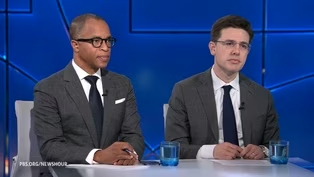
GEOFF BENNETT: From the White House press secretary's exit after just five days on the job to President Trump's renewed feud with Ukraine's president, we turn tonight to the analysis of Capehart and Continetti.
That's Jonathan Capehart of MS NOW and Matthew Continetti, a Wall Street Journal, opinion columnist and scholar at the American Enterprise Institute.
David Brooks is away this evening.
Good evening, gentlemen.
JONATHAN CAPEHART: Hey, Geoff.
MATTHEW CONTINETTI: Good evening.
GEOFF BENNETT: So President Trump's press secretary, former press secretary, Katie Zacharia, is out after five days on the job.
That's, what, roughly half a Scaramucci.
The president was said to be embarrassed by coverage of the briefing that she held earlier this week, and he spoke to aides and allies, and there was no one willing to defend her.
Jonathan, given the fact that the White House press secretary is the most visible role, among the most visible roles in any administration, what do you make of the way this all came together and then unceremoniously fell apart?
JONATHAN CAPEHART: Well, the person at the center of all of this, besides Ms.
Zacharia, is the president.
He's the one who gave her the job.
He's the one, because of the bad press, told her maybe she should think about do doing other things.
This is a job that should have never been offered to her.
This is a job she never should have accepted.
The thought I have is, the White House press secretary is one of the most prestigious jobs there is in the administration, particularly the number of former journalists who've held that role.
And she doesn't even come close to rising to that level, one, just to be in the job, and then performing the job.
Look, it is not an easy job.
We have seen new press secretaries come in.
They're raw.
They're rough.
They're nervous, understandably, but, over time, you see them getting better.
And watching her in real time, it -- I felt for her, because there was just -- she was thrown in the deep end without very much help, and then didn't help herself when questions started coming up about her credentials.
GEOFF BENNETT: What does this say about the president's priorities and the White House's vetting process how this all came together?
MATTHEW CONTINETTI: Well, I don't think there was a vetting process, and that was part of the problem.
But I think, when you step back, you see that the White House is beginning to show signs of second-term-itis.
And when you have the talented folks, they start leaving.
Karoline Leavitt left big shoes to fill.
And so you're searching for replacements.
You're not always getting exactly what you want, or they're not meeting the marks that you would like them to meet.
And so we have had a flurry of stories in the past week about potential infighting in the White House, attacks against the chief of staff.
President Trump has to defend Chief of Staff Susie Wiles today on his way to his latest trip, press secretary mess, political consultants' infighting.
This is only going to get worse as we approach the end of Donald Trump's term.
JONATHAN CAPEHART: But could we just say, in any other administration, there would be incredible heat right now on the White House chief of staff?
There's no way a functioning White House with a powerful functioning chief of staff would ever have allowed Ms.
Zacharia to even be -- to have a meeting with the president about this job.
GEOFF BENNETT: Well, let's shift our focus to something a bit more consequential, and that is this apparent rupture between President Trump and President Zelenskyy.
President Trump says he finds Ukraine's President Zelenskyy more difficult to deal with than Vladimir Putin.
At the same time, his administration is pressing -- pressuring Ukraine to stop attacking Russian oil facilities, even as Russia continues striking Ukrainian cities.
What explains the president's apparent willingness to exert more pressure on the country being invaded than the country that invaded it?
MATTHEW CONTINETTI: Well, I think President Trump has always wanted to find some type of peace in Ukraine and between Ukraine and Russia.
And now he has the added challenge of wanting lower diesel prices, in particular lower fuel overall.
But President Trump has also always thought that Ukraine is the obstacle to peace in the Ukraine-Russia war, when, in fact, it's the opposite.
Right now, I have -- he has all the tools granted to him by Congress in the Lindsey Graham Sanctions Act to actually apply the pressure where it is needed.
And that's the pressure on Vladimir Putin, who is responding to setbacks on the ground by escalating his proxy war against NATO and also escalating his attacks on civilians in Ukraine.
GEOFF BENNETT: What about that, the president effectively subordinating Ukraine's security to his own domestic political needs, which is to bring down rising energy prices?
JONATHAN CAPEHART: Well, try to.
The diesel deal, which I can't believe was only a week ago that it was announced just before we came on, is about, to his mind, lowering prices here.
But it's not going to happen.
It's not going to happen in the short term that he needs it to happen.
This is just one more piece in an ongoing effort by the United States and by President Trump to make Volodymyr Zelenskyy, make him knuckle under to the pressures and the whims and the desires of Vladimir Putin.
I mean, Matthew, you call it, some -- the president wants to bring about some type of peace.
I call -- it's capitulation.
Every time the two of them seem to talk, it is always about, Ukraine, you must do this.
You must give up your territory.
You must accede to the wishes of the country that invaded you.
And thank God for President Zelenskyy and being able to do so much with so little help from the United States.
MATTHEW CONTINETTI: I would just say, what strikes me about the diesel deal and the calls for Zelenskyy to step down was how out of the blue they were.
And so we were in a position, I think, where the Trump administration had the right policy with Ukraine.
And as recently as the UNGA in September, President Trump had a pretty good meeting with Zelenskyy.
What intervened?
A phone call with Vladimir Putin.
And the phone call was supposed to be about this lab leak.
Instead, we got this string of anti-Zelenskyy pronouncements.
That's what needs to change, and the pressure needs to be -- go back where it belongs, on Putin.
GEOFF BENNETT: In the time that remains, I want to talk about what is the intersection of money and influence at the White House and this new reporting about who's paying for the president's ballroom.
The Washington Post obtained records identifying major donors to President Trump's $330 million White House ballroom project.
You have got individuals and companies that have benefited from government contracts, regulatory decisions, even a presidential pardon.
What concern, Jonathan, does this raise about the intersection of private money and public power?
JONATHAN CAPEHART: I mean, this -- there is a poll.
I cannot remember where it's from.
It's brand-new, showing that corruption, concerns about corruption is the number one issue for those surveyed.
It's like up in the upper 80s, 80 percent.
This, the ballroom in this story, is a perfect crystallization of that, folks who are regulated by the federal government giving money to a ballroom, to a president who initially told everybody, this isn't going to cost anyone anything, I'm going to -- I am going to pay for it, I am going to put money into it.
And as we now know, not a single dollar is coming out of Donald Trump's pocket or his family's pocket for this ballroom.
And so what I wonder is, where -- this is a rhetorical question.
Where is Congress?
This should not be happening without any kind of congressional oversight, and certainly no private funding should be happening on public land, and particularly at the White House, in a spot where the president demolished the East Wing to put this up.
GEOFF BENNETT: And there will be those who say presidents have always relied on wealthy donors and have cultivated relationships with corporate America.
What, if anything, is different about this arrangement?
MATTHEW CONTINETTI: Well, private money was used to build the bowling alley at the White House.
It was used to build the pool in the White House.
And, in a way, the president is stuck in a crossfire here, because, as Jonathan said, he said he and his private donors would pay for the ballroom because Congress wasn't going to appropriate the funds.
Well, now he's being attacked for paying it with private funds.
The end result would be, what, just a hole in the ground?
At some point, the ballroom is going to be completed.
And then I think, to Jonathan's point, the next Congress is going to start taking a look at how not only this deal was financed, but also the broader questions about corruption that surround this administration.
GEOFF BENNETT: Right.
There are questions about transparency.
The Washington Post had to get these secret documents to identify the major donors.
Why shouldn't the White House be required to disclose those donors?
JONATHAN CAPEHART: Yes, that's an excellent question, Geoff.
Yes, they should be required, especially because this is something involving the people's house, involving the White House, something that is a pet project of the president.
And the other thing that I forgot to mention is, right, yes, private entities have always given money and helped support.
But the question, particularly with this White House, what are they getting in return?
GEOFF BENNETT: Jonathan Capehart, Matthew Continetti.
MATTHEW CONTINETTI: A big, beautiful ballroom they're getting in return.
GEOFF BENNETT: It's certainly big.
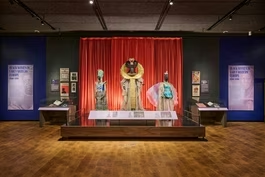
The Folger Shakespeare Library's newest exhibit maps an unlikely historical connection between Black women and the works of William Shakespeare over a period of more than 450 years.
Nearly 100 objects document the stories of renowned scholars, popular actors, and little-known historic figures.
I sat down with exhibit curator and the director of the Folger Institute, Patricia Akhimie, who spoke about the exhibit, which opens today.
It's part of our arts and culture series, Canvas.
Patricia Akhimie, welcome to the "News Hour."
PATRICIA AKHIMIE, Director, Folger Institute: Thank you.
GEOFF BENNETT: I have to confess this was not a connection I'd ever really considered, Black women and Shakespeare.
Shakespeare wrote so specifically about his time and place 400 years ago.
And you have traced this extraordinary line between his work and Black women across centuries.
How did those two become intertwined?
PATRICIA AKHIMIE: This is a story I have been really following in my own research for many years, but it's not a story that we have had the chance to kind of share with the general public.
It really begins in the time when Shakespeare is living and writing.
There's a sort of longstanding myth that Shakespeare's world was not a diverse world.
It's just not true that it wasn't.
And so one of the things we do in the exhibition is start by telling the stories of Black women who lived and worked in London at the same time that Shakespeare was living and writing there, and often in the same neighborhood, the same streets that he was walking, so to bring to life a world that is much more diverse and one that kind of celebrates the presence and the contributions of Black women.
But that's just the starting place.
Then we go on to look at all of the ways that Black women, as artists, as creators, as theater professionals themselves have used Shakespeare to tell their own stories.
And, really, that's what Shakespeare can do for us as contemporary audiences, is give us a starting place to make the work our own, make new work, and tell our own tales.
GEOFF BENNETT: We often talk about how performers interpret Shakespeare, but this exhibition makes a different argument, that Black women have actually shaped the way that Shakespeare is understood, taught, and performed?
How so?
PATRICIA AKHIMIE: Absolutely.
There are a number of artists.
It's hard to pick a favorite, but there are a number of artists who have pulled from Shakespeare to do some extraordinary things.
Probably my favorite is Toni Morrison, who is a beloved author that many of us know very well.
But we might not all know that Toni Morrison also was an avid Shakespearian, a careful reader of Shakespeare.
And towards the end of her life, she gave herself the project of rewriting and recreating one of Shakespeare's most well-known plays, "Othello," in her play, "Desdemona."
And, in "Desdemona," which is an incredible piece of work, the entire play is seen from the eyes of the female characters, Desdemona, but also the unnamed Black woman who appears in Desdemona's memories within "Othello" becomes a speaking character in Toni Morrison's revision.
But in our exhibition, what you will get to see is Toni Morrison's handwritten notes on a yellow legal pad as she's mapping out the structure of what will become "Desdemona" and sharing with us her ideas about what the interior of this character who Shakespeare only gives a few lines, what it's going to be.
GEOFF BENNETT: You have committed your entire professional career to this work.
Is there a story or a woman that fundamentally changed your understanding of Shakespeare and all of this history?
PATRICIA AKHIMIE: Again, it's hard to choose, but I think I'd like to tell the story of Frances DeBerry, who -- so there are lots of women in the exhibit who are famous, well-known, Rosa Parks, Maya Angelou.
Frances DeBerry was a woman who I did not know.
She was -- she was a contestant on a quiz show in the 1950s, "The $64,000 Question."
And she wasn't a Shakespeare professor.
She wasn't a theater professional.
She was just a person who loved to read, self-taught, but who considered herself an expert on Shakespeare.
And she chose Shakespeare as her category of expertise when she was a contestant on the show.
When asked what she would do with the winnings if she were to win "$64,000 Question," she said, well, I would publish my book.
And, actually, she did go on to do that.
She won $16,000 on the show, and she published her book, which was called "All the World's a Stage," and it was a monograph about Shakespeare's comedies.
And, in 1958, when that book was published, the Folger Shakespeare Library purchased a copy, and we have had it in our collection ever since.
That is an incredible story that I didn't know and that I'm so glad to know now.
GEOFF BENNETT: When someone encounters this exhibition, what do you want them to understand differently, either about Shakespeare or Black women or history or some connection thereof?
PATRICIA AKHIMIE: I think one of the most important things that I hope folks will take away is that we are the archivists of the future, that the objects that we will be able to use to tell important stories in the future, we're the ones who decide which of those will be preserved and how.
And so it's not just the Mona Lisa hanging in a museum.
It's, what is in your possession?
What's in your family's -- attic of your family home?
What are the objects that tell the important stories, especially about people who are marginalized in our society?
What are the objects that tell those stories?
And how can you make sure that we will have those available for future generations to see and understand?
GEOFF BENNETT: The exhibition is "To Hear Her Speak: Black Women in Shakespeare" at the Folger Shakespeare Library.
Patricia Akhimie, great to speak with you.
PATRICIA AKHIMIE: Thank you so much.
GEOFF BENNETT: Be sure to tune into a special hour-long "Washington Week With The Atlantic" later tonight right here on PBS.
AMNA NAWAZ: Jeffrey Goldberg and his panel are in the battleground state of Texas for a look at that state's competitive Senate race.
EVAN SMITH, Managing Director For Events, "The Atlantic": Let me tell you what the most important thing that we haven't talked about yet that's going to decide this race is.
What will John Cornyn's voters do?
That is the one unanswered question that we have right now; 900,000 people voted for John Cornyn in the first round against Ken Paxton; 500,000 voted for John Cornyn in the run-off that he lost to Ken Paxton.
The difference between Beto O'Rourke and Ted Cruz in 2018 was 216,000 votes.
Are the Cornyn people going to put two clothespins on their nose in case one falls off and vote for Talarico?
Are they going to put merely one clothespin on their nose and vote for Paxton, or are they going to skip that race?
Will there be a significant undervote?
That math is the ball game, I'm telling you, on November 3.
AMNA NAWAZ: And that's coming up tonight at 8:00 p.m.
right here on PBS.
Check your local listings.
GEOFF BENNETT: And watch "Horizons" this weekend.
William Brangham and his guests discuss humanoid robots and consider their potential to become part of our everyday lives.
AMNA NAWAZ: And, on "Compass Points," Nick Schifrin and his panel assess what's known and unknown about the mysterious Havana Syndrome.
You can watch both "Horizons" and "Compass Points" on our YouTube channel, wherever you get your podcasts, or on your local PBS station.
And that is the "News Hour" for tonight.
I'm Amna Nawaz.
GEOFF BENNETT: And I'm Geoff Bennett.
For all of us here at the "News Hour," thanks for spending part of your evening with us.
Have a great weekend.
 New
NewCapehart and Continetti on the press secretary's quick exit
Video has Closed Captions
Capehart and Continetti on the White House press secretary's quick exit (9m 18s)
 New
NewExamining Trump's claims at his midterm rallies
Video has Closed Captions
Examining the controversial claims Trump is making at his midterm rallies (6m 48s)
 New
NewExhibition explores link between Black women and Shakespeare
Video has Closed Captions
Exhibition explores connection between Black women and the works of Shakespeare (6m 17s)
 New
NewHow Alaska became a battleground in the fight for the Senate
Video has Closed Captions
How Alaska became a key battleground in the fight for the Senate (5m 1s)
 New
NewKerry Kennedy remembers mother's life, advocacy in new book
Video has Closed Captions
Kerry Kennedy remembers her mother's life and advocacy in new book (8m 49s)
 New
NewNews Wrap: Zacharia out as White House press secretary
Video has Closed Captions
News Wrap: Zacharia out as White House press secretary after less than a week on the job (4m 57s)
 New
NewOregon shooter attacked special ed classroom, police say
Video has Closed Captions
Oregon school shooter attacked special education classroom, police say (4m 32s)
 New
NewWhat makes the Oregon school shooting different
Video has Closed Captions
What makes the Oregon school shooting different – and what can be learned (4m 58s)
Providing Support for PBS.org
Learn Moreabout PBS online sponsorship New Episode
- News and Public Affairs

Today's top journalists discuss Washington's current political events and public affairs.
 New Episode
- News and Public Affairs

FRONTLINE is investigative journalism that questions, explains and changes our world.

 New Episode
 New Episode
 New Episode


 New Episode
 New Episode

 New Episode
Support for PBS provided by:
Major corporate funding for the PBS News Hour is provided by BDO, BNSF, Consumer Cellular, American Cruise Lines, and Raymond James. Funding for the PBS NewsHour Weekend is provided by...