
Key U.S.-Russia nuclear arms reduction treaty expires
Clip: 2/4/2026 | 3m 11sVideo has Closed Captions
Expiration of U.S.-Russia nuclear weapons treaty sparks concerns of new arms race
For the first time in more than half a century, there are no limits on the world’s two largest atomic arsenals. The sole remaining nuclear arms treaty in the world, known as New START, is expiring between the U.S. and Russia, and arms control advocates fear a new arms race. Nick Schifrin reports.
Problems playing video? | Closed Captioning Feedback
Problems playing video? | Closed Captioning Feedback
Major corporate funding for the PBS News Hour is provided by BDO, BNSF, Consumer Cellular, American Cruise Lines, and Raymond James. Funding for the PBS NewsHour Weekend is provided by...
Support provided by:

Key U.S.-Russia nuclear arms reduction treaty expires
Clip: 2/4/2026 | 3m 11sVideo has Closed Captions
For the first time in more than half a century, there are no limits on the world’s two largest atomic arsenals. The sole remaining nuclear arms treaty in the world, known as New START, is expiring between the U.S. and Russia, and arms control advocates fear a new arms race. Nick Schifrin reports.
Problems playing video? | Closed Captioning Feedback
How to Watch PBS News Hour
PBS News Hour is available to stream on pbs.org and the free PBS App, available on iPhone, Apple TV, Android TV, Android smartphones, Amazon Fire TV, Amazon Fire Tablet, Roku, Samsung Smart TV, and Vizio.
Providing Support for PBS.org
Learn Moreabout PBS online sponsorshipGEOFF BENNETT: Welcome to the "News Hour."
For the first time in more than a half-century, there are no limits on the world's two largest atomic arsenals.
The sole remaining nuclear arms treaty in the world, known as New START, is expiring, and arms control advocates fear a new arms race.
Nick Schifrin starts our coverage.
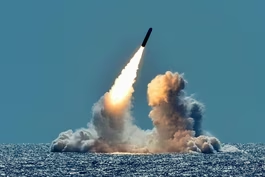
NICK SCHIFRIN: They're the world's deadliest weapons, able to obliterate entire cities and, when mounted on missiles, can fly thousands of miles in minutes.
And for the last 15 years, the deployment of Russia and American long-range nuclear weapons has been restricted.
BARACK OBAMA, Former President of the United States: Today is an important milestone for nuclear security and nonproliferation.
NICK SCHIFRIN: It was 2010 when President Barack Obama and then-Russian President Dmitry Medvedev signed the New Strategic Arms Reduction Treaty.
It limited the U.S.
and Russia to 700 deployed intercontinental ballistic missiles on land, at sea, and on heavy bombers, and it limited to 1,550 the number of deployed nuclear warheads.
It also included extensive verification measures, such as movement notifications, data exchanges, and on-site inspections, although the inspections stopped during COVID and never resumed.
JEN PSAKI, Former White House Press Secretary: That the New START Treaty is in the national security interests of the United States.
NICK SCHIFRIN: In 2021, U.S.
and Russia agreed to extend the treaty for another five years until today.
Last year, Russian President Vladimir Putin offered to extend it further into next year.
VLADIMIR PUTIN, Russian President (through translator): In the past, the New START Treaty worked.
It worked well, fulfilling its fundamental role as a constraint, curbing the arms race and controlling weapons.
NICK SCHIFRIN: But, today in Washington, Secretary of State Marco Rubio said New START was no longer fit for purpose.
MARCO RUBIO, U.S.
Secretary of State: In order to have true arms control in the 21st century, it's impossible to do something that doesn't include China because of their vast and rapidly growing stockpile.
NICK SCHIFRIN: For years, China's stockpile has been a fraction of the U.S.
and Russian stockpile, what Beijing has long labeled a minimum level required for national security.
But the Department of Defense says, by 2030, Beijing will have more than 1,000 warheads, including lower-yield tactical nuclear weapons.
But regardless of adversaries' arsenals, for decades, the U.S.'
nuclear deterrence works thanks to trust that the U.S.
will provide allies a nuclear umbrella.
But some allies are losing the faith.
LT.
COL.
JOHANNES KIBSGAARD, Norwegian Armed Forces: I think one of -- sort of one of the direct consequences of the recent diplomatic noise is that credibility that just isn't there right now.
NICK SCHIFRIN: Johannes Kibsgaard is a lieutenant colonel at the Norwegian Armed Forces command and a professor at the Staff College.
He says the U.S.
can no longer be trusted to use nuclear weapons to protect Europe and is urging a Nordic nuke, allowing the U.S.
to focus on China.
LT.
COL.
JOHANNES KIBSGAARD: It's crucial that America actually focuses on Southeast Asia, and that means that European allies need to finally step up and actually complete their defenses.

Alicia Graf Mack on leading the Alvin Ailey dance company
Video has Closed Captions
Clip: 2/4/2026 | 6m 58s | Alicia Graf Mack reflects on leading the legendary Alvin Ailey dance company (6m 58s)
Experts debate future of U.S.-Russia nuclear arms treaty
Video has Closed Captions
Clip: 2/4/2026 | 7m 29s | GOTTEMOELLER, MILLER DIS (7m 29s)

Former editor discusses The Washington Post’s mass layoffs
Video has Closed Captions
Clip: 2/4/2026 | 6m 53s | Sweeping layoffs at The Washington Post will do ‘enormous damage,’ former editor says (6m 53s)

News Wrap: Georgia election officials challenge FBI in court
Video has Closed Captions
Clip: 2/4/2026 | 6m 24s | News Wrap: Georgia election officials seek return of materials taken during FBI raid (6m 24s)

Researchers meet big setback to measuring ‘Doomsday Glacier’
Video has Closed Captions
Clip: 2/4/2026 | 5m 28s | Researchers face serious obstacles to measuring Antarctica’s fastest-melting glacier (5m 28s)

Stephen Miller’s influence on the Trump administration
Video has Closed Captions
Clip: 2/4/2026 | 8m 45s | Stephen Miller’s rise to prominence and influence on the Trump administration (8m 45s)

What to know about immigration agents’ surveillance tactics
Video has Closed Captions
Clip: 2/4/2026 | 7m 9s | Immigration agents’ surveillance tools and tactics raise questions about civil liberties (7m 9s)
Providing Support for PBS.org
Learn Moreabout PBS online sponsorship
- News and Public Affairs

FRONTLINE is investigative journalism that questions, explains and changes our world.

- News and Public Affairs

Amanpour and Company features conversations with leaders and decision makers.












Support for PBS provided by:
Major corporate funding for the PBS News Hour is provided by BDO, BNSF, Consumer Cellular, American Cruise Lines, and Raymond James. Funding for the PBS NewsHour Weekend is provided by...