Here and Now
Here & Now for May 8, 2026
Season 2400 Episode 2443 | 26m 47sVideo has Closed Captions
Watch the entire episode of Here & Now for May 8.
Watch the entire episode of Here & Now for May 8.
Problems playing video? | Closed Captioning Feedback
Problems playing video? | Closed Captioning Feedback
Here and Now is a local public television program presented by PBS Wisconsin
Here and Now
Here & Now for May 8, 2026
Season 2400 Episode 2443 | 26m 47sVideo has Closed Captions
Watch the entire episode of Here & Now for May 8.
Problems playing video? | Closed Captioning Feedback
How to Watch Here and Now
Here and Now is available to stream on pbs.org and the free PBS App, available on iPhone, Apple TV, Android TV, Android smartphones, Amazon Fire TV, Amazon Fire Tablet, Roku, Samsung Smart TV, LG TV, and Vizio.
Providing Support for PBS.org
Learn Moreabout PBS online sponsorship>> The following program is a PBS Wisconsin original production.
>> Beagles from the embattled Wisconsin dog breeder had out of state for medical care and adoption and missing and murdered indigenous people are remembered as the capital is wrapped in red.
[MUSIC] I'm Frederica Freyberg.
Tonight on "Here& Now".
Democratic U.S.
Senator Tammy Baldwin on Iran.
[MUSIC] The special prosecutor's deal on research beagles, a rally for missing and murdered indigenous people.
And we hear about the roots and future of Wisconsin's Black culture as envisioned in a new gathering spot.
It's "Here& Now" for May 8th.
>> Funding for Here and Now is provided by the Focus Fund for Journalism and Friends of PBS Wisconsin.
>> This week, there have been dizzying developments in the war with Iran.
Midweek, the U.S.
called the war concluded, moving instead to Project Freedom to open the Strait of Hormuz.
But President Trump quickly quit Project Freedom.
Now both sides are considering a peace plan in the midst of an uneasy cease fire.
How to make sense of this?
Even as the price of oil goes up and down with mixed messaging, while the price at the pump stays high.
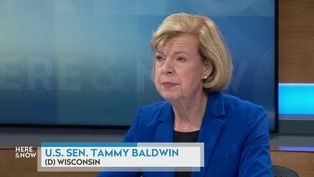
Democratic U.S.
Senator Tammy Baldwin is here.
And thanks very much for being here.
>> Thank you for having me.
>> So with all that's happening, what in your mind is the best outcome?
>> The best outcome would be for the war to come to a quick end and to use diplomacy to settle the issues.
I always have to remind folks that in 2015, there was an international agreement that would have prevented Iran from developing a nuclear weapon.
There were intrusive inspections, and Donald Trump, in his first term as president, ripped it up.
I think we may end up in this conflict with a deal that's less robust than the one that was agreed to in 2015.
Look, diplomacy is the answer.
And instead, Donald Trump has brought us into a war of choice.
And I emphasize that point because we were not under attack from Iran, we were not under imminent threat of attack.
And in those circumstances, the president needs to come to Congress to authorize use of military force.
He didn't.
So now we have 13 service members dead.
We have hundreds more injured, some very seriously.
And we see these price shocks with gasoline, with fertilizer for our farmers that are just getting ready to plant.
I've been a part of an effort with a number of colleagues to force votes on war powers resolutions, and we are gaining support over time from our Republican colleagues.
But that's what we need to do is bring this to a quick end and use diplomacy to achieve our goals.
>> Do you feel as though the administration is skirting the War Powers Resolution by declaring this war concluded, terminated over?
>> I heard just a week ago the Secretary of defense say, well, you can't toll the days that we've been in a cease fire.
Those don't count as part of the 60 days that the War Powers Act.
References.
But regardless, they are.
We are currently in hostilities.
We are clearly in a war, and it is an unmitigated disaster for the U.S.
and the global economy.
>> Because you were just describing the best case outcome.
What would be the worst?
>> The worst is that we end up far less secure.
And as an economy as well as as a nation, because of this war of choice, this illegal war of choice.
You know, and while it's not tangible, the damage it's doing to the rule of law in this country is worth noting.
>> What are your constituents saying about what it means for them here at home?
>> Well, I'm hearing mostly about the costs.
We have had the highest costs really ever, on average for gasoline at $4.50 on average across the state.
Farmers are really reaching out to describe the shortage of fertilizer as well as the high price.
If they can source it.
This will affect what they're able to plant this year.
And, you know, that's all on top of the president's previous trade wars that have cut off markets for our farmers and have really up the cost of inputs.
So I would say overwhelming opposition to the war, but mostly articulated by folks who are just feeling the squeeze.
And they were already feeling the lack of affordability prior to the war beginning.
This has just doubled down on that.
>> So we were just talking about agriculture and fertilizer and input inputs for farmers.
The U.S.
Senate is poised to take up the farm bill after the House passed the $390 billion version of it.
What are your priorities for the farm bill for Wisconsin?
>> Yeah, well, looking at the bill that was passed by the House, I realized that it doesn't really respond to the enormous headwinds our farmers are facing.
One of the things that makes the House passed Bill, really a nonstarter in the Senate is the refusal to restore the $186 billion that was cut out of the Snap program.
And that is something that brings folks together in terms of farm policy.
But the House passed.
Bill does not include my healthy H2O act, which helps folks in rural areas check their water for PFAs and other contaminants, things that they really can't afford to do without some help.
And also the Farmers First Act farmers, because of the stresses, financial and otherwise that they face, have high rates of suicide.
And so this is a mental health program that helps reduce that stress and helps make sure that there are support groups locally for them to turn to.
>> All right.
Senator Tammy Baldwin, thanks very much.
>> Thank you.
>> The Wisconsin Beagle Breeding and Research Facility that was infiltrated by animal activists has shined a spotlight on biomedical research conducted on animals, as well as the laws meant to protect animal welfare.
Following last week's announcement that 1500 beagles from Ridglan Farms were purchased by Big Dog Ranch Rescue.
The undertaking of where they will go next began in one group.
Around 60 dogs arrived at the Janesville airport, where the ones most in need of medical attention were loaded onto a plane and flown to a facility in new Jersey.
The rest went by ground to New York and Virginia.
The fate of these beagles is very different from the majority of animals used for research.
The current farm bill includes a measure prioritizing animals no longer needed for research to be given up for adoption instead of euthanized.
Euthanasia was one consideration for the special prosecutor assigned to investigate Ridglan Farms in 2025.
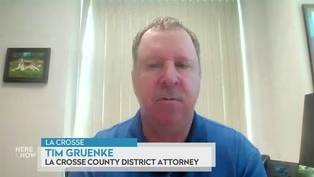
La Crosse County D.A.
Tim Gruenke found enough evidence to charge the facility with one felony over the mistreatment of animals.
In a report summarizing the case, he states, quote, Ridglan Farms made clear they would argue that because they conduct research and all of the dogs being bred would also be for research purposes.
The Wisconsin statutes do not apply to them.
Okay.
In the end, Ridglan Farms agreed to end its breeding for sale operations by July in exchange for the state not filing charges.
La Crosse County District Attorney Tim Gruenke joins us now.
And thanks very much for being here.
>> No problem.
>> So why did you seek this resolution with Ridglan Farms?
>> Well, the conclusion I came to was that I could charge one of the types of things that I was referred to by the judge in Dane County, and I was going to charge that.
But charging that would only have started a process that probably would have taken six months to a year to get to trial.
There were some issues that could have been appealed.
So charging it would have just been the start of a process of.
When the farm offered to close down in exchange of charging.
I thought that was a good outcome because even if I had charged and convicted them, I still had no authority to close them down and the fines that they had been charged with as well, they could have just paid and kept on running.
So I thought them ending the business is what most people wanted, and it's more than I could do by charging, and it would happen much quicker than me charging.
So I thought that was a good resolution to have them agree to end their business in exchange for not charging a crime.
>> So the resolution effectively closes down the operation, because I thought that under the deal, they'd still be able to maintain their own research on remaining animals.
>> Correct.
There's two parts to the business.
The part where they do their own research.
I was never part of.
I had no authority over them.
The judge didn't involve that in the appointment of my special prosecution.
The only control I had was on the breeding part, which is the part they agreed to shut down.
So they did anything after that, they'd be doing it without a license and could be prosecuted.
The federal law and the state law exempt research facilities and research on animals from the animal cruelty law.
So if they are doing research on dogs under the federal grant of authority under the USDA, the state statutes exempt that from prosecution.
So that's why I never had any authority over them and wouldn't in the future if they continued testing on animals.
>> You did find that you could support charging on one procedure conducted on these beagles.
Can you describe what that was?
>> It's called a Chiari I procedure.
It's basically an eye gland that is swollen or prolapsed that has to be removed.
If you were doing it with a pet, it would be an expensive procedure and you'd want to have a licensed veterinarian doing it.
They were doing it the way they'd been doing it in decades past, which is kind of outdated, which was removing the gland without general anesthesia and without having a licensed veterinarian do it.
Honestly, if they had found that it did not fall below the veterinary standards, I'm not sure I would have had a legal authority to go forward.
But basically, they were performing a surgery without proper veterinary methods required by the state of Wisconsin.
>> One thing that you talked about in your charging decision was the prospect of euthanasia of the beagles.
Why did you consider that?
>> Being familiar with a lot of farmers growing up and farmers in La Crosse area that I talked to, you know, and they have animals that are injured or need some help.
They have the right to euthanize them as long as it's done humanely.
And if you had a dairy farm or a pig farm where an animal had some injuries, if it costs more than the cost that animal is to you, most farmers would would put it down.
And so that was a factor in my charging decision that it's not a place that was breeding dogs for sale for pets.
It's a farm like a turkey farm or pig farm, or bringing them for food or for, in this case, testing.
So it's not looked at the same under the veterinary standards or under the law.
And so that just reality of the economics of farms that are doing business.
>> Did it pull on your heartstrings to pour over evidence in this case, especially as we know that you are a beagle owner and a fan of beagles, actually have a painting of one in your office.
>> It's heartbreaking to see them in cages and heartbreaking to see them, you know, not being socialized properly, not being able to run free and do what dogs do.
But the law allows for this behavior on a farm.
So as long as you're following the USDA regulations and the regulations, the fact that I don't like it or we don't like it doesn't mean that we could charge a crime.
So I was relying mostly on the state regulators, inspectors that are experts in this area and going by their advice on what they normally see on farms, dog breeders.
And that's why one of the reasons I came to the decision I came to about this behavior.
>> We leave it there.
Xia Tim Gruenke, thanks very much.
>> Thank you.
>> Indigenous advocates want the state to provide better tracking of victims and a special office inside the Capitol to address missing and murdered indigenous people, both on and off the reservations.
Here and now.
And I see t reporter Erica Ayisi traveled to Menominee Nation hearing one family's story of tragedy and why they were saying her name at this week's Missing and Murdered Indigenous Women's Rally in Madison.
>> She was so cool, down to earth, kind, loving.
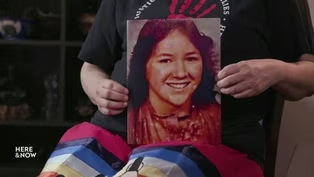
>> Rachel Fernandez is holding a picture of her late sister in law, Linda Amy Dickinson.
She was a day care worker who gave nicknames to her preschoolers.
and she loved the children.
>> Fernandez remembers her as a patient listener, committed to family.
>> She treated my kids like her own, you know?
And she just had that caring personality.
>> Dickinson and Fernandez, both of the Menominee Indian Tribe, spent time together as friends and family on the rural reservation north of green Bay.
>> She always had me cracking up.
She always had a joke.
She's very witty.
>> Dickinson eventually relocated from the reservation to green Bay with her new partner.
Fernandez says Dickinson's life with him was private, but the impact of their ten year relationship was public.
>> She would show up to work with with Black eyes.
>> Where did she say she got these Black eyes from?
>> From him.
From him.
And she would.
She wouldn't really talk about it.
>> According to Fernandez, when Dickinson didn't show up for work at the daycare on the morning of February 24th, 2014, her colleagues requested a police welfare check to her home, finding the unthinkable by the door.
>> She was shot through her left cheek in the corner.
Told them that she had died in seconds.
>> Her partner was found dead in the bedroom.
>> He shot himself.
So it was a murder suicide.
>> Leaving Dickinson's three children, Vanessa, Kenny and Warren, motherless.
>> It's tragic all around because he has kids, too.
>> Fernandez says news of the double tragedy spread quickly throughout the tight knit Menominee community.
reservation.
They're both tribal members.
>> She says many indigenous people follow a code of silence in violence and abuse stemming from historical trauma during the federal Indian boarding school era.
>> Because our children were taken from their homes and they were taught in these boarding schools not to talk about what happened to them.
>> Fernandez says she's also a victim of abuse and trafficking, but she's been able to work through her challenges and support other indigenous people through intergenerational suffering.
>> I'm okay to accept forgiveness of myself and so that really birthed the activist and the advocate in me.
>> This empty lot behind me is where Linda Amy Dickinson lived here in Neopit on the Menominee Reservation with her children before moving to green Bay.
She lived in a trailer that's gone now, but Fernandez says her memory is alive forever, and she will say her name.
At the Missing and murdered Indigenous Women's Rally at the Capitol in Madison.
>> Linda Amy Dickinson.
>> Fernandez, says the Wrap the Capitol Red rally is about breaking the code of silence within indigenous communities.
>> You know who was involved in someone being missing?
You know, why aren't you saying anything?
>> Relatives of victims of homicide shared their loved ones names.
>> I want to speak today on behalf of my cousin J.C.
Vijoo, who succumbed to domestic violence.
>> Bad River Ojibwe, Wisconsin.
Angeline Whitebird Sweet murdered February 1989.
Susan Poupart Lac du Flambeau murder, 1992.
Children unsolved.
>> Mentioning family members who never came home.
>> Charlene Couture Bad River missing 2009.
>> Including indigenous men.
>> Levon Frank Lac du Flambeau 1997.
>> Braxton Lee Phillips say his name.
>> And a plea for more justice.
>> My lawmakers here.
Are you listening?
>> Attorney general Josh Kaul says the missing and murdered.
Task force recommends a permanent office inside the Capitol and a report indicating tribal data tracking.
>> That, unfortunately, was not included in the last state budget.
But hopefully we'll see some progress on these ideas once the report is out.
>> He says the state is investing in violence prevention and collaborative efforts between tribal, state and federal law enforcement to effectively respond to incidents.
More than 100 advocates, survivors and families held hands to wrap the Capitol red.
>> No more stolen sisters.
No more stolen brothers.
No more violence.
>> In solidarity that their testimonies will be heard.
>> We demand justice for our relatives.
For those that cannot speak.
>> Reporting from Madison.
I'm Eric Ayisi for Here and Now and ICT.
>> In brighter news, thousands are celebrating the completion of a new space in Madison that honors and cultivates African American culture.
>> We're almost open.
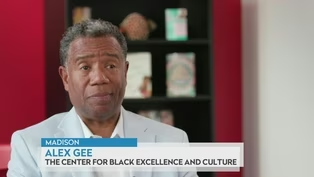
>> Surrounded by community leaders, the founder of the center for Black Excellence and Culture, Alex G. Proudly led the ribbon cutting, which marks the completion of the 3700 zero square foot space on Madison's south side, with a place for meetings, lectures and social events.
G says the center unapologetically celebrates Black history and people "Here& Now".
Reporter Murv Seymour talked to him about building the $31 million space.
>> Alex Gee, good to see you again.
>> It's good to see you too.
>> Murv by the time this airs, we know that little clock on your website will have been ticking, ticking, ticking.
And it will hit zero.
>> What has it been like and how long has that clock been ticking to make all this happen?
>> Oh man, this clock has been ticking my whole life in some ways.
Murv more specifically, probably the thinking about putting campaign team, we had to slow things down because of Covid.
So we started fundraising in 2021.
So it's been five years plus countdown in terms of, of seriously being able to see the finish line.
>> Yeah.
And I hate to do the old what does it feel like that that reporter a great question, but what does it feel like Alex, after all this?
>> Oh, it feels like a dream that's come true.
It's one of those things that's been in the back of my mind for probably most of my life.
It's why I chose to stay in Madison, because I had my sights on doing something in South Madison, where we grew up, where we spent time in a community that's given so much to me.
But to be here and to realize that I stand on the shoulders of so many people who rub my head and pinch, pinch my cheeks and said, you're going to do something, young man.
You know, keep going to school, you know, give back to the community, you know, keep your faith to stand on their shoulders and to realize that they saw something in me, and they encouraged me to stay here and make the community better if I could.
And so I feel really honored to be chosen to, to do this and pull our community together the way I've been able to.
>> Yeah.
And as I was looking at your website, I saw a line there.
It says, this is going to be a sanctuary for healing, a catalyst for growth, where we bring Black culture, creativity, leadership, research, innovation, all under the same roof.
That's right.
How the heck do we do that, Alex?
>> Oh, with lots of partners and lots of thought.
You know, when we talk about health and health disparities with African Americans, typically the the assumption is many of us don't have health care.
We don't take advantage of the health care that we want.
But research through schools of medicine and public policy are showing that many of our degenerative diseases are stress related.
And so I can pick up a magazine and read 15 different ways you and I die more readily than our white counterparts.
But what you don't read is how do you mitigate that?
So if stress is the culprit, what do we do to reduce it?
And so in our community, historically, it's dance is swag.
It's food, it's hanging out.
It's playing the dozens, it's intergenerational programing, it's checkers, it's watching TV, it's watching old 70s movies, but it's spending time together where we don't have to code, switch or feel that we have to be someone other than who we really are.
And so the role here is to use all of those things that you have said to reduce the stress.
But the benefit of this, my my great desire is that Black people live longer and healthier lives.
I haven't raised all this money.
So Black people can have fancy places to have dances.
>> And when you say all this money, people should know 31 million, probably.
>> 32, sir, 32 million.
>> I don't want to cut.
>> You short.
Who's counting.
>> Right?
You're right.
For a debt free facility for completely debt free facility.
paint a picture, Alex, of just like, what really is going to go on here?
I mean, yeah, we talked about, you know, the kind of a mission statement kind of thing there, but like, give paint a picture for us.
>> Sure.
Well, some of the like we're sitting right here in our senior space.
So this is one of the programs that's ready to go because so many of our seniors, once they've retired, they just seem to disappear.
We don't we don't see them anymore.
So we want them to come out and have a place to hang out right next door to our children's library, where they can help young, young readers.
We have a program that's for entrepreneurs, innovators, and and folks that are ready to start their own businesses.
We're going to work on leadership development, business strategy, development, helping to raise money to launch those businesses, and then helping to introduce people into our social network so that you don't have a business that's ready to go and no place to carry it out.
We have two films that will be showing real soon in our in our theater.
We're doing a couple of weddings here, graduation parties.
But the special thing that I want people to know, Murv, is that we're only designing about 25 to 30% of the of the programs here because we want the community to come in and say, you know what we need.
Like someone came in here the other day who's, who's newer to their job, and they said, we need an NABJ like National Association of Black Journalists.
There's one in Milwaukee.
I'm sure you're familiar with it, but because there's a space to host it, someone said we ought to do a Madison version.
That's the beauty of this space.
Like, that's not my job to do that.
A journalist came in here and said that others have come in and said, you know, we need a doula program.
Can we can we do that here?
We need self-defense programs for Black women and moms.
Do we have can we do that here?
So for me, the beauty the program is when we have space to come in together and say, let's create an association or let's do something to bring all the Greek organizations together, the sororities and fraternities together so that we can create a regional office of working together.
The beauty of this is I built it, I've worked to fund it, but the community is going to help to fill it.
>> Yeah.
And we thank you for that, Alex.
And there's a lot more to talk about.
So this will be continued.
And we appreciate your.
I appreciate appreciate you Thank you.
>> For more on this and other issues facing Wisconsin, visit our website at PBS wisconsin.org and then click on the news tab.
That's our program for tonight.
I'm Frederica Freyberg.
Have a good weekend.
>> Funding for "Here& Now" is provided by the Focus Fund for Journalism and friends of PBS Wisconsin.
 New
NewHere & Now opening for May 8, 2026
Video has Closed Captions
Clip: S2400 Ep2443 | 1m | The introduction to the May 8, 2026 episode of Here & Now. (1m)
 New
NewOne Menominee Nation Family's Story of Tragedy and Advocacy
Video has Closed Captions
Clip: S2400 Ep2443 | 6m 1s | Advocates and family gathered at a rally to honor missing and murdered Indigenous women. (6m 1s)
 New
NewTim Gruenke on Investigating Animal Welfare at Ridglan Farms
Video has Closed Captions
Clip: S2400 Ep2443 | 6m 51s | Tim Gruenke on an investigation of the Ridglan Farms dog breeding and research business. (6m 51s)
 New
NewUS Sen. Tammy Baldwin on the War and Ceasefires with Iran
Video has Closed Captions
Clip: S2400 Ep2443 | 9m 24s | Tammy Baldwin on negotiations on ceasefires amid hostilities in the Strait of Hormuz. (9m 24s)
 New
NewAlex Gee on Sustaining Madison's Black Community and Culture
Video has Closed Captions
Clip: S2400 Ep2443 | 6m 6s | Alex Gee on opening a facility to celebrate African American communities and culture. (6m 6s)
Providing Support for PBS.org
Learn Moreabout PBS online sponsorship
- News and Public Affairs

Top journalists deliver compelling original analysis of the hour's headlines.

- News and Public Affairs

Today's top journalists discuss Washington's current political events and public affairs.












Support for PBS provided by:
Here and Now is a local public television program presented by PBS Wisconsin