
Subpoenas over NYT report raise press freedom concerns
Clip: 7/15/2026 | 5m 57sVideo has Closed Captions
Subpoenas over New York Times report on Air Force One raise press freedom concerns
Several New York Times reporters were subpoenaed to appear before a federal grand jury after the paper published stories raising security concerns about the new Air Force One. White House correspondent Liz Landers discusses questions the case is raising about freedom of the press with Will Creeley.
Problems playing video? | Closed Captioning Feedback
Problems playing video? | Closed Captioning Feedback
Major corporate funding for the PBS News Hour is provided by BDO, BNSF, Consumer Cellular, American Cruise Lines, and Raymond James. Funding for the PBS NewsHour Weekend is provided by...
Subpoenas over NYT report raise press freedom concerns
Clip: 7/15/2026 | 5m 57sVideo has Closed Captions
Several New York Times reporters were subpoenaed to appear before a federal grand jury after the paper published stories raising security concerns about the new Air Force One. White House correspondent Liz Landers discusses questions the case is raising about freedom of the press with Will Creeley.
Problems playing video? | Closed Captioning Feedback
Where to Watch PBS News Hour
PBS News Hour is available to stream on pbs.org and the PBS app.
Providing Support for PBS.org
Learn Moreabout PBS online sponsorshipGEOFF BENNETT: Several New York Times reporters were subpoenaed to appear before a grand jury today after the paper published stories raising security concerns about the new Air Force One, a plane gifted to the Trump administration by the government of Qatar.
White House correspondent Liz Landers looks now at the questions the case raises about freedom of the press.
LIZ LANDERS: In some cases, the subpoenas were served by federal agents to New York Times reporters at their homes.
The paper denounced the actions and vowed to fight efforts to compel the reporters to identify confidential sources.
JOSEPH KAHN, Executive Editor, The New York Times: The Trump administration issued subpoenas to five of our journalists in what I think is a naked attempt to intimidate The New York Times and to keep us from reporting on matters that we think are essential to national security.
LIZ LANDERS: Joining us now to discuss this is Will Creeley.
He's the legal director for FIRE.org, the Foundation for Individual Rights and Expression.
Will, thank you for joining "News Hour."
WILL CREELEY, Legal Director, Foundation for Individual Rights and Expression: It's an honor.
Thank you for having me.
LIZ LANDERS: The Justice Department says here that they are targeting the leakers of the classified information in this case and not the journalists.
Acting Attorney General Todd Blanche was asked about these subpoenas today.
TODD BLANCHE, Acting U.S.
Attorney General: The Department of Justice requires that I authorize it, which I did.
And those reporters -- we're not targeting reporters.
They're material witnesses, just like a reporter would be a material witness to a car crash.
There are witnesses.
SEN.
PETER WELCH (D-VT): And the question you want to ask them is, who were their sources?
That goes to the heart of the First Amendment.
TODD BLANCHE: No.
No.
No, the question we want to ask them is, who provided them with classified national security information, which everybody in this body should want to protect.
LIZ LANDERS: What does the law say about what protections journalists have in this case?
WILL CREELEY: Well, the law has been clear for a long time that somebody else's illegal conduct does not remove speech about a matter of public concern, like the president's new jet, from First Amendment protection.
There's no federal shield law, but the heart of the First Amendment does indeed protect this kind of activity.
What we're seeing here should be a last resort.
Subpoenaing reporters is a shot across the bow, designed to get people to stop asking questions about subjects the administration would rather not talk about.
And it's chilling.
LIZ LANDERS: In this case, the subpoenas were issued to these five New York Times reporters and some were served at their homes.
Is that unusual?
And why do you think it was done in that way, in your opinion?
WILL CREELEY: It is unusual, and it's theatrical.
It's designed to send a very clear message.
Stop asking questions, sit down and shut up.
I'm awfully tired of federal law enforcement agents showing up on people's doorsteps about protected speech.
And, unfortunately, this is just the latest in a pattern.
This administration has evinced a real hostility to press that should concern Americans no matter their politics.
It's designed to get people to sit down and be quiet.
LIZ LANDERS: The New York Times has said that it will fight these subpoenas.
How do they do that and what could they argue in court?
WILL CREELEY: Well, 55 years ago, The New York Times found itself in the Supreme Court defending its publication of the Pentagon Papers.
And in deciding that the publication of those papers was protected by the First Amendment, despite the arguments then, like now, that national security dictated otherwise, Justice Hugo Black wrote, the First Amendment was designed by the founders to protect the governed, not the governors.
That's us.
And I hope the First Amendment should -- will protect The New York Times again here.
I imagine The New York Times will fight.
They have called it brazen, and so it is.
LIZ LANDERS: What happens if the reporters refused to testify?
WILL CREELEY: Well, I don't want to speculate, but we shall find out.
I imagine they could be held in contempt.
We will see.
We will be watching closely.
I think, again, every American who cares about a free press, who cares about knowing what's going on with our government should be tuning in.
This isn't an authoritarian dictatorship.
We're not China.
We're not a repressive society where you can't ask questions of our leaders.
We should want to know what's happening with the folks who make decisions that affect our lives, including the president of the United States.
LIZ LANDERS: You mentioned this, but this is not the first time that the Trump administration has tried to subpoena or question journalists about stories that are critical of the administration or the president.
Is this a pattern that you're seeing?
How would you describe this kind of behavior?
WILL CREELEY: Again, the president is in court and his administration is in court against The Washington Post, The New York Times, The Wall Street Journal.
Just last week, my colleagues were in Iowa state court defending a pollster, Ann Selzer, against charges filed by the president alleging that her poll constituted consumer fraud.
It's beyond the pale.
It is a direct attack on the First Amendment's protection of our free press.
In the 250th anniversary of our country, we should demand better.
LIZ LANDERS: How does this administration compare to previous administrations?
I mean, other presidents and other administrations have asked reporters to reveal their sources, but how does this moment compare to those?
WILL CREELEY: That's right.
Other presidents have done it, but this is not something we should get used to.
Just because other presidents have done it, and they have, of both parties isn't a grounds for justification.
We shouldn't normalize this behavior.
We should ask for the freest press we can demand.
That's what we deserve under the First Amendment.
That's what we are guaranteed, beyond deserve.
Again, I think that you have to look at this in the larger context of the president's attacks on the press.
Really almost from day one, attacking the press has been a trademark of his, and the result is a chill on speech.
LIZ LANDERS: Will Creeley, thank you for your expertise.
WILL CREELEY: Thank you so much for having me.
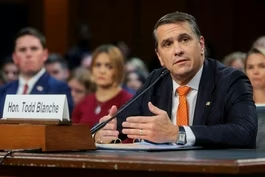
Blanche questioned on Jan. 6 cases and Epstein files
Video has Closed Captions
Senators question Blanche on Trump loyalty, Jan. 6 cases and Epstein files (5m 19s)

Daniel Umemezie on using his words to bridge worlds
Video has Closed Captions
National Youth Poet Laureate Daniel Umemezie on using his words to bridge worlds (6m 32s)
Lawmakers push to make daylight saving time permanent
Video has Closed Captions
What to know about the latest push to make daylight saving time permanent (5m 27s)
News Wrap: Trump ends pause on ICE traffic stops
Video has Closed Captions
News Wrap: Trump ends pause on ICE traffic stops (5m 57s)
Police cameras help solve crimes, but spark privacy debate
Video has Closed Captions
Police say Flock cameras help solve crimes, but critics call them an invasion of privacy (7m 13s)
Trump's DNI nominee refuses to say who won 2020 election
Video has Closed Captions
Trump's intelligence nominee refuses to say who won 2020 election (8m 9s)
Why fewer Americans are reading for pleasure
Video has Closed Captions
'Post-literate age': Why fewer Americans are reading for pleasure (7m 47s)
Providing Support for PBS.org
Learn Moreabout PBS online sponsorship New Episode
- News and Public Affairs

Today's top journalists discuss Washington's current political events and public affairs.

- News and Public Affairs

FRONTLINE is investigative journalism that questions, explains and changes our world.

 New Episode
 New Episode
 New Episode
 New Episode
 New Episode
 New Episode
 New Episode
 New Episode
Support for PBS provided by:
Major corporate funding for the PBS News Hour is provided by BDO, BNSF, Consumer Cellular, American Cruise Lines, and Raymond James. Funding for the PBS NewsHour Weekend is provided by...