
February 13, 2026 - PBS News Hour full episode
2/13/2026 | 57m 46sVideo has Closed Captions
February 13, 2026 - PBS News Hour full episode
February 13, 2026 - PBS News Hour full episode
Problems playing video? | Closed Captioning Feedback
Problems playing video? | Closed Captioning Feedback
Major corporate funding for the PBS News Hour is provided by BDO, BNSF, Consumer Cellular, American Cruise Lines, and Raymond James. Funding for the PBS NewsHour Weekend is provided by...
Support provided by:

February 13, 2026 - PBS News Hour full episode
2/13/2026 | 57m 46sVideo has Closed Captions
February 13, 2026 - PBS News Hour full episode
Problems playing video? | Closed Captioning Feedback
How to Watch PBS News Hour
PBS News Hour is available to stream on pbs.org and the free PBS App, available on iPhone, Apple TV, Android TV, Android smartphones, Amazon Fire TV, Amazon Fire Tablet, Roku, Samsung Smart TV, and Vizio.
Providing Support for PBS.org
Learn Moreabout PBS online sponsorshipWILLIAM BRANGHAM: Good evening.
I'm William Brangham.
Amna Nawaz and Geoff Bennett are away.
On the "News Hour" tonight: the shifting world order.
At a summit in Munich, with the U.S.
no longer seen as a dependable ally, European nations warn of the urgent need to protect themselves.
U.S.
citizens detained by immigration officers speak out about their treatment, as some lawmakers push to rein in the Department of Homeland Security.
ALIYA RAHMAN, U.S.
Citizen Detained By ICE: Nobody knew I was there.
I wasn't told where I was going.
I wasn't given a phone call.
And I'm going unconscious.
And I'm wondering, is this it?
WILLIAM BRANGHAM: And humanitarian conditions worsen in Sudan, where millions are fleeing the devastating civil war.
ANN CURRY, Journalist: There is a massive gap between the need, the desperation here, and the humanitarian funding cuts, especially from the United States.
(BREAK) WILLIAM BRANGHAM: Welcome to the "News Hour."
America's historic allies came together at one of the world's key diplomatic gatherings today to try and chart a new future.
The Munich Security Conference has long hosted frank debates.
And, this year, European leaders confronted a world in which some of them aren't sure whether the United States will continue to help guarantee their security.
But U.S.
officials portrayed their foreign policy as a necessary correction to years of mismanagement.
Nick Schifrin is in Munich for us tonight.
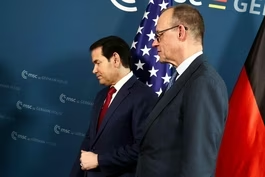
NICK SCHIFRIN: Today, in Munich, world leaders displayed all the stages of grief for their old relationship with the U.S., denial, anger, bargaining, and perhaps a little depression, but, in the end, acceptance and calls to action.
FRIEDRICH MERZ, German Chancellor (through translator): A true ally takes his obligation seriously.
No one forced us into the excessive dependence on the United States that we have found ourselves in recently.
This immaturity was our own fault.
But we are now leaving this situation behind us, and sooner, rather than later.
NICK SCHIFRIN: German Chancellor Friedrich Merz spoke for many here when he admitted that Europe had relied too much on the U.S.
And French President Emmanuel Macron also spoke for many when he called for Europe to step up.
EMMANUEL MACRON, French President: In this new geopolitical environment, Europe has to become a geopolitical power.
It's ongoing, but we have to accelerate and clearly to deliver all the components of a geopolitical power, in defense, in technology, and in the de-risking vis-a-vis all the big powers in order to be much more independent.
NICK SCHIFRIN: That de-risking language used to be reserved for China.
DONALD TRUMP, President of the United States: Well, I think Greenland's going to want us.
NICK SCHIFRIN: But it's now also used for the U.S., especially since President Trump's pressure on Greenland including today at the White House.
For decades, the U.S.
has promised Europe nuclear protection, but now doubts about the U.S.
guarantee... NARRATOR: This picture is impressive evidence of the bomb.
NICK SCHIFRIN: ... has led to talk of France, promising it would use its nuclear weapons to protect all of Europe, a step it has never taken.
FRIEDRICH MERZ (through translator): In Article 42 of the Treaty on the European Union, we commit ourselves to assist each other in the event of an armed attack in Europe.
I have begun initial discussions with French President Emmanuel Macron on European nuclear deterrence.
KAJA KALLAS, Foreign Affairs High Representative, European Commission: The international order between reform and destruction.
NICK SCHIFRIN: But this is not a new world order that's established.
It's being created and debated on stage today between U.S.
Ambassador to the U.N.
Mike Waltz and Europe's top diplomat, Kaja Kallas.
MICHAEL WALTZ, U.S.
Ambassador to the United Nations: I have to push back on the premise the world on the brink, which I think was the name of this panel.
We are returning the world from the brink.
And if we have to reform multilateralism that hasn't been reformed, frankly, in 80 years, then I think that should be welcomed.
KAJA KALLAS: If we reform, then we should actually take into account the world as it currently is, where all the states are equal and also that nobody is above the law.
That's why I'm talking about accountability.
It's true that those who have the power have had different rules.
But even in jungle, animals cooperate.
And so you are better off when you work with others.
NICK SCHIFRIN: To discuss all of this, I spoke with Alexander Stubb, the president of Finland.
President Stubb, thanks very much.
Good to see you.
The German chancellor, Friedrich Merz, opened this conference saying the current world order as we know it is over.
And the written report that was published ahead of this conference blamed President Trump for -- quote -- "taking the axe" to the system that has ensured European security for decades.
Do you agree with those statements?
ALEXANDER STUBB, President of Finland: No, I've just written a book saying that the world order is actually in transition.
So let's not throw the baby out with the bathwater.
World orders change.
After World War I, it lasted for two decades, after World War II, for four decades, and after the Cold War for three decades.
And now we're looking for something new.
And, for me, it's very important that the transatlantic partnership still stands in the middle of it.
NICK SCHIFRIN: There is enormous angst among some of the Europeans I speak to.
And I acknowledge it's divisions within Europe, but, still, enormous angst.
And I had a European foreign minister at this conference tell me that Europe cannot defend itself conventionally, lack of a trust in the United States or losing trust.
This minister is going to raise the idea of more European countries getting nuclear weapons beyond France and the United Kingdom.
Is that a conversation that's actually been happening?
Is that a good idea?
ALEXANDER STUBB: Well, first, I disagree with the minister in question.
I mean, the full Finnish defense composure, with 830 miles of border with Russia is based on our capability to defend ourselves.
NICK SCHIFRIN: Conventionally.
ALEXANDER STUBB: Conventionally.
The reason we have one million men and women who have been trained in Arctic conditions.
We have 62 F-18s.
We just bought 64 F-35s.
We have long-range missiles, air, land and sea, and we have the biggest artillery in Europe together with Poland.
So I don't want to hear anyone telling me that we can't defend ourselves.
Then, as far as nuclear weapons are concerned, I think we still need the U.S.
nuclear umbrella.
NATO is based on three deterrent pillars, and nuclear is one of them, of course, we have some nuclear weapons in the U.K., obviously in France, but the key umbrella comes from the United States.
NICK SCHIFRIN: Chancellor Merz said today that he was speaking to Emmanuel Macron of France the idea of France providing protection to Europe with its own nuclear weapons, something that France, a decision that France has not made yet.
Is that a sign, you think, that there is some doubt in the U.S.
nuclear umbrella?
ALEXANDER STUBB: No, I don't think there should be any doubt in that.
I think the whole nuclear posture of the world is changing, in the sense that previously had two big players, Russia and the U.S.
Now you have a third one, in other words, China with 600 nuclear warheads.
NICK SCHIFRIN: Going to 1,500.
ALEXANDER STUBB: Going to 1,500.
So this sort of changes the landscape.
And, of course, Europe has to look at its own protection, but, at the end of the day it is in the vested interest of the United States to give the nuclear umbrella to Europe and for Europe to accept that as well.
NICK SCHIFRIN: You have a close relationship, of course, with President Trump, as many have pointed out.
And some of your European counterparts, I think, have taken a lesson from the Greenland crisis and why President Trump chose to defuse that or take the off-ramp that was offered him by the secretary-general.
And that is that strength, the European strength pushing back against President Trump, rather than giving in, somehow was a better way to deal with President Trump.
Is that how you see it?
ALEXANDER STUBB: Well, I mean, always in diplomacy you can either de-escalate or then you can escalate to de-escalate.
I think that it's always best to do the de-escalation publicly and the escalation privately.
NICK SCHIFRIN: So is that how Greenland got solved?
Publicly, you reassured the president, but actually privately you said, hey, this is a little bit of threatening?
ALEXANDER STUBB: No.
No, no.
I mean, no, I think what we had were three scenarios, the good, bad and the ugly.
So the good was to de-escalate, find an off-ramp and focus on Arctic security.
A bad one was a trade war and increase of tariffs.
And the ugly one was the continued threat of a military threat.
So we sort of played two and three out, and now we're working on number one.
And I think these kinds of off-ramps and processes are important.
NICK SCHIFRIN: Let's talk about Russia a little bit, of course, as you mentioned, the longest border with Russia and NATO.
Russian forces are building up or have been building up military bases on the other side of Finland infrastructure as well.
What do you think Russia is after and how concerning have Russian moves been, in your opinion?
ALEXANDER STUBB: Well, again, we're not concerned.
And we also accept the fact that there have always been Russian troops or Soviet troops by our border.
And when the war ends, there will be more.
I actually think that Russia is losing this war.
I think starting the whole war with Ukraine was a strategic mistake of Putin.
He wanted to Russify Ukraine.
It's becoming European.
He wanted to prevent the enlargement of NATO.
He got Finland and Sweden.
And he wanted to keep European defense expenditure down, and we're going to 5 percent.
So I'm not excessively worried.
And I don't like this rhetoric that the Nordics are next or the Baltics are next.
No.
No, they're not.
I mean, Russia is not going to test Article 5.
NICK SCHIFRIN: But does that mean that Russia is not the long-term threat that... ALEXANDER STUBB: It is a long-term threat.
NICK SCHIFRIN: OK.
ALEXANDER STUBB: There's no question about that, because in its DNA is imperialism and expansion.
It's done that throughout its history.
And to, be honest, it hasn't been able to cope with its own history in an honest kind of way, Soviet era or otherwise.
I think what we need to do in the future is to make sure that those imperialistic threats don't move over to the Southern Caucasus or to Central Asia.
NICK SCHIFRIN: Do you think Putin, do you think Russia is serious in the conversations about ending the war?
ALEXANDER STUBB: I hope they are.
But some people are saying that Russia is not ending this war because they want to continue to acquire territory.
I don't believe in that at all.
I think Russia is not able to end this war because the social and political cost for Putin not being able to pay the soldiers when they go back is too high.
So that's why I'm skeptical about Putin's intention.
NICK SCHIFRIN: Finland President Alexander Stubb, thank you very much.
WILLIAM BRANGHAM: You can see an extended version of Nick's interview with President Stubb and other leaders at the Munich Security Conference on "Compass Points."
Find that on our YouTube page and on your local PBS station this weekend.
In the day's other headlines: New economic data out today showed inflation easing to start the year.
Prices rose just 2.4 percent last month compared to a year ago.
It is a welcome sign for consumers, even as prices remain stubbornly high.
As anyone who has gone grocery shopping or filled up their gas tank knows, inflation surged as the COVID pandemic took hold.
It peaked near 10 percent before a steady decline to where we are today, near a five-year low.
Speaking to troops today at Fort Bragg, President Trump celebrated today's data.
DONALD TRUMP, President of the United States: We just had fantastic reports on inflation, way down, cost of products, way down.
We inherited a mess, total mess, and now it's really coming along.
WILLIAM BRANGHAM: In fact, inflation still remains above the Federal Reserve's 2 percent target rate and consumers remain frustrated by high prices.
But economists say today's better-than-expected numbers are likely to boost the chances of rate cuts moving forward.
The Trump administration is suing Harvard University, saying it refused to provide admissions records that officials have demanded.
A lawsuit filed today alleges that Harvard -- quote -- "thwarted the Justice Department's efforts to investigate potential discrimination related to affirmative action at the school."
Harvard insists that it is in compliance with the law.
This is just the latest legal battle between the two, with Harvard saying today that it will -- quote -- "continue to defend itself against these retaliatory actions by the Trump administration."
In Minneapolis, federal authorities are investigating whether two ICE agents lied under oath about an incident in which one of them shot a Venezuelan immigrant in the leg.
ICE Acting Director Todd Lyons announced the joint probe with the Justice Department after video evidence revealed what Lyons called untruthful statements in their testimony.
The shooting in mid-January kicked off hours of tense protests in the city after agents initially claimed that they were assaulted by two men with a broom and a shovel.
The officers have been put on administrative leave.
It comes after a federal judge dropped all charges against the two immigrants involved.
Teachers in San Francisco reached a tentative deal with the school district to end their strike and get back to class.
Roughly 6,000 educators walked off the job earlier this week in the city's first such strike in nearly 50 years.
Some 50,000 students were affected.
Today's deal addresses teacher demands for higher wages and better benefits.
But the district superintendent warns that more belt tightening will be needed in the future.
MARIA SU, Superintendent, San Francisco Unified School District: We also want to be clear about our path to fiscal stability.
We stretched our resources to the limit to get this agreement done.
WILLIAM BRANGHAM: San Francisco School District faces 100 million dollar deficit.
Officials say after today's deal schools are set to reopen to staff on Friday and students will return next Wednesday.
There has been more fallout from the recent release of millions of documents related to Jeffrey Epstein, both here and overseas.
The top lawyer at Goldman Sachs, Kathy Ruemmler, says she will step down after e-mails showed her close relationship with the late sex offender.
Ruemmler also worked as White House counsel for President Obama.
She once described Epstein as -- quote -- "another older brother."
Former Israeli Prime Minister Ehud Barak says he regrets his yearslong relationship with Epstein.
And one of the world's largest logistics companies, DP World, replaced its chairman after e-mails linked him to Epstein.
None of those individuals are accused of any crimes.
The Bangladesh Nationalist Party has claimed victory in the country's first election since a student movement toppled the last government.
Party leader Tarique Rahman is set to be prime minister.
He's a member of one of the nation's political dynasties and has been living in exile for nearly 20 years.
The result comes after a student-led uprising forced the previous prime minister out of office back in 2024.
While final results have yet to be announced, the U.S., India and Pakistan have all congratulated the BNP on its victory.
On Wall Street today, stocks ended mixed following that January inflation data.
The Dow Jones industrial average posted a small gain of just under 50 points.
The Nasdaq lost ground, giving back 50 points of its own.
The S&P 500 closed mostly flat on the day.
And a new crew is on its way to the International Space Station.
They will replace the astronauts who returned to Earth a month early in NASA's first medical evacuation.
MAN: And liftoff.
Go, Falcon.
Go, Dragon, and Godspeed Crew-12.
WILLIAM BRANGHAM: Their SpaceX Falcon 9 rocket blasted off from Florida early this morning with four people on board.
The U.S., French and Russian astronauts are expected to arrive at the ISS tomorrow and stay until the fall.
Once the astronauts were safely in orbit, SpaceX launch control said of the launch date -- quote -- "It turns out Friday the 13th is a very lucky day."
And the first week of the Winter Olympics came to a close today with a shocking result.
And fair warning, we have some spoilers ahead.
Figure skating phenom and gold medal favorite Ilia Malinin fell twice in his free skate, knocking him all the way down to an eighth place finish.
In the women's hockey quarterfinals, Team USA were victorious against Italy in front of its hometown crowd.
And, in curling, the U.S.
women's team beat Canada for the first time ever at an Olympics with a dramatic 9-8 win.
Looking at the overall medal count, the U.S.
is now tied for third with 14 total.
Norway and host nation Italy have widened their lead with 18 apiece.
Still to come on the "News Hour": David Brooks and Jonathan Capehart give their analysis of President Trump's latest policy moves at home and abroad; the humanitarian crisis worsens in Sudan's civil war; a new book explores the often forgotten legacy of the missing Tuskegee Airmen.
Tonight at midnight, the Department of Homeland Security will begin to shut down, except for essential operations.
Democrats here in Washington are refusing to fund the agency unless it changes how it conducts its immigration crackdown.
Part of the outcry has been the agency's treatment of U.S.
citizens.
Our Lisa Desjardins has more on that.
LISA DESJARDINS: William, there was an uproar last month following the killings of Renee Good and Alex Pretti by immigration officers.
But videos from across the country have shown months of other violent interactions, including with U.S.
citizens.
We reached out and heard from three of them.
GEORGE RETES, U.S.
Citizen Detained By ICE: My name is George Retes.
I am -- I was born and raised here in Ventura, California, I'm 26 years old and I am an Iraq combat veteran.
ALIYA RAHMAN, U.S.
Citizen Detained By ICE: My name is Aliya Rahman.
I was born in Northern Wisconsin, grew up in Bangladesh.
I now live in Minneapolis.
GINA CHRIST, U.S.
Citizen Detained By CBP: My name is Gina Christ.
And I live in St.
Louis Park, Minnesota.
GEORGE RETES: I was going to work like normal.
I show up.
ICE is there.
There's kind of like a roadblock.
I get out.
I identify myself, that I'm a U.S.
citizen, that I'm just trying to get to work.
ALIYA RAHMAN: So I came upon a traffic jam that I pretty quickly realized was ICE.
GINA CHRIST: I was on my way to work, and I honestly thought I'm going to observe or I'm going to try to help slow something down.
GEORGE RETES: I'm trying to leave.
I'm getting ready to leave and they surround my car, start banging on it, start shouting these contradictory orders.
ALIYA RAHMAN: I was told: "Move.
I will break your effing window."
And I couldn't get a clear answer to where they wanted me to move to.
GINA CHRIST: There's people all around my car.
And so I have both hands up on either side of my face.
I have both hands up on either side of my face and I -- you cannot hear me.
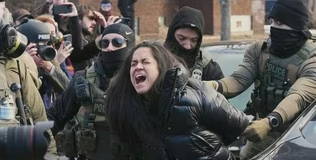
(SHOUTING) ALIYA RAHMAN: Very quickly, I was pulled out of that car.
I fell twice, once right outside the car that you can see, and once behind the car face down.
GINA CHRIST: An ICE agent breaks my driver's side window, glass, reaches in, opens my door, pulls me out of the door, tells me to get on the ground, zip-ties me, and now gas, flashbangs, pepper spray.
GEORGE RETES: Even though I was giving them no reason, they still felt the need to -- one agent knelt my back and another agent knelt on my neck.
And during that time, I'm just pleading with them that I couldn't breathe.
ALIYA RAHMAN: I am disabled.
I am autistic.
I have a brain injury.
And when I hit that ground face first, I just experienced shooting pain through my neck, through my head.
My vision became blurry.
GINA CHRIST: There was no need.
They detoured to grab me.
They could have continued to drive.
Their cars were past my car.
They passed my car, jumped out of their cars, apprehended me and kept going.
ALIYA RAHMAN: What happened to me in detention was far worse than what happened to me on camera.
What happened to me in detention was a complete stripping of my rights.
GINA CHRIST: Once I was kind of detained, it was very like, do you have water?
Are you comfortable?
How's the heat?
It was a very schizophrenic experience.
And I spent an enormous amount of time, most of my time in my head, trying to figure out what was really, really going on.
GEORGE RETES: I was an isolation.
I was in basically this concrete cell.
I was stripped naked in like a hospital gown.
And they leave the lights on 24/7.
ALIYA RAHMAN: Nobody knew I was there.
I wasn't told where I was going.
I wasn't given a phone call.
And I'm going unconscious and I'm wondering, is this it?
They call us bodies.
Is this it for me?
Am I going to die?
GEORGE RETES: They just came out and they said that I was violent and that I assaulted agents.
Why lie when it's on video of everything that happened?
Why lie?
GINA CHRIST: I mean, this is insane.
This isn't anything that could minutely be referred to as a couple of bad apples, which is what we heard for years and years and years.
ALIYA RAHMAN: I want to live in a country where people who are enforcing the law treat people humanely.
LISA DESJARDINS: In response to our request, DHS sent a statement about all three of these cases.
Here are some key quotes.
The agency insisted: "If a U.S.
citizen is arrested, it is because they have obstructed or assaulted law enforcement."
In many cases, even after arrest, charges are never filed.
They were not filed in these cases.
The agency said there can be myriad reasons for that, but it did not provide any of those reasons.
William, some of the statements they sent us is contrary to the evidence that we have seen.
For example, the agency referred to Aliya Rahman as an agitator.
We know she was on her way to work.
There's no other evidence about her.
DHS added that George Retes, in their opinion, the veteran, they said he refused to move his car.
The video shows him moving his car.
I raise this because, as Tom Homan says he's de-escalating in Minnesota, right now, DHS is digging in on blaming Americans without evidence.
WILLIAM BRANGHAM: Lisa, you were at two of those hearings on Capitol Hill this week where ICE and CBP officials were asked about some of these things.
How did they respond?
LISA DESJARDINS: Well, the leaders of ICE and Customs and Border Protection did say some things, like pepper spraying inside of a car or using a canister as a weapon are wrong unless there's no other defense for an officer.
But they didn't admit any specific mistakes and they didn't address any idea of systemic problems here.
Specifically relevant to our story, the ICE director, Acting Director Todd Lyons, was asked about the detention of and the treatment of American citizens.
TODD LYONS, Acting Director, U.S.
Immigration and Customs Enforcement: Under Title 8, no U.S.
citizen is subject to civil and racial enforcement and that just doesn't happen.
There are multiple safeguards in that way.
And if a U.S.
citizen is detained in the course of immigration investigation, they're quickly released.
We don't take action on American citizens.
LISA DESJARDINS: But the interviews we just said counter that.
That's just flatly not true.
We know that CBP has repeatedly act against American citizens.
And some of -- these are just a few of the stories.
There are more.
Aliya Rahman said her point is, if this is how U.S.
citizens like her were treated, what about people who are not citizens?
WILLIAM BRANGHAM: Right.
And another part of the issue here that people may not realize is that people who go to court with these cases, they don't have the same rights that we would expect?
Explain.
LISA DESJARDINS: This is because of federal law, a specific statute, in fact, about civil rights when they're violated.
Here, I want to take a look at this.
This is a section of code about who you can sue for civil rights violations.
It says: "Those acting under color of statute or ordinance," meaning law enforcement, "acting for the government."
But look at this.
It says "if that government is a state or territory."
So, William, it does not say the United States itself.
And because of this, courts have said there's a very narrow lane that you can use to sue officers of the United States.
This is not a hard fix.
It's something that people want to include in negotiations under way right now over DHS.
But talking to some experts, especially some experts from Cato, a man named Mike Fox, he told me he thinks that what Democrats are asking for actually may have less impact than changing this.
MIKE FOX, Cato Institute: If I tell you can't wear masks, but nothing happens when you do, what does that do?
That's why it's so fundamentally important that Congress add a component that allows you to sue for constitutional violations and then precludes the actors, the government agents, benefiting from immunity.
LISA DESJARDINS: Advocates are pushing for this to be part of the talks, but my reporting is, there's no evidence that it is.
WILLIAM BRANGHAM: All right, Lisa Desjardins, thank you so much.
LISA DESJARDINS: You're welcome.
WILLIAM BRANGHAM: The United Nations is accusing a paramilitary group in Sudan of committing widespread atrocities that amount to war crimes and possible crimes against humanity.
In a report out today, the U.N.
found more than 6,000 people were killed in the first three days of the Rapid Support Forces offensive in El Fasher, which is in Sudan's Northwestern Darfur region.
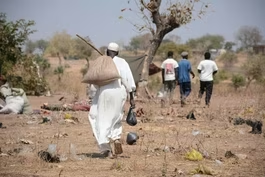
It's been nearly three years of relentless conflict in Sudan, and it has triggered the world's largest humanitarian crisis.
Amna Nawaz filed this report earlier.
AMNA NAWAZ: This week, hundreds of shelters at a displacement camp in the North Darfur region of Sudan were burned down, pushing an already traumatized people through more hardship.
What began as a power struggle between Sudan's military and the paramilitary Rapid Support Forces has now become one of the world's gravest humanitarian crises.
Nearly two-thirds of Sudan's population now need assistance, with hunger rising, health systems shattered, and families fleeing across borders.
Veteran journalist and humanitarian Ann Curry has made her way to South Sudan, is at a camp for displaced people, and joins me from there now.
So, Ann, you're there on the border with Sudan -- in South Sudan.
What more can you tell us about the impact this war has had in the state of that war today?
ANN CURRY, Journalist: Well, as you well know, "News Hour" has been reporting in fact that this catastrophic war in Sudan has caused the world's largest humanitarian crisis, and it has got unprecedented numbers of displacement, recently rising to 13.6 million people.
And many are fleeing to neighboring countries, and about a million have arrived here in South Sudan since the war started, about three years ago, Amna.
AMNA NAWAZ: With so many people displaced, I'm sure the stories that you're hearing are just heartbreaking.
Can you tell us more about where exactly you are and what you're seeing there?
ANN CURRY: I'm on the border of Renk in South Sudan.
It's in the northernmost part of South Sudan.
And this is where people, survivors have been arriving by bus and by car, by donkey cart and by foot.
And they're arriving hungry and thirsty and they're in need of -- desperate need of shelter.
But there is a massive gap now, as you well know, as you have been reporting, between the need, the desperation here and the humanitarian tearing funding cuts, especially from the United States.
And this has caused a lot of extra suffering here.
I can tell you I'm walking into a transit center which was set up by UNHCR, which is the United Nations Refugee Agency.
And this center was built to house 3,000 people.
And it -- they were supposed to be here just for a few days.
And they're given blankets and they're given tents and they're given best basic necessities.
But, in fact, there are 9,000 people here, Amna.
And what you're going to see here is not just these buildings, which are the shelters.
But you're going to see that there are so many people that there are makeshift tents here.
People are sleeping outside in the elements.
Children are among them.
You can see they have used fabric to figure out a place to stay.
UNHCR is heartbroken about this, as are all humanitarians in the area, because not only are these people who have fled war and persecution and seen violence and experienced trauma in great need.
They are really hoping for the world's compassion, Amna.
AMNA NAWAZ: And, Ann, have you been able to speak to any of the people or any of the families who've arrived there?
Have they shared with you what they went through just to get to this camp?
ANN CURRY: That's right.
Some -- one actually said that she had traveled for years.
What has been happening is, they are experiencing -- in many cases, they tell me about being struck with aerial bombs, being in areas that are being bombed from the sky, running with their children, not always able to grab all of their children.
There was a woman we spoke to who carried her mother, her elderly mother, on her back because she was aging and ran with four kids and keeping them all in line to leave as the bombs were falling.
And she said that her mom eventually died.
And so that's the story we're hearing.
People did not want to leave Sudan.
What they wanted is to find a safe place, and then they couldn't find a safe place.
And so they ended up having to cross the border and come here.
AMNA NAWAZ: As you have mentioned, the impact of the funding cuts, their not being enough support.
What does the future hold for these families?
And is there any hope for more international intervention?
ANN CURRY: Well, there are movements, but there isn't any clear sense that the funding will come.
I think that there is a real wish that the world will know that people here exist and will care about their suffering, even in this time when we are distracted by so much else in the world, that we will know that these people matter.
We have also been able to document, in speaking to these survivors, that some have described not only seeing with their own eyes people being killed on the streets and running, but one told us today she witnessed sexual violence upon women and was herself a victim and that they're -- and this was in an attack.
So I think the atrocities, when the full story is told about what is exactly happening in Sudan -- and we should probably also mention that there is a tremendous famine occurring in several parts of the country that has reached acute levels, and that in some areas more than 50 percent of the children are at such acute levels that there is fear that they could succumb.
So hope is hard to find.
But the ultimate hope is in us, is in the people in the outside world and whether we have the capacity, the compassion still within us to care for people who are suffering the most in the world, or at least, one should say, in the largest humanitarian disaster in the world.
And AMNA NAWAZ: Ann, we're so grateful to you for helping to make sure that we can all bear witness along with you.
That is Ann Curry reporting from the South Sudanese border.
Ann, thank you.
ANN CURRY: Thanks, Amna.
WILLIAM BRANGHAM: The Trump administration pulls ICE back from Minnesota, European leaders reckon with a new world order, and parts of the U.S.
government are about to shut down again.
It is time for the analysis of Brooks and Capehart.
That's "The Atlantic"'s David Brooks and Jonathan Capehart of MS NOW.
Good evening, gentlemen.
Nice to see you on Valentine's Day eve.
JONATHAN CAPEHART: William, good to see you.
DAVID BROOKS: I can feel the romance.
(LAUGHTER) WILLIAM BRANGHAM: Well, this is going to turn out quite differently.
(LAUGHTER) WILLIAM BRANGHAM: President Trump put - - I'm talking about Minnesota -- put his border czar in charge of what was going on there.
And Tom Homan said, OK, we're going to now start to pull this back.
David, what do you make of this development?
DAVID BROOKS: Well, when Tom Homan is the reasonable and cuddly one, then you know we have come a long way.
(LAUGHTER) DAVID BROOKS: And I think it's partly because of the awfulness of those videos and the killings.
But it's partly because of citizen power.
We have been talking a lot over the months about a civic movement.
And the people of Minneapolis in bitter cold weather behaved in a self-disciplined, humane way that appealed to people across the political spectrum and in a disciplined way.
And they turned up the heat and they put the regime in an impossible situation.
Either behave brutally and generate more hostility or lose control of the streets.
And that's what a civic movement needs to do, put the pressure on the government and expose the moral distance between one side and the other.
And I was with a historian yesterday.
And she said, learn from the civil rights movement.
Everybody should be studying the civil rights movement.
That's what they did.
And it worked in this case in Minneapolis, and even the Trump administration had to back down.
WILLIAM BRANGHAM: Do you see it that way too, that this is power of the people?
JONATHAN CAPEHART: Absolutely.
And I saw it from the beginning.
Remember, I went to college in Minnesota.
And so Minnesota holds a special place in my heart.
And I was just there.
I wasn't on the show last weekend because I was at Carleton Board of Trustees meeting.
And what you were talking about in Minneapolis wasn't just in Minneapolis.
It was throughout.
In Northfield, Minnesota, they were dealing with ICE.
And they were dealing with ICE in a very quiet way, not the whistles and the horns, but text chains, people who were observing, taking license plates, letting people know.
I went to do something on Friday and the person who picked me up said -- apologized for the vehicle and then said to me, I was -- quote - - "underground railroading food all night."
WILLIAM BRANGHAM: Wow.
JONATHAN CAPEHART: And so to David's point... WILLIAM BRANGHAM: These are for people who feel that they can't go to the grocery store because they're scared of what... JONATHAN CAPEHART: Could not... (CROSSTALK) JONATHAN CAPEHART: They had not left home.
We're talking about people who had not left home in more than a month.
And so what you had in Minneapolis, what you had in Northfield, Minnesota, what you have throughout Minnesota are people coming to the aid of their neighbors and their loved ones, standing up for their communities in the face of incredible, I don't know any other word to use, but oppression from the federal government, targeting, targeting their communities.
WILLIAM BRANGHAM: We have still seen, though, this is now the third instance where ICE agents have shot people, one, this Venezuelan immigrant, plus the killings of Renee Good and Alex Pretti, where the federal government says one thing happened, and the video or testimonial evidence completely contradicts their story.
And yet they stick to that story over and over again.
And there's just an Orwellian quality to what is going on here.
They will not budge.
DAVID BROOKS: This has been a revelation since the first Trump term, that so much of government is governed by norms.
There's no rule.
But you assume, when you see a video like that, there's going to be an investigation and heads will roll.
And if you have an administration that's completely shameless, then heads -- there's going to be no real investigation and heads will not roll.
And even Kristi Noem, the head of the Department of Homeland Security, I mean, she -- you would think she'd be in trouble.
WILLIAM BRANGHAM: Right.
DAVID BROOKS: And she's in desperate trouble in her agency.
WILLIAM BRANGHAM: For calling Alex Pretti a domestic terror.
DAVID BROOKS: There was a fantastic Wall Street Journal piece this week.
She's firing a pilot because he forgot to bring her blanket off the airplane.
But the key thing in that story was, people were leaking from all across the agency.
They're offended by how she does her job.
And yet Trump again has endorsed her.
WILLIAM BRANGHAM: As I mentioned, tonight at midnight, we will start to see part of the government shut down because the Democrats are putting their foot down and saying, we need reforms to these agencies, and some of the Republicans are saying, you're asking for too much.
Do you think this is the fight worth having, that the Democrats are doing the right thing?
JONATHAN CAPEHART: Yes, and just give you two reasons, Renee Good, Alex Pretti, two American citizens who were killed by federal officers attached to that agency.
And let's also keep in mind that the government most likely will go into a partial shutdown at 12:01 because everyone's gone out of town anyway.
But keep in mind, ICE is fully funded for at least the next five to six years.
So we're talking about other agencies, TSA and others that will be hit by this shutdown.
The Democrats are right to demand not just reform, but some kind of accountability for what happened on the streets of Minneapolis and what could happen on the streets of other cities.
Let's not breathe too much of a sigh of relief for what's happening in Minnesota.
Great for the people of Minnesota and Minneapolis.
But in talking to the folks there, they're also concerned about, where will this be exported next?
And I think that's what Democrats are also thinking.
This -- folks should not view this as a partisan issue.
Folks should view this as holding the government accountable for what it is doing in the name of the American people to the American people.
DAVID BROOKS: Can I disagree?
WILLIAM BRANGHAM: Please.
JONATHAN CAPEHART: Oh.
(LAUGHTER) WILLIAM BRANGHAM: Just because it's Valentine's Day.
DAVID BROOKS: Thank you.
JONATHAN CAPEHART: Right.
DAVID BROOKS: I will disagree emotionally.
We have a democracy.
And when you have a disagreement and when something outrageous happens, you go to the voters.
And I think that's what the Democrats should do.
Look at what the Republicans are doing.
Go to the voters.
When you have a policy disagreement in between elections, you don't shut down the government.
We haven't done that in the last -- until Newt Gingrich walked into town, and he set a precedent, and now we're spiraling.
And so when you shut down the government, A, it hurts the government.
B, it hurts public faith in the government.
It makes us look ineffective.
And as Jonathan said, we're not taking this out on ICE.
It's the people at TSA who aren't going to get a check.
So I believe that if you weaken the institutions of democracy by shutting the government every time there's a policy of disagreement -- and, by the way, the Republicans are going to do this even more often in the future -- it's just terrible for our democracy.
WILLIAM BRANGHAM: I want to quickly pivot to what's happening overseas.
We have been seeing some of Nick's tremendous reporting from the Munich Security Conference, where European leaders are grappling with this idea that America is not what America was.
And, Jonathan, when you look at this, how they are reckoning with it and how Trump and his administration is pressing their case to the Europeans, how do you see that playing out?
JONATHAN CAPEHART: Well, I think the Europeans are right to look at the United States and think, you know what, we should probably not depend on them as much.
We should come up with contingency plans, because the United States is no longer a trusted friend, trusted ally.
In many instances -- take, for instance, Greenland - - it's become an adversary.
And their wariness is not new.
Four years ago, Vice President Harris went to the Munich Security Conference, gave a speech, and the first question to her from the president of the Munich Security Conference was, President Biden said America is back, but, Madam Vice President, the question is, for how long?
And now the Europeans have seen the answer to that question.
So they're absolutely right to be skittish, weary, whatever synonym Mr.
Thesaurus will throw out there.
WILLIAM BRANGHAM: But, David, we have seen some instances where European leaders have acknowledged that some of the things that Trump has pressed them to do, like to not rely on the United States as much, they are saying, some of them overtly, Trump is right.
We do need to shore our own defenses up.
DAVID BROOKS: There's always a kernel of truth in every attack Trump makes until he overreacts and destroys.
And I have said, you go to Trump -- Trump is like - - governs like, you go to the doctor saying, I have acne, and he says, OK, we will decapitate you.
That will solve your acne.
(LAUGHTER) DAVID BROOKS: And that's what he does.
He overreacts and destroys.
And the difference is, somebody made -- I think it was the German leader this week said, we have shared interests still, but we don't have shared values.
And I think that's the right distinction to make, because Trump fundamentally sees the world, not as the Western alliance, which has been built since 1945.
He sees the world as regional hegemons.
And that's just not how Europe sees the world.
And so Trump sees Russia over here, their hegemon, China's over there, their hegemon, we're a hegemon here in the Americas, and we get to rule our neighborhood.
And the problem with that is that you're asking for an invitation for bloodshed over and over and again.
And I mentioned this on the "News Hour" about a month ago.
If you go back to 2,000, there were about 15,000 people dying in a war all around the world.
Since 2013, it's been over 100,000 a year.
That's death.
That's death and violence caused by the destabilization of the American-led international order.
And for people who don't like that international order, wait until it goes away.
WILLIAM BRANGHAM: I mean, I hear you.
No one is here celebrating the idea that there's additional death.
Do you think, though, Jonathan, that there is any utility in Trump driving a wedge here that is help shoring up an alliance, maybe in the long run, that, when Trump is no longer here, that this will - - might clarify our alliance with our allies?
JONATHAN CAPEHART: I don't -- no, I don't see it that way, in the way you pose it, because the way the Europeans are looking at the United States, it's this international order that's been eight decades running with the Western alliance, but the United States is the foundation of it.
And so, without the United States being there as a trusted ally, then what does it mean?
What does it stand for?
And, great, they will spend more money on their defense, they will do all sorts of other things.
But, to David's point, if we're not sharing the same values, if Europe looks at us, the United States, and says, they're not like us, and so we need to just leave them out.
In fact, hey, China, let's talk to you about more deals, more collaboration.
WILLIAM BRANGHAM: We already see some of that happening.
JONATHAN CAPEHART: Yes.
WILLIAM BRANGHAM: Jonathan Capehart, David Brooks, so nice to see you both.
Thank you.
JONATHAN CAPEHART: Thanks, William.
DAVID BROOKS: Good to see you.
WILLIAM BRANGHAM: Often overlooked in the history of World War II are the 27 Tuskegee Airmen who disappeared in combat over Europe.
Geoff Bennett recently sat down with Cheryl W. Thompson.
Her father was also an airman, and she chronicles the lives of those missing men and the racism they endured while serving their country in her new book, "Forgotten Souls: The Search for the Lost Tuskegee Airmen."
GEOFF BENNETT: Cheryl Thompson, welcome to the "News Hour."
CHERYL W. THOMPSON, Author, "Forgotten Souls: The Search for the Lost Tuskegee Airmen": Thank you for having me.
GEOFF BENNETT: This book centers on 27 Tuskegee Airmen who vanished during World War II.
Why have their disappearances remained unresolved for nearly eight decades now?
CHERYL W. THOMPSON: You know, Geoff, I think there's a lot of reasons why, but I think they just were forgotten, right?
The war ended in '45.
People went on with their lives.
And it wasn't really until like 2011 when a research analyst, it was his job to sort of find the missing World War II veterans, and he decided to focus on the 27 missing airmen.
But I just think they were forgotten, right?
There were so many people who disappeared in that war and others that I think they just were forgotten.
GEOFF BENNETT: And the families, as you point out in the book, left with no remains, no answers, no official acknowledgement.
How did that official silence really compound the sense of loss they felt?
CHERYL W. THOMPSON: Well it's funny because, when I first reached out to the families -- and there was one -- the first one I reached out to, my standard line was always, hey, my dad was an airman.
Like, I'm looking.
I'm researching this book, and I want to know, like, when was the last time you heard from the government?
And they were so happy that somebody cared enough to reach out to them, that they have never forgotten, right?
They just kind of suffered in silence, if you will, for all of these almost 80 years.
And I think that now that somebody has said, hey, we really care about this, like, tell us your story, now it's brought all this stuff up.
And they're still hoping that someone - - somebody will try and find these men.
GEOFF BENNETT: Yes.
You mentioned your father.
His presence runs quietly, but powerfully throughout this book.
At what point did this stop becoming just a reporting exercise and become something really personal for you?
CHERYL W. THOMPSON: Well, I always say that I wish I had paid more attention growing up to the stories that he used to tell.
But it was when I first decided to do the book, I thought, I wonder what he would think?
But being the reporter, I always sort of like kept that reporting hat on.
But, yes, there were times when I thought, over my God, this is like, what would my dad think about this?
What would his reaction be?
When I reached out to the airmen who were still surviving at the time when I was doing the research, I wondered, like, did he know them?
What was their relationship?
And so I think it was always in my mind somewhere, like the reporter/daughter thing and wonder, like, would he be proud?
Would he be happy about this?
Would he think I was going too far by asking certain questions?
GEOFF BENNETT: Did you ever answer that question for yourself about what he ultimately thought or would think?
CHERYL W. THOMPSON: I like to think that he would be happy that -- because he knew these -- some of these men.
He was over in Italy with a lot of these men.
And so I wish I knew which ones he knew.
I know from my research that he was in the cadet class with some of them.
The guy who was on the cover of the book, he knew him.
They were in the same cadet class.
And I just thought, he would be -- I think he would be pleased to know that they weren't forgotten.
GEOFF BENNETT: You document that one pilot's remains were recovered, but it was only after a researcher followed a hunch.
And this is in 2018.
What does that suggest about what still might be possible?
CHERYL W. THOMPSON: Well, technology has changed so much.
Everything has changed so much since the 1940s, 80 years, I mean, because a lot of these guys went -- some of them went down in the Mediterranean.
And it goes deep, thousands of feet deep.
And there are remains out there.
But I'm not sure what's going to happen.
My hope is that somebody will pick up the torch.
GEOFF BENNETT: Let's talk more about the airmen, because what so often gets lost about them is that they had to be flawless simply to be allowed to exist.
They had to be perfect in every way.
What did perfection cost them, though, emotionally and psychologically?
CHERYL W. THOMPSON: What I always say about these men is -- and I say it in the book -- they were resilient.
They were treated badly because of the era.
It was Jim Crow South, and they weren't wanted.
And they weren't wanted in Uncle Sam's Army.
They certainly were not wanted as the first Black military pilots.
And so they had to sort of put that aside, even though you knew it was -- it stayed with them.
The airmen I talked to when I started this book, there were seven of them who had flown over in Europe and seven of them who were still alive.
And I talked to five of the seven.
And now they're all gone.
The last one died last year.
But it still haunted them.
The way they were treated, they never forgot it.
But they knew that they had to rise above it, because their goal was really to serve this country.
That's what they wanted to do.
They wanted to be pilots.
They wanted to fly.
They didn't want the politics of all of this.
And that came along with it, unfortunately.
But they persevered.
And they did amazing things.
And they were still proud of it until the day they died of what they accomplished.
GEOFF BENNETT: What does the federal government owe these men and owe their families, not just symbolically, but materially?
CHERYL W. THOMPSON: I think that the families I talked to would be happy if somebody just reached out to them to say, hey, we haven't forgotten your dad.
We haven't forgotten your brother.
We haven't forgotten your uncle.
But they have heard nothing from the government, according to them, in decades.
And, so, so many of these families, the spouses and the parents, they are gone.
They died without getting any closure.
And I think, at this point, the families just want to know that somebody still cares.
GEOFF BENNETT: The book is "Forgotten Souls: The Search for the Lost Tuskegee Airmen."
Cheryl W. Thompson, it's a great pleasure to speak with you.
CHERYL W. THOMPSON: Thank you, Geoff.
WILLIAM BRANGHAM: Football fans are going to love this one.
As part of our podcast "Settle In," Amna Nawaz spoke recently with legendary CBS sportscaster James Brown, better known as J.B.
Among many things, including his upbringing in D.C.
and how being cut from the NBA shaped his path, they talked about the role of protest in modern sports and how he decides when to weigh in on difficult topics.
Here is some of that conversation.
JAMES BROWN, CBS Sports: I have delivered probably at least four commentaries.
One was on domestic violence.
And the only pushback that I got was from Rush Limbaugh, God bless him, who said that I was trying to chickify football.
Well, that's the problem.
That characterization is exactly what I wanted all of us men especially to understand.
No, I'm not chickifying football.
This is an issue in society at large with women.
I talked about the rise of antisemitism and hate, and I just said, to disavow that the Holocaust never occurred is like telling me that my forefathers weren't lynched.
Strong wording.
I knew I was going to get some pushback on that, but I wanted to make certain.
As the lawyers looked it over, they understood where I was coming from because I had to have a strong example to capture the attention and to make the point.
AMNA NAWAZ: J.B., there are people who will have watched that and say, I don't need to hear all this when I just want to tune in and watch a football game.
JAMES BROWN: That's right.
AMNA NAWAZ: That there's no place for this in sports.
JAMES BROWN: And they're still going to watch a football game.
Turn me off then at the time that I'm giving a commentary.
Turn the football game back on.
But that doesn't mean that I'm supposed to stick my head in the sand and ignore something that is problematic and has been for a while and continues.
And I certainly want to make certain that young people understand that there's a meaningful way, a proper way that we can go about resolving this, and that is to confront it properly and together.
It ought to be universal.
WILLIAM BRANGHAM: You can find that full episode of "Settle In" and more on our PBS News YouTube page or wherever you get your podcasts.
Be sure to tune into "Washington Week" tonight here on PBS.
Jeffrey Goldberg and his panel examine Stephen Miller's role as the architect and enforcer of some of President Trump's most controversial policies.
And then join me this weekend for a new episode of "Horizons."
We explore the Winter Olympics, how athletes prepare mentally and physically for the Games, even as climate change changes the snow underneath their feet.
And that is the "News Hour" for tonight.
I'm William Brangham.
On behalf of the entire "News Hour" team, thank you so much for joining us.
After 3 years of war, Sudan faces worst humanitarian crisis
Video has Closed Captions
Clip: 2/13/2026 | 6m 43s | After 3 years of relentless war, Sudan faces world's worst humanitarian crisis (6m 43s)
Brooks and Capehart on what's next as ICE leaves Minnesota
Video has Closed Captions
Clip: 2/13/2026 | 11m 8s | Brooks and Capehart on what's next as ICE leaves Minnesota (11m 8s)
Citizens detained by immigration agents describe treatment
Video has Closed Captions
Clip: 2/13/2026 | 8m 28s | U.S. citizens detained by immigration agents describe how they were treated (8m 28s)
European weighs self-defense as U.S. reliability questioned
Video has Closed Captions
Clip: 2/13/2026 | 3m 22s | European leaders warn of urgent need for self-defense as U.S. reliability questioned (3m 22s)

'Forgotten Souls' explores the missing Tuskegee Airmen
Video has Closed Captions
Clip: 2/13/2026 | 6m 34s | 'Forgotten Souls' explores the legacy of the missing Tuskegee Airmen (6m 34s)

James Brown joins Amna Nawaz on ‘Settle In’
Video has Closed Captions
Clip: 2/13/2026 | 2m 12s | James Brown and Amna Nawaz discuss protest in sports on ‘Settle In’ (2m 12s)

News Wrap: Data shows inflation easing at start of year
Video has Closed Captions
Clip: 2/13/2026 | 6m 52s | News Wrap: Economic data shows inflation easing at start of year (6m 52s)

U.S. still a key ally for Europe, Finnish president says
Video has Closed Captions
Clip: 2/13/2026 | 6m 18s | World order in transition, but U.S. is still a key ally for Europe, Finnish president says (6m 18s)
Providing Support for PBS.org
Learn Moreabout PBS online sponsorship
- News and Public Affairs

FRONTLINE is investigative journalism that questions, explains and changes our world.

- News and Public Affairs

Amanpour and Company features conversations with leaders and decision makers.












Support for PBS provided by:
Major corporate funding for the PBS News Hour is provided by BDO, BNSF, Consumer Cellular, American Cruise Lines, and Raymond James. Funding for the PBS NewsHour Weekend is provided by...