
How data centers became a major issue in the midterms
Clip: 8/26/2026 | 8m 2sVideo has Closed Captions
How data centers became a major issue in the midterms
While there are many issues dividing voters this midterm season, one seems to be uniting them: opposition to AI data centers. Candidates who've taken notice are racing to shape policy around these centers, which could be a defining issue in some races. Lisa Desjardins discussed what it might mean for the midterms with Clara Ence Morse of The Washington Post.
Problems playing video? | Closed Captioning Feedback
Problems playing video? | Closed Captioning Feedback
Major corporate funding for the PBS News Hour is provided by BDO, BNSF, Consumer Cellular, American Cruise Lines, and Raymond James. Funding for the PBS NewsHour Weekend is provided by...
How data centers became a major issue in the midterms
Clip: 8/26/2026 | 8m 2sVideo has Closed Captions
While there are many issues dividing voters this midterm season, one seems to be uniting them: opposition to AI data centers. Candidates who've taken notice are racing to shape policy around these centers, which could be a defining issue in some races. Lisa Desjardins discussed what it might mean for the midterms with Clara Ence Morse of The Washington Post.
Problems playing video? | Closed Captioning Feedback
Where to Watch PBS News Hour
PBS News Hour is available to stream on pbs.org and the PBS app.
Providing Support for PBS.org
Learn Moreabout PBS online sponsorshipAMNA NAWAZ: While there are many issues dividing voters this midterm season, one seems to be uniting them, opposition to A.I.
data centers.
Candidates who've taken notice are racing to shape policy around these centers, which could be a defining issue in some races.
Our Lisa Desjardins has more.
LISA DESJARDINS: It is national, from Minnesota... WOMAN: We're afraid for our lives.
LISA DESJARDINS: ... to Virginia.
Voters are concerned... MAN: We do not want a data center in this county!
(CHEERING) LISA DESJARDINS: ... and some, like here in New Jersey, outraged.
WOMAN: You can either end this project, resign effective immediately, or we will take legal action to protect the children, nature and everything that you are destroying!
(CHEERING) LISA DESJARDINS: This anger is over massive humming buildings, A.I.
data centers.
Local critics say these industrial facilities, which house fields of artificial intelligence computers, are loud, decrease property value, and suction off energy and water, harming the environment and raising utility bills.
Polling shows opposition rising fast, at 49 percent in an Annenberg poll earlier this year.
This summer, that shot to 61 percent.
Those running for political office, especially Democrats, are galvanizing the issue.
WOMAN: Big companies have come before, take what they wanted and left us with their mess to clean up.
Now it's data centers.
WILLIAM LAWRENCE (D), Michigan Congressional Candidate: Billionaires want to turn this whole field into a massive data center.
NARRATOR: Jon Husted spent years aggressively recruiting data centers to the state.
LISA DESJARDINS: A recent Washington Post analysis found that candidates in at least 45 states have mentioned A.I.
on their campaign Web sites, and data centers account for the largest share of A.I.
policies discussed by far.
MAN: Data center production and energy use in Texas is skyrocketing to meet A.I.
's needs.
LISA DESJARDINS: In the Texas race for governor, Democratic candidate Gina Hinojosa has made the centers a central issue, attacking her opponent, Republican incumbent Governor Greg Abbott.
STATE REP.
GINA HINOJOSA (D-TX), Gubernatorial Candidate: He is backpedaling on the data center issues, and people see it for exactly what it is.
It is an election time political ploy.
LISA DESJARDINS: Abbott last year declared his state would be the global center for Google A.I.
data centers.
But he's since changed his tune.
Earlier this month, he made Texas the second state in the country to put a pause on data center construction.
GOV.
GREG ABBOTT (R-TX): And so they had not been working in collaboration with the state.
They'd not been working in collaboration with local governments.
And so they basically dug their own graves.
LISA DESJARDINS: In Pennsylvania, Democratic incumbent Governor Josh Shapiro has also changed his views.
GOV.
JOSH SHAPIRO (D-PA): You don't want these irresponsible, burdensome, reckless A.I.
data centers in your community.
And I want you to know, I hear you.
LISA DESJARDINS: Someone still bullish on the centers, President Trump.
DONALD TRUMP, President of the United States: I can say, if I were the mayor of a town or the governor of a state, and I had a chance to get a big plant in, an A.I.
plant or a data center, I would absolutely want it, because the jobs are enormous, and the money paid, the taxes paid, are just enormous.
LISA DESJARDINS: Evidence shows that data centers do create local jobs, but fewer than industry advocates claim.
In Florida: REP.
BYRON DONALDS (R-FL), Gubernatorial Candidate: You don't need a yearlong moratorium.
LISA DESJARDINS: ... Republican Congressman Byron Donalds, who's running for governor, is in line with the president, saying the economic benefits can be enjoyed while lawmakers figure out how to address voter concerns.
But as lawmakers try to connect, voters are the ones moving at high speed.
Joining me to help us understand this surge of opposition around data centers and what it might mean on the ballot is Clara Ence Morse, one of The Washington Post reporters leading that analysis earlier this month.
Thank you for joining us.
Based on what you reviewed, what are the concerns really animating voters and now candidates?
CLARA ENCE MORSE, The Washington Post: I think there are a couple main issues that voters are concerned about when it comes to data centers.
The first and the biggest one is environmental concerns, right?
So, concerns about water quality, about pollution, about land use.
And there are also a lot of questions about energy prices, right?
Some people saw their bills skyrocket when a data center went up near them.
And we have seen that those are the sorts of policies and regulations that politicians are proposing to sort of regulate data centers.
LISA DESJARDINS: But President Trump says, what about the jobs?
He says there are jobs involved with these data centers.
And that is something we heard more a year ago perhaps than now.
How has that changed the economic argument?
CLARA ENCE MORSE: Data centers have seen this almost historic drop in popularity over the past year, right?
I think one of the things that's happened is that people have just seen so many of these data centers go up in their communities.
Obviously, artificial intelligence has also come a long way in the past year as a technology.
And what we have seen is that, as voters find it less and less palatable, politicians are responding and proposing new regulations, in some cases, total moratoriums, on data centers or on A.I.
development.
LISA DESJARDINS: Is there a difference between how Republicans and Democrats are handling this?
We're seeing members of both parties kind of increasingly push back, but is there a difference?
CLARA ENCE MORSE: Definitely.
One of the most interesting things to me about the A.I.
policy debate is that it hasn't quite developed a Republican Party line and a Democratic Party line yet.
So, unlike an issue like abortion or immigration, you can't really predict someone's stance based on how liberal or a conservative they are.
But there are definitely differences at a partisan level.
Republicans, for instance, really tend to focus on the national security implications of A.I., things like we need to beat China in the A.I.
race, we need to be first in the world.
Democrats in general are much more negative on A.I.
They're much more likely to talk about it on their campaign Web sites and to be down on things like A.I.
slop.
And they also have led the push to sort of regulate or even ban data centers.
LISA DESJARDINS: This is fascinating.
Something else rare that has happened in this debate is, a letter came out from the National Republican Senatorial Committee right there, and they wrote that this issue has become a sleeper issue for the entire election cycle, and they blamed high tech, saying, "Campaigns or party committees cannot fix the toxic brand of an entire segment of the economy," clearly trying to say our candidates aren't to blame.
It's big tech that has to change the messaging.
But Republicans are on defense in two big data centers... LISA DESJARDINS: .. a few places, but especially two big data center states, Ohio and Texas.
CLARA ENCE MORSE: Yes.
LISA DESJARDINS: How is this issue playing out in those very big Senate races there?
CLARA ENCE MORSE: I mean, I think what we have seen is that Democrats have seized upon the issue as a target of attack.
Candidates like Greg Abbott have been targeted with ads specifically blaming them for increased data center construction in the state of Texas.
The same has happened in the Ohio Senate race.
And then Republicans feel like they need to respond.
They need to propose policies halting or banning data centers or proposing new regulations.
And now my colleague Jeremy Merrill just found that Republicans have finally flipped over to being more negative than positive about data centers, following the Democrats and doing the same.
LISA DESJARDINS: Just in the last few weeks?
CLARA ENCE MORSE: Just in the last few weeks, correct.
LISA DESJARDINS: That's interesting.
I know the Michigan Senate race is an example of that.
LISA DESJARDINS: Also in Michigan, I think there's a congressional race, Michigan 7, where data centers have been a big issue.
CLARA ENCE MORSE: Yes.
LISA DESJARDINS: Is there time for Republicans to catch up, or is it, if they were positive a year ago, is it too late to change their message?
CLARA ENCE MORSE: I mean, I think everybody's been changing their message.
We have seen this with even Democrats like Illinois Governor J.B.
Pritzker, right, who said very positive things about data centers in the past and now has changed his tune.
Everybody is responding to this voter sentiment that they don't want data centers in their communities and trying to figure out how to message on it, including, by the way, the A.I.
PACs and political committees that have spent so much money to back their preferred candidates.
LISA DESJARDINS: Clara Ence Morse, thank you so much for this great analysis and reporting.
CLARA ENCE MORSE: Thank you.

Custody fight erupts after surrogate refused to get abortion
Video has Closed Captions
Custody fight erupts after surrogate refuses abortion for baby with heart condition (4m 56s)
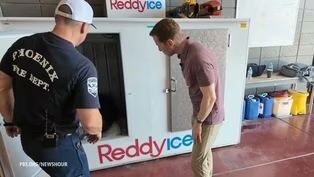
How bags of ice are helping save lives in Phoenix
Video has Closed Captions
In one of the nation's hottest cities, bags of ice are helping save lives (3m 36s)

Martina McBride shares her favorite Dolly Parton memories
Video has Closed Captions
Martina McBride shares her favorite Dolly Parton memories (5m 56s)
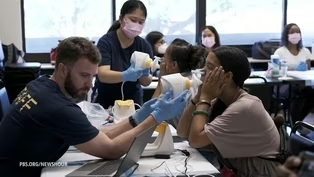
Maui residents face health struggles years after wildfires
Video has Closed Captions
Maui residents face health struggles 3 years after wildfires (8m 15s)
Meta case puts focus on youth mental health, Colo. AG says
Video has Closed Captions
$17B Meta settlement puts focus on youth mental health crisis, Colorado AG says (7m 14s)
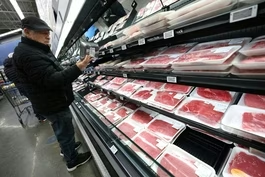
Trump faces backlash from ranchers over plan to import beef
Video has Closed Captions
Trump faces backlash from ranchers over plan to import beef (6m 55s)

Wall of mud and debris floods communities in Nepal and Tibet
Video has Closed Captions
Wall of mud and debris floods communities in Nepal and Tibet (2m 35s)
Providing Support for PBS.org
Learn Moreabout PBS online sponsorship New Episode
- News and Public Affairs

Today's top journalists discuss Washington's current political events and public affairs.
 New Episode
- News and Public Affairs

FRONTLINE is investigative journalism that questions, explains and changes our world.
 New Episode

 New Episode


 New Episode
 New Episode

 New Episode
Support for PBS provided by:
Major corporate funding for the PBS News Hour is provided by BDO, BNSF, Consumer Cellular, American Cruise Lines, and Raymond James. Funding for the PBS NewsHour Weekend is provided by...